
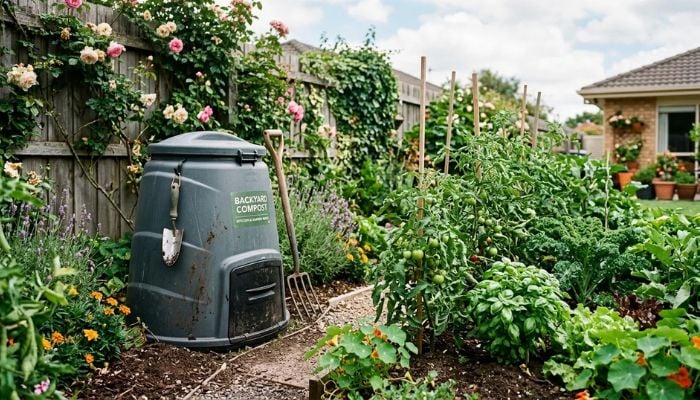
If you’re ready to start composting but are overwhelmed by the options, you’re not alone.
Walk into any garden center or search online, and you’ll find everything from simple wire circles to sleek plastic bins to spinning drum tumblers, all claiming to be one of the best compost bins to turn your kitchen scraps into black gold.
The truth is that there’s no single best compost bin. The right one depends on how much space you have, how much material you’re working with, how fast you want results, and whether you have neighbors (or pests) to consider.
This guide breaks down the three main types, compares their real pros and cons, and gives you a clear top pick in each category.
The 3 Types of Compost Bins
There’s a lot of variation in the composting bin market, but nearly every product falls into one of three categories. Understanding how each type works will help you match the bin to your situation.
Open Heap / Wire Bin
The open heap or wire bin is composting in its purest form. A wire mesh cylinder, or no structure at all, holds your organic material while air, moisture, and microbes do the work. You add materials to the top, and finished compost eventually works its way to the bottom.
Best for: Large backyards with heavy yard waste, garden trimmings, and kitchen scraps in high volume. Price range: $20–$60. Some gardeners build their own from hardware cloth for under $15.
- Very high capacity; some hold 250+ gallons
- Excellent airflow that speeds decomposition
- Easy to add large volumes of material quickly
- Simple design with no moving parts
The main tradeoff is aesthetics and pest control. An open bin is visible, may attract rodents if you’re adding food scraps, and takes longer to produce finished compost without regular turning.
Plastic Lidded Bin
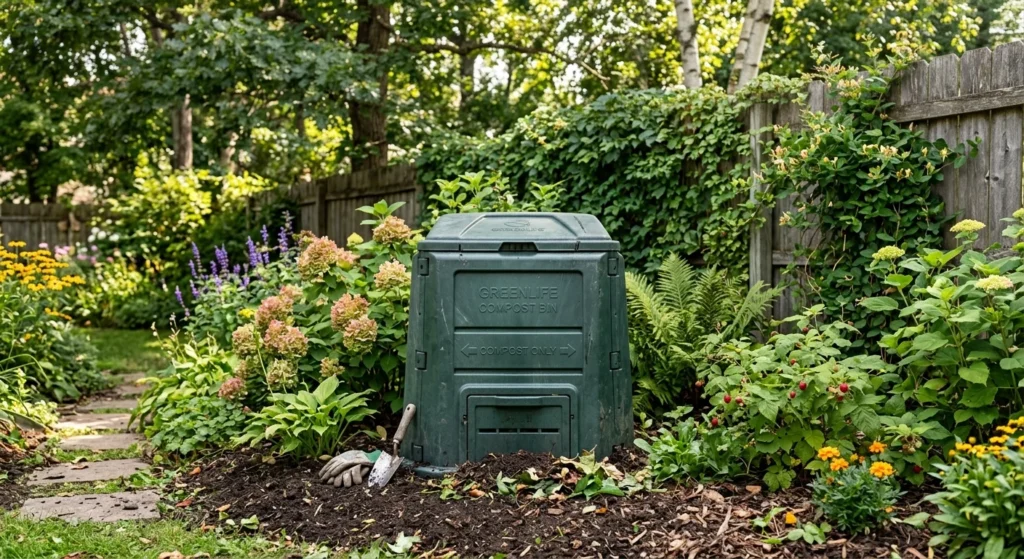
The plastic lidded bin is the classic suburban composter. It’s simply a dark-colored, bottomless plastic box with a lid on top.
You add material through the top and harvest finished compost from a sliding panel at the base. The dark color absorbs heat, and the lid keeps out excess rain and most pests.
Best for: Small to medium-sized yards where aesthetics matter and rodent control is a priority. Price range: $40–$100. Many municipalities sell or distribute these at a discount. It’s worth checking before you buy.
- More discreet than open bins
- Better at retaining heat and moisture
- Reasonably good pest deterrent
- Compact footprint for smaller spaces
The downside is that airflow is limited, which slows decomposition. Without regular turning, these bins tend toward cold composting, which is functional but slow. They’re also harder to work with because you have to reach in or lift the whole bin to turn the pile.
Tumbler Composter
A tumbler is a sealed drum mounted on a frame that spins. You add materials, give it a few turns, and repeat.
Because it’s fully enclosed and aerated with every spin, a tumbler can produce finished compost in four to six weeks under ideal conditions, which is significantly faster than a static bin.
Best for: Gardeners who want results fast, have limited space, or live in areas with persistent rodent pressure. Price range: $80–$200+, depending on size and brand.
- Fastest composting method available for home gardeners
- Fully sealed, rodent-proof, and odor-controlled
- Easy to turn without pitchfork work
- Cleaner, more contained appearance
The main limits are that they have a smaller capacity than open bins and carry a higher upfront cost. Dual-chamber models, where you fill one side while the other finishes, are significantly more practical for continuous composting.
Tumbler vs. Open Bin: How They Compare
| Type | Best For | Capacity | Speed | Pest Control | Price Range |
| Wire / Open Bin | Large yards, high volume | Very High (200+ gal) | Slow–Medium | Low | $20–$60 |
| Plastic Lidded Bin | Small yards, suburbs | Medium (80–120 gal) | Slow | Medium | $40–$100 |
| Tumbler | Fast results, pest pressure | Low–Medium (20–50 gal) | Fast (4–6 wks) | High | $80–$200+ |
How To Choose the Right Bin for Your Yard
Before you buy, use these four questions to guide your decision:
- How much material do you generate? If you’re managing a large garden with heavy yard waste, an open or wire bin will serve you better. If it’s mostly kitchen scraps, a tumbler or plastic bin is plenty.
- Do you have rodent or pest pressure? If rats and raccoons are a concern in your neighborhood, a lidded tumbler is worth the investment. Open bins can attract wildlife.
- How fast do you want compost? If you’re patient, cold composting in a plastic bin or wire heap works fine. If you want finished compost by mid-summer, go with a tumbler and keep turning it.
- How much space do you have? Tumblers and plastic bins are compact. Wire bins need more room but can be tucked away in a corner of the yard.
Best Compost Bins in Each Category
These are the models worth looking at in each category, chosen for reliability, value, and real-world usability.
Best Wire Bin: GEOBIN Composting System
The GEOBIN is the simplest, most flexible open bin on the market. It’s a 216-gallon adjustable wire cylinder that sets up in minutes with no tools required.
The ventilation is excellent, the price is hard to beat, and the diameter adjusts if you need more capacity. For large-volume composting, nothing comes close at this price point.
Best Plastic Lidded Bin: Lifetime 80-Gallon Compost Bin
Lifetime’s lidded composting bin hits the sweet spot of price, durability, and pest resistance. The heavy-duty UV-resistant plastic holds up to weather, the base vents promote airflow, and the sliding harvest door works reliably.
It’s one of the most widely available plastic bins for good reason.
Best Tumbler: FCMP Outdoor IM4000 Dual Chamber Tumbling Composter
The FCMP IM4000 is consistently one of the top-rated tumblers for home gardeners. The dual-chamber design means you’re always filling one side while the other finishes so you’re never waiting on a new batch.
It holds 37 gallons total, it spins smoothly, and the deep fins aerate the compost with every rotation. At around $100–$120, it delivers genuine speed without the premium price tag of larger commercial models.
Tips for Getting the Most Out of Any Compost Bin
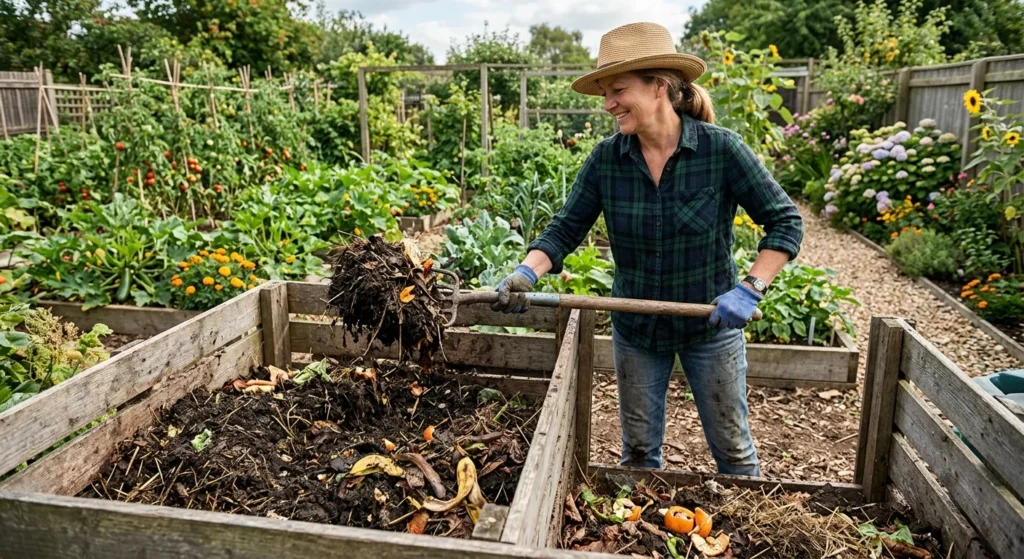
No matter which bin you choose, a few fundamentals make the difference between slow, smelly compost and fast, finished black gold.
- Balance greens and browns. Aim for roughly 1 part green material (food scraps, grass clippings, fresh trimmings) to 3 parts brown material (dead leaves, cardboard, straw). Too many greens, and it gets slimy and smells. Too many browns, and it stalls.
- Keep it moist but not wet. Your compost should feel like a wrung-out sponge. Dry piles don’t decompose; saturated piles go anaerobic and smell bad.
- Turn it regularly. For tumblers, spin every two to three days. For wire bins and plastic bins, turning weekly speeds things up dramatically.
- Chop materials smaller. The smaller the pieces, the faster they break down. Run a lawnmower over leaf piles before adding them to the bin.
- Skip meat, dairy, and oily foods. These attract pests and cause odor problems in open or vented bins. Stick to fruit and vegetable scraps, coffee grounds, and eggshells.
If you’re just getting started, our guide on how to start a compost pile walks you through the full process from scratch. If you’re curious about the difference between the different composting methods, our article about hot vs. cold composting covers everything you need to know.
The Right Compost Bin Makes All the Difference
The best compost bin is the one you’ll actually use consistently. A $200 tumbler sitting in your garage doesn’t beat a $30 wire bin that gets filled every week. Start with whatever fits your space and habits. You can always upgrade once you’ve built the routine.
That said, if you’re genuinely on the fence, most backyard gardeners end up happiest with a dual-chamber tumbler. It’s contained, it’s fast, and it requires almost no effort to maintain once you get the balance right.
Add your kitchen scraps, throw in some dry leaves, give it a spin every other day, and in about a month, you’ll have finished compost ready to feed your beds.
Your garden will thank you for it.