
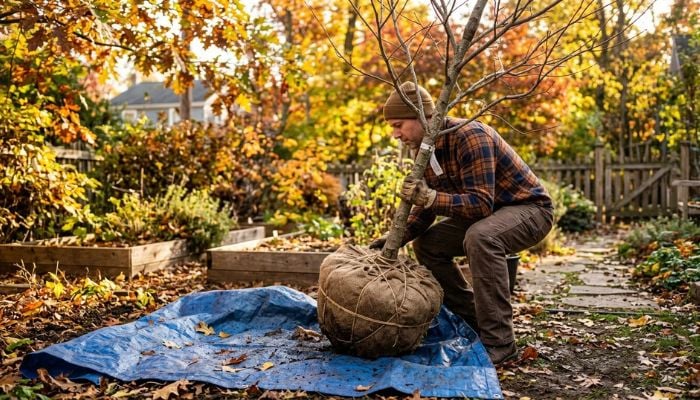
Moving a tree sounds straightforward. Dig it up. Move it. Plant it. But if you skip a few critical steps, what looked like a healthy tree in October will be a dead one by August.
The difference is understanding how a tree anchors itself to the ground and what it needs to re-establish after that anchor is cut.
Trees can be transplanted successfully. Homesteaders and gardeners do it all the time, moving young fruit trees, relocating ornamentals, or salvaging a sapling before clearing land.
This guide shows you how to transplant a tree without killing it, step by step. The key is timing, root ball size, and what happens during the first two growing seasons after the move.
When To Transplant a Tree
The best time to transplant a tree is during dormancy, i.e., late fall after leaf drop through early spring before bud break.
During this window, the tree isn’t actively growing, so the energy demand on the root system is at its lowest. A tree in full dormancy can lose a significant portion of its roots and still recover.
The second-best window is just after bud break in early spring. The tree is waking up, energy is moving through the system, and new roots will grow quickly once it’s replanted.
Avoid late spring through summer transplanting if at all possible. A tree in full leaf is working hard, and cutting the root system during this period creates a severe imbalance between what the leaves demand and what the roots can supply.
Fall transplanting, after the first frost but before the ground freezes, works well for most deciduous trees. Evergreens are best moved in late summer or early fall, giving them a few weeks to settle roots before winter.
How To Calculate Root Ball Size
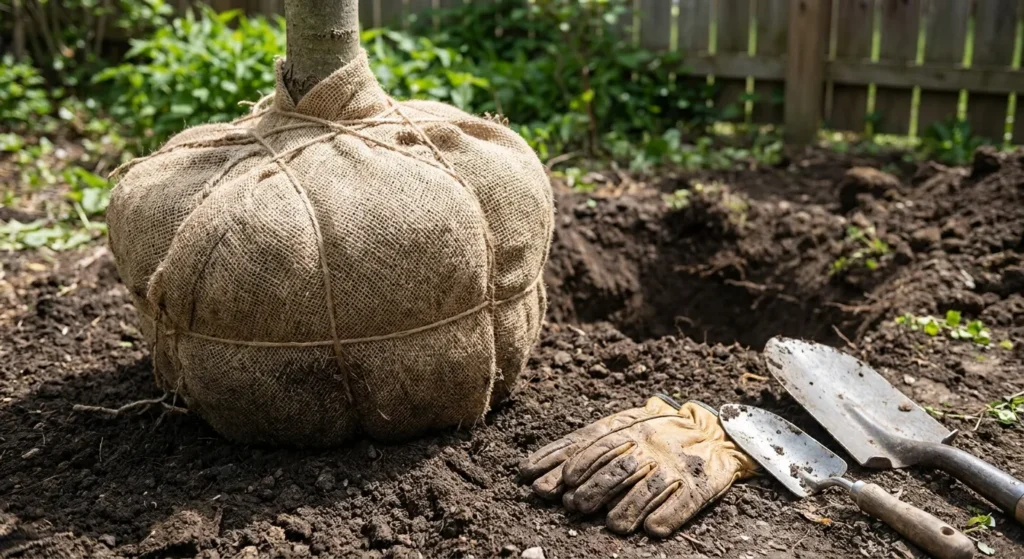
Root ball size is the most commonly underestimated part of a tree transplant.
The standard rule is 10–12 inches of root ball diameter for every inch of trunk diameter, measured 6 inches above the base.
A 2-inch diameter trunk needs a root ball roughly 20–24 inches across. A 3-inch trunk: 30–36 inches across.
That’s a lot of soil to move. This is also why smaller trees, that is, those with 1–2 inches in trunk diameter, have dramatically higher transplant survival rates than larger ones.
Every additional inch of trunk means more fibrous root mass that gets left behind when you dig, and those fine feeder roots are what actually absorb water and nutrients.
Measure your trunk, calculate your root ball, and dig accordingly. Going undersized is one of the top reasons transplanted trees fail.
Step-by-Step: How To Dig and Move a Tree
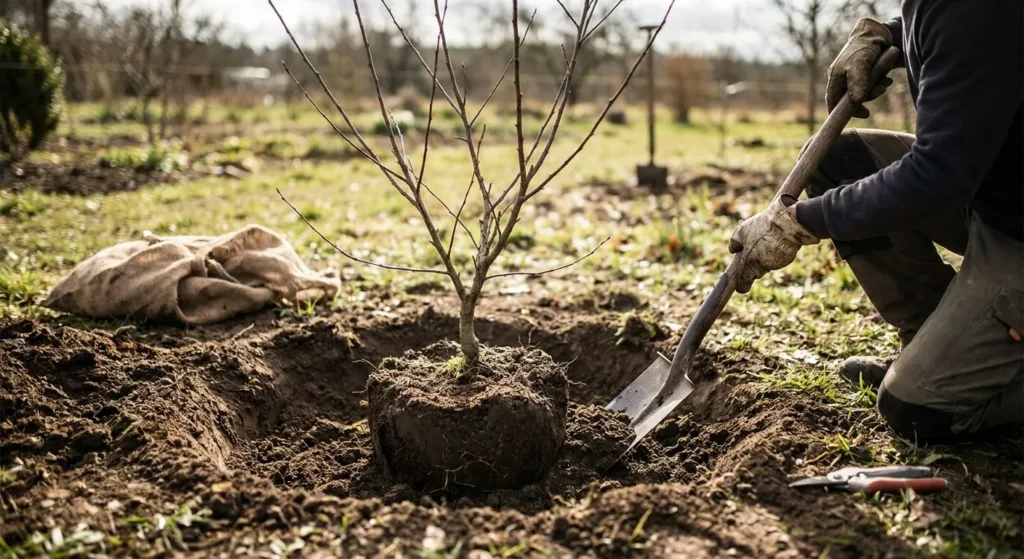
- Before you dig: Water the tree thoroughly 2–3 days before transplanting. Moist soil holds together as a root ball much better than dry soil, and a well-hydrated tree handles transplant stress significantly better.
- Mark your circle: Using your calculated root ball diameter, mark a circle around the base of the tree with string, spray paint, or a garden hose. Use a sharp spade to score the perimeter cleanly all the way around.
- Dig the trench: Dig straight down around the perimeter to a depth of at least 12–18 inches, or roughly equal to the radius of the root ball. Angle your cuts slightly inward under the root ball as you work deeper.
- Sever the base: Once you’ve worked around the full perimeter, use a sharp spade or pruning saw to cut cleanly under the root ball. A clean cut heals faster than a torn one; this matters for recovery.
- Lift and transport: For smaller trees, tilt the root ball onto a tarp, slide it out, and drag or carry it to the new location. For larger root balls, a tarp or wheeled dolly makes this manageable. Never carry a tree by its trunk! Always support the root ball.
Planting the Tree in Its New Spot
Dig the new hole before you move the tree so it can go straight from ground to ground with minimal time exposed to air.
The hole should be 2–3 times wider than the root ball but no deeper than the root ball itself.
Planting too deep is a common mistake; the root flare (where trunk meets roots) should sit at or slightly above the soil line, not buried beneath it.
Set the tree in place, and backfill with the original soil. Don’t add amendments to the backfill.
Roots need to transition from the enriched planting area back into native soil to expand outward, and a heavily amended hole can actually encourage roots to stay put rather than spread. Save any compost for a light top dressing.
Water deeply once planted, and then mulch with 3–4 inches of wood chips out to the drip line, keeping mulch 2–3 inches away from the trunk.
The mulch conserves moisture, moderates soil temperature, and reduces competition from grass and weeds during that critical first year. Wood chips are the most common, but there are other types of mulch to consider as well.
If the tree is tall or in an exposed location, stake it loosely for the first season. The tree needs some movement to develop trunk strength, so don’t stake it rigidly; just enough to prevent uprooting in heavy wind.
Watering and Care for the First Two Seasons
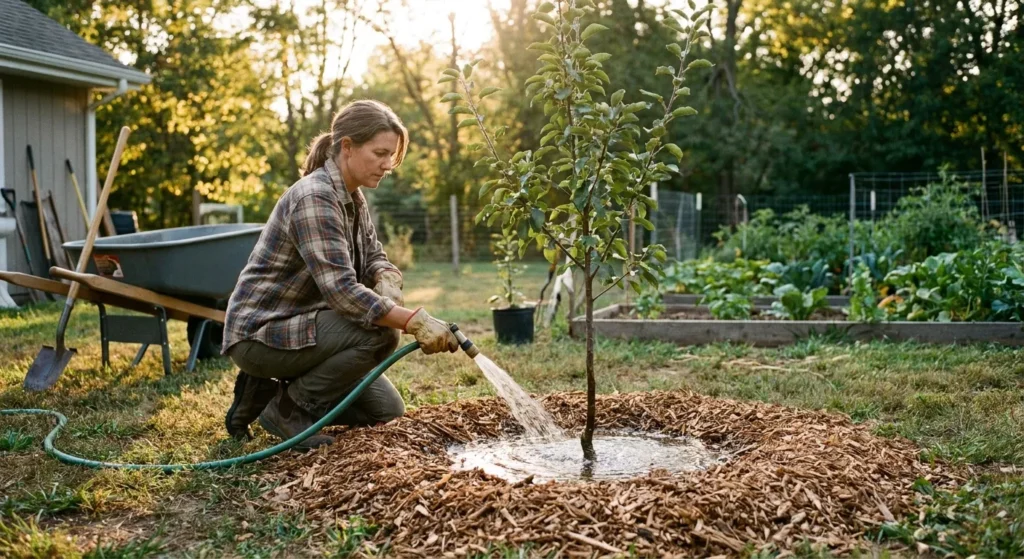
The transplant isn’t done when the tree is in the ground. The first two growing seasons are when most transplanted trees fail, and the cause is almost always inadequate water.
A newly transplanted tree has lost a large portion of its root mass and can’t yet draw water efficiently from the surrounding soil. It needs supplemental watering throughout the first growing season. Water weekly during dry periods, more during heat waves.
Season 1 watering guide:
- Weeks 1–4: Water deeply every 2–3 days.
- Months 2–3: Water deeply once a week if no significant rain.
- Late fall: Taper off as the tree goes dormant, but water thoroughly before the ground freezes.
Season 2 watering:
The tree is re-establishing but still not fully rooted. Water during any dry stretch of two or more weeks. Don’t assume it’s self-sufficient yet; the second summer is when a lot of seemingly recovered trees fail.
Tree watering bags are one of the most practical tools for this stage. They release water slowly over several hours, which gets moisture deep into the root zone rather than running off the surface.
They’re especially useful if you’re transplanting multiple trees or won’t be around to water consistently.
Deep, slow watering is always more effective than shallow and frequent watering. You want roots to grow downward, not sideways along the surface. A slow 30-minute soak beats five quick passes with the hose.
Transplant Shock: Signs and What To Do About It
Some degree of transplant shock is normal and expected. The question is whether the tree recovers or declines.
Signs of transplant shock:
- Wilting leaves despite adequate moisture
- Leaf scorch (brown, crispy edges) without any disease
- Premature leaf drop in summer
- Smaller-than-normal leaves in the season after transplanting
- Dieback beginning at the canopy tips
Signs it’s not recovering:
- Branches that fail to leaf out in spring
- Bark that crinkles and pulls away from the wood
- No visible new growth by early summer in the second year
If you’re seeing mild shock, the tree is likely just adjusting. Keep watering, maintain the mulch ring, and resist the urge to fertilize, as nitrogen pushes top growth the tree can’t support yet.
If you’re seeing progressive dieback, scratch a small section of bark near the base. Green and moist underneath means the tree is still alive. Brown and dry means that the section is gone.
Japanese maples are particularly prone to transplant shock and require extra care with timing, root ball size, and consistent watering after a move.
Trees That Are Hardest To Move
Some trees transplant easily. Others resent being disturbed and will punish you for it.
Difficult to transplant:
- Tap-rooted species: Oaks, walnuts, hickories, and pecans develop deep tap roots that are nearly impossible to preserve in a manageable root ball. Young seedlings under two years are the only practical stage for moving these.
- Large established conifers: Older pines, spruces, and firs have extensive lateral root systems that transplant poorly once mature. If you need these species, buy container-grown or balled-and-burlapped nursery stock.
- Tulip poplar: Grows fast but has a fleshy root system that doesn’t handle disturbance well.
- Magnolia: Transplant young (under 3 inches trunk diameter), in early spring only, with an extra-large root ball.
Easier to transplant:
- Dogwood, redbud, serviceberry, ornamental cherries, and most fruit trees transplant well when handled correctly.
- Most trees under 1-inch trunk diameter, regardless of species, have a high success rate with proper care and consistent follow-up watering.
Before you decide to transplant a tree, consider whether the current location is truly a problem or whether it’s the species that’s wrong for the spot.
Some trees are better replaced than moved, especially if they’re fast-growing species that you can reestablish from a young plant with minimal effort.
When the Tree Earns Its New Ground
Transplanting a tree is a multi-year commitment, not a weekend project. The actual move takes a few hours. The real work is the watering, the patience, and resisting the urge to over-manage the recovery.
Get the timing right. Dig a root ball that actually preserves the root system. Plant at the correct depth. Water consistently for two full seasons. Most trees that die after a move fail in that first summer from drought stress that could have been prevented.
A tree that survives the move and roots into its new spot will be stronger for it. They’re more resilient than they get credit for. They just need a decent start.