
Everyone wants privacy and shade, but a slow-growing oak is a gift to your grandchildren, not to you. That’s why fast-growing trees are so tempting, and in many cases, exactly the right call.
The internet is full of advice that glosses over a critical truth: some of the most popular “fast growers” will spend the next decade trying to wreck your foundation, invading your neighbor’s yard, or losing limbs in the first major storm.
This guide cuts through the noise. You’ll find the best fast-growing trees for privacy and shade that work for smaller yards, organized by what they do best, and an honest look at the trees that deserve to stay off your property.
Whether you’re planting this spring or just doing your research, this is where to start.
The biggest thing to understand before buying any fast-growing tree is that speed comes with trade-offs.
Trees that gain two to three feet per year are putting most of their energy into height and canopy spread.
That often means softer, less dense wood, shallower root systems compared to slow-growing hardwoods, and in some cases, shorter total lifespans.
None of that disqualifies a tree, but it changes which species belong where.
What “Fast-Growing” Really Means
In tree terms, “fast-growing” generally means more than two feet of height gain per year under good conditions.
That’s a meaningful threshold, and it’s the difference between a tree that’s 15 feet tall in five years and one that’s barely reached head height.
But growth rate alone doesn’t tell the full story. A tree can grow fast and still be a poor choice if it grows too large for the space, crowds your neighbor’s yard, or sends roots toward your water line.
The trees that make this list grow fast and behave well.
Another thing to remember is that fast-growing trees benefit enormously from good planting technique and consistent watering in their first two years.
A stressed, under-watered tree in year one will fall behind a well-planted tree by years. Growth rate is a potential, but you have to unlock it.
Best Fast-Growing Trees for Privacy Screens
If your goal is blocking a view, creating a windbreak, or establishing a property boundary, these three are your best options. They grow quickly, stay dense, and won’t become future problems.
Green Giant Arborvitae
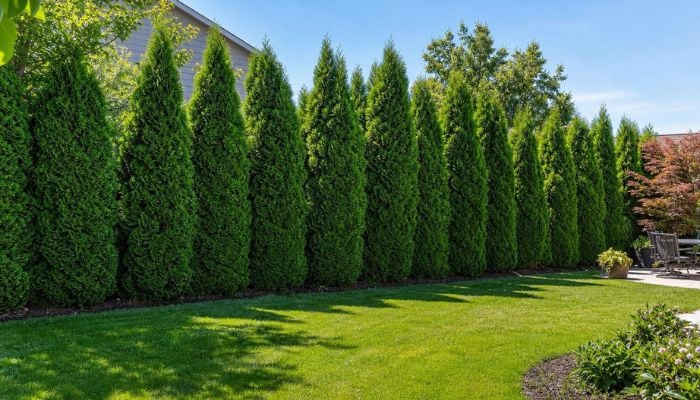
The Green Giant is the gold standard of privacy trees. It grows 3–5 feet per year when young, holds its dense, dark-green form through winter, and reaches a mature height of 30–40 feet, which is tall enough to actually block what you need it to block.
Unlike many arborvitae, it handles deer browsing reasonably well, tolerates a wide range of soils, and doesn’t have aggressive root behavior.
Plant them 5–6 feet apart for a solid screen that fills in within three to four years. If you want a softer, more naturalistic look, space them 8–10 feet apart. This is as close to a foolproof privacy tree as exists.
Leyland Cypress
Leyland cypress grows fast (3–4 feet per year is common) and forms a tall, tight screen that can hit 60–70 feet at maturity. It’s been a landscaping staple for decades and delivers real results when planted in the right conditions.
The main drawback: Leyland cypress is susceptible to Seiridium canker and Botryosphaeria dieback, fungal diseases that can devastate mature trees with no effective cure.
In humid climates, poor spacing makes this worse by reducing airflow. If you go this route, plant no closer than 8 feet apart, keep them pruned, and have a backup plan. If you’re in an area where these diseases are common, Green Giant Arborvitae is the more reliable choice.
Eastern Red Cedar
Eastern red cedar doesn’t get the attention it deserves. It grows about 1.5–2 feet per year, which is slower than Leyland cypress, but it’s one of the toughest trees in North America.
Drought, clay soil, rocky ground, full sun, harsh wind: it handles all of it without complaint. It’s also native to most of the eastern and central U.S., which means it supports local birds and pollinators in a way that non-native species simply don’t.
Mature trees are dense, pyramidal, and fragrant. For homeowners looking for a bamboo alternative for privacy screening and something that grows fast, stays contained, and doesn’t become an invasive nightmare, Eastern red cedar is the answer.
Best Fast-Growing Shade Trees for Large Yards
A shade tree does more than cool your yard. The right one reduces energy costs, creates an outdoor living space, and becomes the anchor around which the rest of your landscape is organized.
The three trees below do it better than anything else in the fast-growing category.
October Glory Red Maple
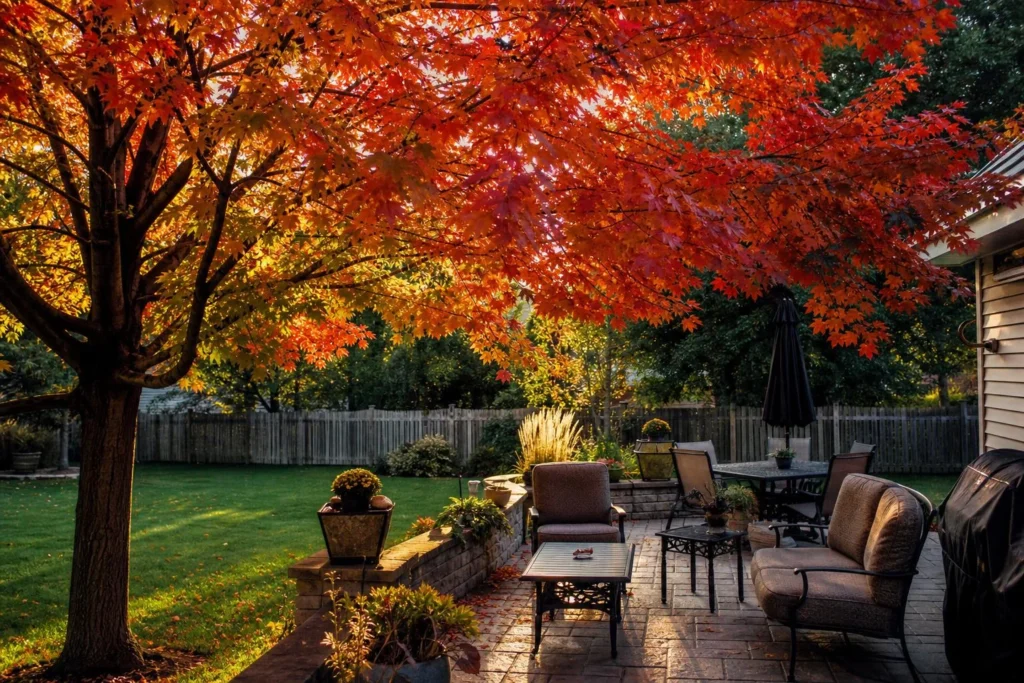
October Glory is a cultivar of the native red maple, and it’s one of the most reliable landscape trees available.
It grows 1.5–2.5 feet per year, develops a broad, rounded canopy at 35–45 feet, and delivers brilliant deep-red fall color, far better than straight-species red maples.
Unlike silver maple (more on that below), October Glory has better-behaved roots and stronger branch structure.
It thrives across the eastern U.S. in moist to average soils, handles part shade, and is fairly forgiving once established.
Plant it on the west or southwest side of your home where you want afternoon shade in 10 years. You’ll be surprised how quickly it starts delivering.
Tulip Poplar
Tulip poplar is one of the fastest native trees on the continent. Under good conditions, it grows 2–3 feet per year and eventually reaches 70–90 feet with a canopy spread of 35–50 feet.
It grows tall and straight, which makes it excellent for creating a forest canopy on larger properties.
Spring blooms are a genuine bonus with tulip-shaped flowers in yellow, orange, and green that appear on mature trees every spring.
Tulip poplar does best in deep, well-drained soil with consistent moisture. It doesn’t perform as well in compacted or poorly drained suburban sites, so choose the planting spot carefully and give it room.
River Birch
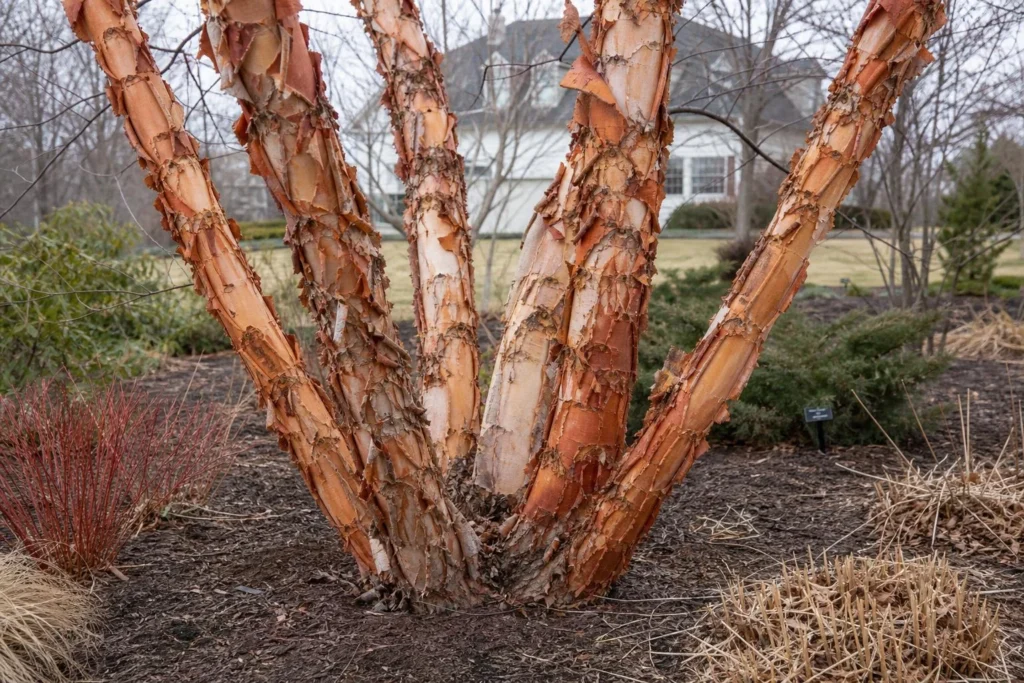
River Birch is a standout shade tree for wet or low-lying areas. It grows 1.5–2.5 feet per year and offers something most shade trees can’t match: multi-season visual interest.
The peeling, cinnamon-colored bark is one of the most beautiful bark textures in any yard, especially in winter when the rest of the landscape is dormant.
It’s the most heat-tolerant birch tree available, making it a far better choice than white or paper birch in most of the country.
It handles soggy soil exceptionally well, resists the bronze birch borer, and grows beautifully in single or multi-stem form. Plant it near a rain garden, drainage swale, or any low spot that occasionally sits wet.
Best Fast-Growing Trees for Privacy and Shade in Small Yards
Not everyone has space for a 90-foot tulip poplar. These three trees stay compact, grow quickly enough to see real results, and fit into a typical residential yard without taking over.
Serviceberry (Amelanchier)
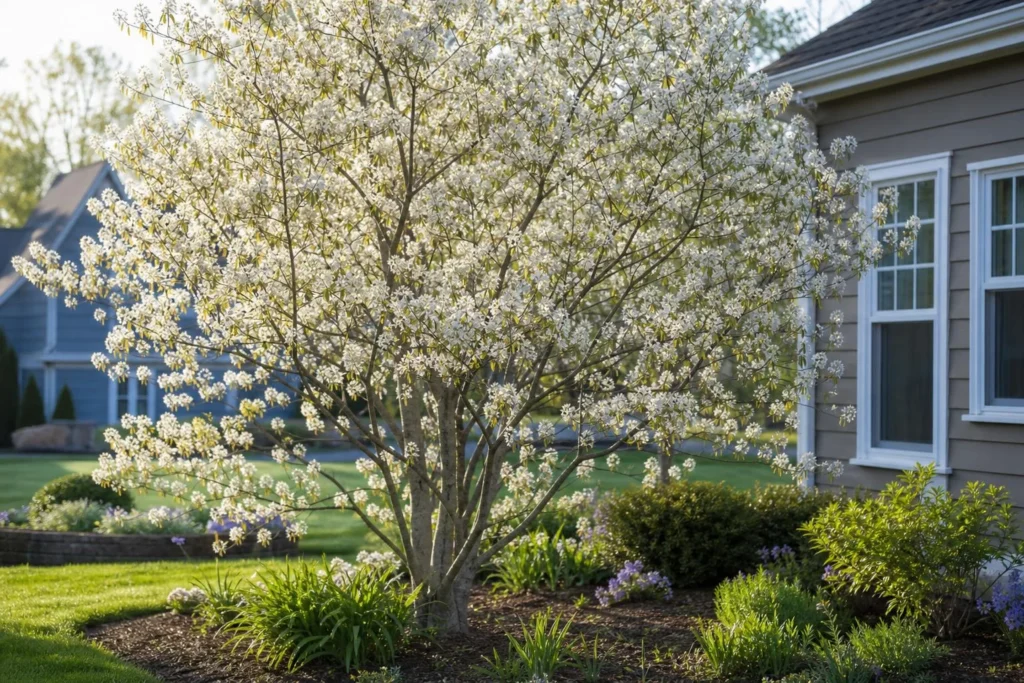
Serviceberry is one of the most underused small trees in residential landscaping.
It grows 1.5–2 feet per year, tops out at 15–25 feet depending on species, and earns its keep in every season: white flowers in early spring before the leaves unfurl, edible berries in early summer, orange and red fall color, and attractive gray-brown bark in winter.
It’s native across most of North America, requires minimal care once established, and is a magnet for birds and pollinators.
The berries are genuinely good; saskatoon serviceberry in particular is used in jams, pies, and preserves. If there’s one small tree that does everything a residential yard needs, serviceberry is it.
Flowering Dogwood
Flowering dogwood grows more slowly when young, about 1 foot per year in the first few years, but it establishes well and picks up to 1–1.5 feet per year once settled.
Mature trees reach 15–30 feet tall, keeping them human-scale and easy to work around. The spring bloom is iconic: large white or pink bracts that appear before the leaves and last for several weeks.
Dogwood performs best in partial shade with well-drained, slightly acidic soil. It struggles in harsh afternoon sun or compacted ground.
For disease resistance, look for cultivars like ‘Appalachian Spring’ or the hybrid Stellar series if powdery mildew or dogwood anthracnose are concerns in your region.
Autumn Blaze Maple
Autumn Blaze is a hybrid between red maple and silver maple, selected for fast growth and better structure than pure silver maple.
It grows 2–3 feet per year and tops out at 40–55 feet, which is larger than serviceberry or dogwood, but workable for a mid-sized suburban lot if given room.
Fall color is exceptional: a vivid orange-red that holds for weeks. It tolerates a wide range of soils and handles drought reasonably well once established.
The one caveat is that it inherits some surface root tendency from its silver maple parentage, so keep it away from sidewalks, patios, and driveways.
Fast-Growing Trees You Should Avoid (Or Think Twice About)
The following trees grow fast and are widely sold. Each also comes with serious drawbacks that outweigh the speed advantage in most situations.
Bradford Pear
A Bradford pear grows fast and flowers spectacularly in spring, but its co-dominant branch structure fails routinely in ice and windstorms, and the blossoms do not smell sweet or even remotely pleasant.
It’s also invasive in much of the eastern U.S., spreading from ornamental plantings into natural areas. Several states have already banned sales. Don’t plant it.
Silver Maple
Silver maple is among the fastest-growing shade trees you can buy… and one of the most problematic. Surface roots crack sidewalks, invade drain tiles and pipes, and heave driveways.
The wood is brittle and fails in storms. If you want maple speed without the liability, choose Autumn Blaze or October Glory instead.
Weeping Willow
Weeping willow is visually stunning and fast-growing, but the roots are relentless. They’ll find and grow into drainage pipes, irrigation lines, and septic systems.
If you have a large property with a natural water feature and a significant buffer distance from any infrastructure, it can work. For most yards, skip it.
Tree of Heaven (Ailanthus altissima)
This invasive species is frequently mistaken for a native tree. It grows fast, spreads aggressively by seed, and releases chemicals that suppress the growth of surrounding plants.
It’s listed as invasive in 32 states. Never plant it intentionally, and if you have one, consult your local cooperative extension office for removal options.
Getting the Most Out of Your Fast-Growing Tree
Planting the right tree is step one. Giving it a strong start is step two… and the one most people skip.
What matters most in the first two to three years:
- Water consistently. A tree watering bag or slow-drip watering system delivers moisture directly to the root zone and dramatically reduces transplant shock. Consistent watering in year one is the single biggest factor in early growth rate.
- Mulch the root zone. Apply a 3-inch layer of wood chip mulch in a ring around the base, keeping it a few inches away from the trunk. Mulch retains moisture, moderates soil temperature, and reduces grass competition. Learn about the different types of mulch before purchasing.
- Plant at the right depth. The root flare should be visible at or slightly above grade. Planting too deeply is one of the most common and most damaging mistakes.
- Choose the right site. Know the mature spread before you plant, especially near structures, power lines, and property lines. Placement is especially important when planting trees close to a house.
If you’re moving an established tree rather than starting from a container or bare root, technique matters enormously.
Getting the timing, root ball size, and aftercare right is what determines whether a transplanted tree thrives for decades or slowly declines.
Plant With Purpose and Results Will Follow
The right fast-growing tree won’t just deliver results this decade; it’ll earn its place for decades beyond that.
Green Giant arborvitae along the property line, a river birch anchoring the low end of the yard, and an October Glory maple casting afternoon shade over the patio: these are choices that pay off visually, functionally, and financially.
Fast growth isn’t a compromise. It’s a head start. The key is choosing trees that grow fast and last… and knowing which ones to leave at the nursery.