
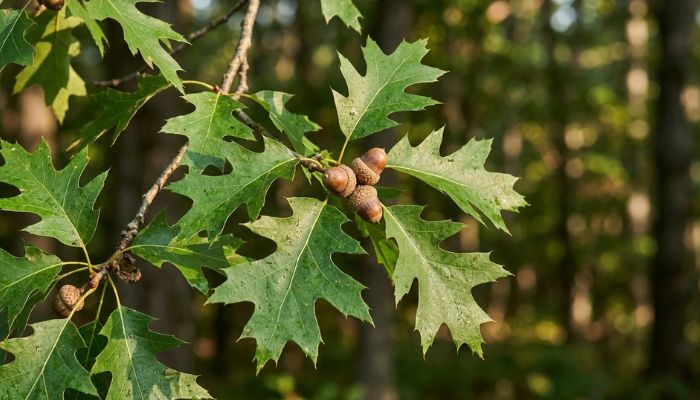
Oaks are everywhere, in forests, backyards, city parks, and roadsides across North America. But with over 90 native species on the continent, telling them apart can feel like an impossible task, especially when you’re staring at a lobed leaf with no idea where to start.
The good news is that you don’t need to know all 90. Most people will only ever encounter a handful of common species, and once you learn the two major oak groups and a few reliable field features, most oaks become recognizable in minutes.
Focus on a handful of key features, practice in the field, and the rest follows.
This guide covers how to identify oak trees, the two major oak divisions, the key traits to look for, and detailed profiles of 8 common species you’re most likely to encounter across the eastern and central United States.
Whether you’re a backyard naturalist, a homesteader with wooded acreage, or just someone who wants to know what tree is shading the garden, this is where to start.
The Two Major Oak Groups
Every oak identification starts in the same place: figuring out which of the two major groups the tree belongs to.
All North American oaks fall into either the red oak group (also called the black oak group) or the white oak group. This single distinction tells you more about a tree than almost any other feature.
Red Oak Group
Red oaks have pointed lobe tips, each ending in a tiny bristle or hair-like projection called a mucro.
Their acorns take two full years to mature, which means you’ll find both small first-year acorns and full-size second-year acorns on the same tree in late summer. The acorn caps are typically shallow and saucer-like, covering only the base of the nut.
Red oak wood is more porous than white oak, which is why it’s generally not used for tight barrel staves or watercraft.
White Oak Group
White oaks have rounded lobe tips, with no bristles and no points. Their acorns mature in a single season, making them a critical mast crop for deer, turkeys, and squirrels every fall.
The acorn caps tend to be deeper and more cup-shaped, often wrapping further up the nut.
White oak wood is dense and tight-grained. It’s the traditional choice for whiskey barrels, hardwood flooring, and boat-building, as the closed pores prevent liquid from passing through.
How To Identify Oak Trees: Key Features for Identification
Leaf Shape and Lobes
Most oaks have lobed leaves, the classic silhouette with finger-like projections running up each side of the blade, but lobe depth, width, and number vary dramatically between species.
Some oaks (such as chestnut oak) have rounded, scalloped edges that look almost like teeth rather than deep lobes.
What to look for:
- How deep do the lobes cut toward the midrib? Shallow notches vs. deep sinuses that nearly reach the center vein
- How many lobes? Pin oak: 5–7; white oak: 7–9; chestnut oak: 10–15, with rounded teeth
- What’s the overall leaf shape: elongated, broad, or narrow? Bur oak leaves are distinctly club-shaped and wider at the tip than at the base.
Lobe Tips: The Fastest Way To Split Red From White
This is your single most useful field character.
- Pointed tips with a tiny bristle = red oak group.
- Rounded tips with no bristle = white oak group.
You can usually confirm this in under 10 seconds. Flip a leaf over and look at each lobe tip under good light. Even a microscopic hair-like point counts. If the tip rounds off cleanly with no projection at all, you’re in white oak territory.
Acorns and Their Caps
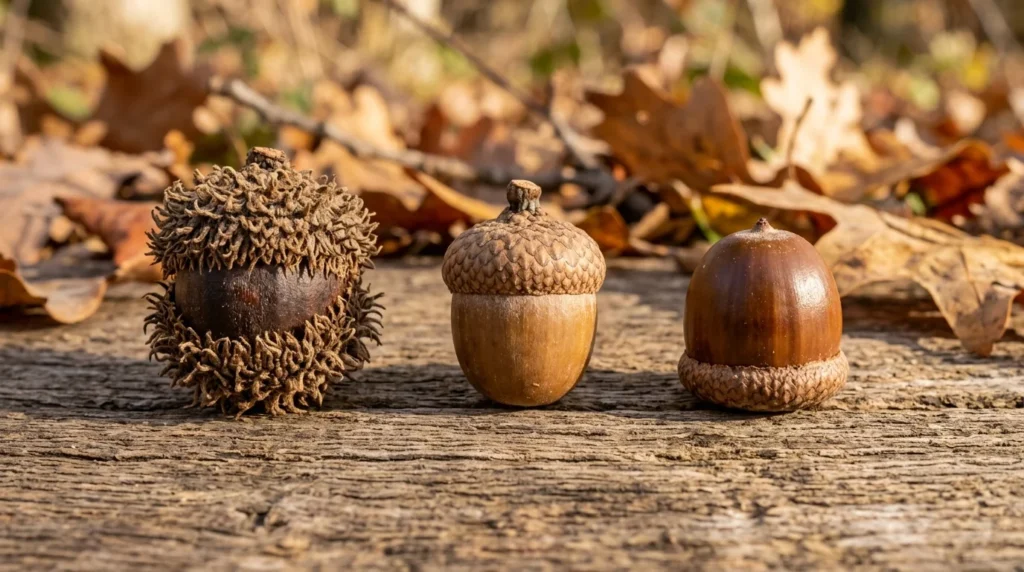
Oak acorns can confirm an ID once you’ve narrowed things down by leaf.
Key things to check:
- Cap depth: Does the cap barely cover the base (red oak, pin oak) or wrap halfway up or more (bur oak, chestnut oak)?
- Cap texture: Bumpy or warty vs. smooth flat scales
- Acorn size: Bur oak produces the largest acorns of any eastern species; pin oak produces the smallest.
- Maturation: First-year red oak acorns are small and pale; don’t mistake them for a different species.
Bark
Bark changes with tree age and varies up and down the same trunk, so it’s a supporting clue rather than a primary ID feature.
A few species do have distinctive bark worth knowing:
- White oak: Light gray, often platy or scaly on older trees
- Chestnut oak: Thick, very deeply ridged dark bark, often described as alligator-skin texture
- Pin oak: Relatively smooth and gray on upper branches, darker and furrowed near the base
- Bur oak: Deeply furrowed with corky ridges on young branches
If you’re used to identifying trees by bark and encounter something with unusually smooth bark, keep in mind that smooth-bark trees can throw off beginners who expect a rough texture on a mature hardwood.
Habitat and Range
Range is one of the fastest ways to narrow down an unfamiliar oak.
- Pin oak is almost exclusively a lowland species, so if you’re standing in a floodplain or wetland margin, pin oak is your first guess.
- Bur oak is the classic prairie-edge and oak savanna tree of the Midwest, built to withstand fire.
- Northern red oak is one of the most widespread upland oaks in the east, equally comfortable in suburban yards and Appalachian ridges.
- White oak prefers well-drained upland sites but tolerates a wide range of conditions.
8 Common Oak Species: Field Profiles
Northern Red Oak (Quercus rubra)
- Group: Red oak
- Leaf: Large (5–9 inches), with 7–11 sharply pointed lobes separated by deep sinuses. Lobes end in prominent bristle tips. Turns deep red in fall; one of the best fall-color oaks in the eastern US.
- Acorn: Large and round, with a flat saucer-cap that covers only the top quarter of the nut.
- Bark: Smooth and gray on young trees; develops flat-topped ridges with dark furrows at maturity. The upper trunk often stays noticeably flat and shiny well into old age.
- Range and habitat: Eastern and midwestern U.S.; adaptable to a wide range of upland sites. One of the most common street and yard oaks in the northeast and mid-Atlantic.
- Quick ID tip: Flat, beret-like acorn cap and deep-red fall color. If the cap barely covers the nut base, you’re very likely looking at northern red oak.
White Oak (Quercus alba)
- Group: White oak
- Leaf: 5–9 inches, with 7–9 rounded lobes and deeply cut sinuses. No bristle tips. Turns deep red-purple in fall.
- Acorn: Oblong, with a bumpy cap covering about a quarter of the nut. Sweet enough to eat raw; a staple food for both wildlife and Native Americans for thousands of years.
- Bark: Light gray, flaky or platy in older trees.
- Range and habitat: Widespread in eastern and central U.S. on well-drained upland sites. One of the most iconic timber trees in North America, valued for flooring, furniture, and barrel staves.
- Quick ID tip: Rounded lobes and light gray, flaky bark. Almost nothing else in its range matches both features.
Pin Oak (Quercus palustris)
- Group: Red oak
- Leaf: 3–6 inches, with 5–7 deeply cut lobes and large C-shaped sinuses. Bristle tips. Characteristically dead lower branches often point downward along the trunk.
- Acorn: Very small (about ½ inch), nearly round, with a thin saucer-cap.
- Bark: Relatively smooth and gray on the upper trunk. Darker and more furrowed near the base.
- Range and habitat: Lowlands, floodplains, and poorly drained flats throughout the eastern U.S. Also planted by the millions as a landscape and street tree.
- Quick ID tip: Lower branches angling sharply downward are the fastest field marks. No other common oak does this consistently. Pair with the small round acorns for confirmation.
Scarlet Oak (Quercus coccinea)
- Group: Red oak
- Leaf: 3–7 inches, deeply lobed with C-shaped sinuses that cut nearly to the midrib. Bristle tips. Produces spectacular scarlet fall color, among the most vivid of any eastern deciduous tree.
- Acorn: Medium-sized, half-buried in a deep cup covering roughly half the nut.
- Bark: Dark gray-brown with broad flat ridges.
- Range and habitat: Dry, sandy, or rocky upland sites in the eastern U.S. Often found on south-facing slopes and ridgetops. Frequently confused with pin oak.
- Quick ID tip: Very deep C-shaped sinuses (the gaps nearly touch the midrib) and dry upland habitat. If you’re on a sandy or rocky ridge and see extreme lobe depth, think scarlet oak before pin oak.
Bur Oak (Quercus macrocarpa)
- Group: White oak
- Leaf: 6–12 inches, distinctly club-shaped, wider at the tip than the base. Upper lobes are large and rounded; lower lobes are smaller and widely spaced. No bristle tips.
- Acorn: The largest acorn of any native eastern oak. The cap is deep and fringed with a shaggy, mossy fringe that gives it the “bur” name, covering half or more of the nut.
- Bark: Deeply furrowed with corky ridges on young branches.
- Range and habitat: Prairies, oak savannas, and upland edges across the Midwest and Great Plains. Exceptionally fire-resistant; a keystone species of North American grasslands.
- Quick ID tip: Mossy, fringed acorn cap and club-shaped leaf. Once you’ve seen a bur oak acorn, nothing else looks like it.
Chestnut Oak (Quercus montana)
- Group: White oak
- Leaf: 4–9 inches, oblong with large, rounded teeth rather than true lobes; resembles American chestnut leaves (hence the name). No bristle tips.
- Acorn: Large and egg-shaped, with a deep, bumpy, warty cap covering nearly half the nut.
- Bark: Very thick, dark, and deeply ridged; widely considered the most heavily ridged bark of any eastern oak. A reliable ID character on mature trees.
- Range and habitat: Dry, rocky ridges and slopes in the eastern U.S., especially common in Appalachia and the Ridge and Valley province.
- Quick ID tip: Alligator-skin bark and rounded-tooth (not truly lobed) leaves. If the bark alone catches your attention on a rocky ridge, it’s probably chestnut oak.
Shumard Oak (Quercus shumardii)
- Group: Red oak
- Leaf: 5–8 inches, with 7–9 deeply cut lobes and bristle tips. Closely resembles both scarlet oak and northern red oak. Habitat and range become important differentiators.
- Acorn: Flat and wide, with a cap covering only the very base of the nut; almost like a beret sitting lightly on top.
- Bark: Gray-brown with flat-topped ridges on mature trees.
- Range and habitat: Bottomlands, stream margins, and lowland slopes across the southeastern and south-central U.S. Less common north of the Ohio River valley.
- Quick ID tip: If you’re in a southeastern creek bottom and see a large, typical-looking red oak, check the acorn cap. Shumard’s cap is notably flat and wide-rimmed; it barely cups the base.
Post Oak (Quercus stellata)
- Group: White oak
- Leaf: 4–7 inches with a very distinctive cross or plus-sign silhouette. Three large lobes at the tip form the crossbar of the cross, with a narrower base below. No bristle tips.
- Acorn: Small to medium, with a cap covering about a third to half the nut.
- Bark: Grayish-brown with narrow, blocky ridges.
- Range and habitat: Dry, sandy, or rocky upland sites across the eastern and south-central U.S. Often found alongside blackjack oak on poor, dry soils.
- Quick ID tip: Cross-shaped leaf. It’s genuinely unlike any other common oak. Once you’ve seen it, you won’t mistake it for anything else.
Red Oak vs. White Oak at a Glance
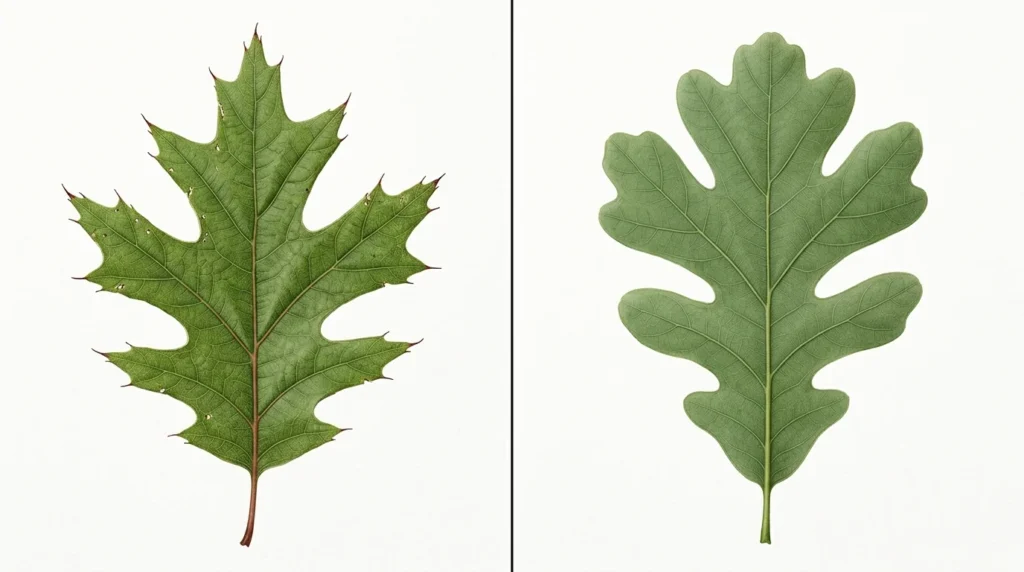
Not sure which group you’re dealing with? Here’s a quick reference.
Red oak group:
- Pointed lobe tips with a visible bristle or hair.
- Acorns take 2 years to mature (small and large acorns on the same tree in late summer).
- Acorn caps are shallow and saucer-shaped.
- Wood is porous.
- Common examples: northern red oak, pin oak, scarlet oak, shumard oak.
White oak group:
- Rounded lobe tips, no bristle.
- Acorns mature in a single season (ready by fall).
- Acorn caps are deeper and more cup-shaped.
- Wood is dense and tight-grained.
- Common examples: white oak, bur oak, chestnut oak, post oak.
The Oaks You Know Will Change How You See Every Tree
Oak identification gets easier with repetition. The first time you correctly split a red oak from a white oak by its bristle tips, you’ll start noticing that detail everywhere, on a hike, in the yard, and in a parking lot median.
From there, let habitat guide your guesses.
Wet lowland? Lean toward pin oak. Rocky ridge with heavy bark? Check for chestnut oak. Prairie-edge Midwest? Bur oak is a strong first call. Club-shaped leaf with a mossy acorn cap removes all doubt.
If oaks are growing in your yard or on your property and something looks off, such as unusual sap flow, discolored bark, or weeping from a wound, that’s worth taking seriously.
If you notice your tree bleeding or oozing sap, know that oak trees can develop bacterial wetwood, and early identification helps you address it before the problem spreads.
Oak literacy is also a great gateway to broader tree identification. If you’ve already started connecting leaf shape to species, you’re already thinking like a field naturalist.
The same approach scales to any genus; once you’ve got oaks, you’ve got a method that works everywhere.