
If you’re tired of mulching the same bare spots every year or pulling weeds from the base of your trees, native ground covers are the answer.
These plants are adapted to your region’s soil, rainfall, and climate, which means once they establish, they largely take care of themselves.
The best native ground cover plants spread steadily to fill gaps, outcompete weeds without herbicides, and provide food and habitat for pollinators and wildlife. Most are perennials, which means they come back year after year without replanting.
Below are 10 reliable native ground cover plants organized by growing conditions. Whether you’re working with baking full sun, dense shade, dry rocky soil, or a low-lying wet area, there’s a native option that will do the job.
Why Native Ground Covers Are Worth the Switch
Non-native ground covers, such as English ivy and wintercreeper, spread aggressively and crowd out native wildflowers and shrubs.
Native alternatives stay in bounds (or spread at a manageable rate), support local insect populations, and require no supplemental watering once established, which is usually after the first growing season.
They also handle local conditions better than anything you’d find at a big-box garden center. A plant native to your region has evolved to handle your winters, your summers, and your soil pH.
Many are also naturally deer resistant, unlike traditional annuals such as geraniums, which deer find quite appealing, making them a smart choice for gardens in areas with heavy wildlife pressure.
Best Native Ground Cover Plants for Full Sun
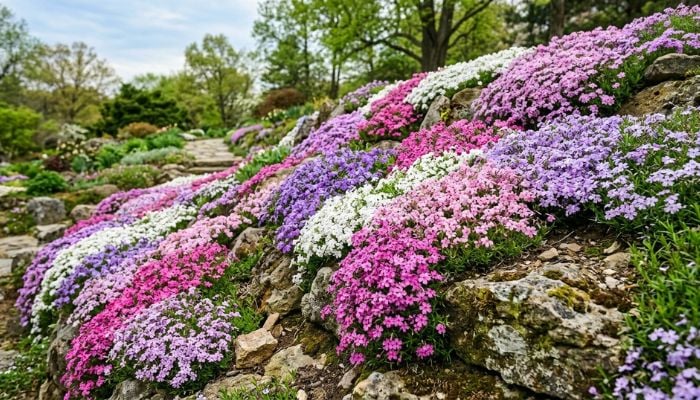
Creeping Phlox (Phlox subulata)
Creeping phlox explodes into color in early spring with dense mats of needle-like foliage covered in pink, purple, white, or red blooms.
After flowering, the foliage stays tidy and semi-evergreen through the rest of the season. It thrives in poor, well-drained soil and is dense enough to suppress weeds once established.
- Light: Full sun to partial shade
- Spreading speed: Moderate; forms wide mats over 2–3 years
- Maintenance: Minimal; trim lightly after flowering to keep compact
- Best for: Slopes, rock gardens, front borders, and erosion control
Wild Thyme (Thymus serpyllum)
Wild thyme forms a dense, fragrant carpet that releases a pleasant herbal scent when walked on, making it one of the few ground covers that actually gets better with light foot traffic.
It blooms in small lavender-pink flowers in summer and stays evergreen in milder climates.
Though technically a naturalized plant rather than a strictly North American native species, it’s widely used in pollinator-friendly plantings and is a favorite of bees.
- Light: Full sun
- Spreading speed: Moderate
- Maintenance: Very low; drought-tolerant once established
- Best for: Pathways, patios, sunny slopes, and filling cracks between stepping stones
Wild Strawberry (Fragaria virginiana)
Wild strawberry is a true North American native that spreads by runners to form dense, low-growing mats. It produces small white flowers in spring and tiny strawberries that birds and small mammals love.
The foliage stays attractive through the season, and it handles moderate foot traffic without complaint. It’s particularly useful for naturalizing large open areas quickly.
- Light: Full sun to partial shade
- Spreading speed: Fast; spreads readily by runners
- Maintenance: Low; can be mown once per season if needed
- Best for: Naturalizing open areas, orchard understory, and wildlife gardens
Best Native Ground Covers for Shade
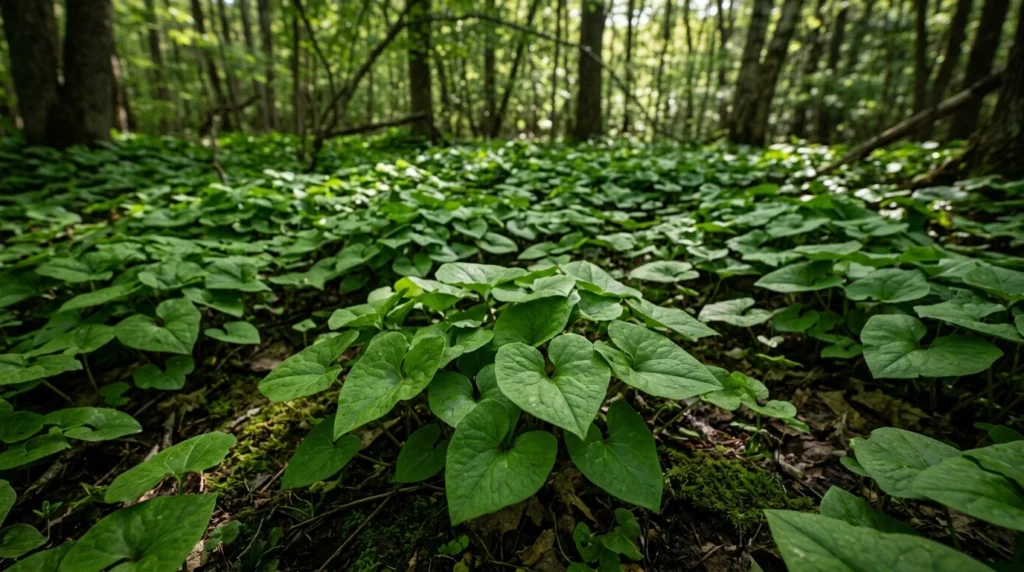
Wild Ginger (Asarum canadense)
Wild ginger is one of the most elegant shade ground covers you can plant. Its large, heart-shaped leaves create a lush carpet under trees where little else will grow.
It spreads slowly by rhizome but knits together into a dense weed-suppressing mat over time. It’s not edible ginger, but it smells remarkably similar when the leaves are bruised. It’s deer-resistant and virtually maintenance-free.
- Light: Full to partial shade
- Spreading speed: Slow to moderate; patience pays off
- Maintenance: None once established
- Best for: Shaded beds under trees, woodland gardens, and formal shade plantings
Green-and-Gold (Chrysogonum virginianum)
Green-and-gold is a cheerful, semi-evergreen native that produces yellow star-shaped flowers from spring through early summer.
It tolerates a wide range of conditions, from full shade to partial sun, and spreads via stolons and seed, filling in gaps without much help. It’s deer-resistant and attractive to native bees throughout the bloom season.
- Light: Partial shade to full shade (tolerates some sun)
- Spreading speed: Moderate
- Maintenance: Very low; no deadheading needed
- Best for: Shaded borders, woodland edges, and pollinator gardens
Pennsylvania Sedge (Carex pensylvanica)
Pennsylvania sedge is the closest thing to a low-maintenance native lawn alternative in dry shade.
Its fine-textured, arching leaves stay green year-round in most climates and never need mowing if you want a natural look (or can be mowed once or twice per year for a tidier appearance).
It thrives in the dry shade under trees where grass refuses to grow.
- Light: Part shade to full shade
- Spreading speed: Slow by rhizome; fills in over 3–4 years
- Maintenance: Minimal; drought-tolerant once established
- Best for: Dry shade under trees, lawn alternatives, and naturalistic woodland gardens
Best Native Ground Covers for Dry or Rocky Soil
Buffalo Grass (Bouteloua dactyloides)
Buffalo grass is the ultimate low-maintenance lawn alternative for the central and southern U.S.
Native to the Great Plains, it stays under 4–6 inches tall without mowing and naturally goes dormant in winter, turning a warm straw color before greening up in spring.
It requires a fraction of the water traditional turf grass needs and handles foot traffic reasonably well.
- Light: Full sun
- Spreading speed: Moderate; spreads by stolons
- Maintenance: Very low; no mowing required if allowed to grow naturally
- Best for: Hot, dry regions; lawn replacements; slopes and pasture edges (central and southern U.S.)
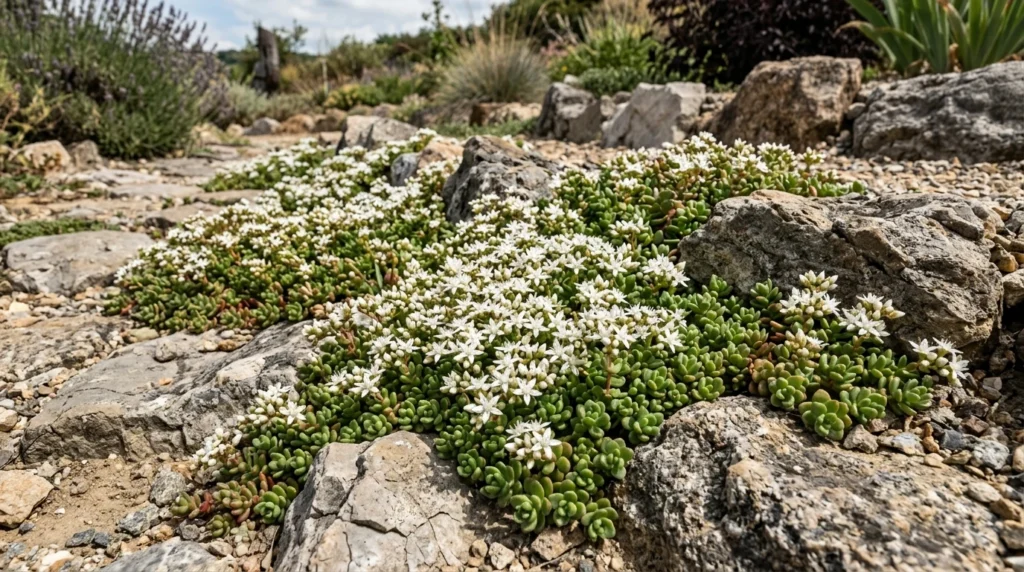
Stonecrop (Sedum ternatum)
Stonecrop is a native succulent that thrives where almost nothing else will, including rocky slopes, dry banks, and thin soil over stone.
Its fleshy leaves store water, and it blooms in clusters of small white star-shaped flowers in spring.
It’s one of the few native ground covers that genuinely prefers neglect. Overwatering and overly fertile soil actually stress it.
- Light: Full sun to partial shade
- Spreading speed: Slow to moderate
- Maintenance: None; it prefers being left alone
- Best for: Rock gardens, dry slopes, gravelly or shallow soils, and containers
Best Native Ground Covers for Moist Areas
Blue-Eyed Grass (Sisyrinchium angustifolium)
Blue-eyed grass is a delicate-looking native that belies its tough nature. Despite the name, it’s in the iris family, and its tiny blue-violet flowers with yellow centers bloom prolifically in late spring.
It naturalizes well in moist, grassy areas and along stream banks, self-seeding freely once established to fill in bare spots year after year without any help.
- Light: Full sun to light shade
- Spreading speed: Slow to moderate; self-seeds readily
- Maintenance: Very low
- Best for: Wet meadows, rain gardens, streambanks, and naturalized lawn areas
Wild Violet (Viola sororia)
Wild violet is both beautiful and persistent, which makes it excellent as a ground cover if you embrace it. It spreads by seed and rhizome to form dense, low colonies of heart-shaped leaves and purple, blue, or white spring flowers.
It’s one of the most important native plants for fritillary butterfly larvae, which feed exclusively on violet leaves. Once established, it’s effectively self-managing.
- Light: Full sun to full shade
- Spreading speed: Fast once established
- Maintenance: None; may need boundaries if planting in a mixed bed
- Best for: Moist shaded areas, wildlife gardens, naturalizing slopes, and lawn edges
How To Get Native Ground Covers Established (The Only Hard Part)
The one thing native ground covers ask of you is patience during establishment. Most need a full growing season to develop their root systems before they start spreading aggressively.
Here’s how to set them up for success:
- Plant in the right conditions for each species. A shade-lover planted in full sun won’t thrive, no matter how tough it is. Match the plant to the site.
- Water consistently during the first season. Even drought-tolerant natives need regular water in their first summer while their roots establish. After that, most don’t need supplemental irrigation.
- Mulch between plants at planting time. A 2–3 inch layer of mulch suppresses weeds while your ground cover fills in. Once the plants spread, they’ll take over weed control on their own.
- Don’t fertilize heavily. Most native ground covers prefer lean soil. Heavy fertilization encourages leggy growth and can reduce flowering.
- Give it one to three years. The saying goes: “first year it sleeps, second year it creeps, third year it leaps.” Native ground covers are building infrastructure underground before they spread above.
The Lowest-Maintenance Yard Starts With the Right Plants
The plants on this list have been covering ground and feeding pollinators without human help for thousands of years.
What they need from you is simple: the right location, decent soil prep, and one growing season to get their roots down. After that, they do the rest.
If you’re new to native planting and aren’t sure where to start, your state’s native plant society is a good resource for finding which species are best suited to your specific region.
Not every plant on this list is a fit for every part of the country; buffalo grass is best in the central US, while wild ginger and Pennsylvania sedge thrive in the East and Midwest.
The goal is a landscape that takes care of itself. Native ground covers are one of the most effective tools for getting there.
Start with one or two species that match your existing conditions, see how they do in the first season, and expand from there.
For more on building a yard that works with nature, check out our guide to native plants for pollinators and our roundup of perennials for containers if you want to bring the native plant strategy to pots and planters.