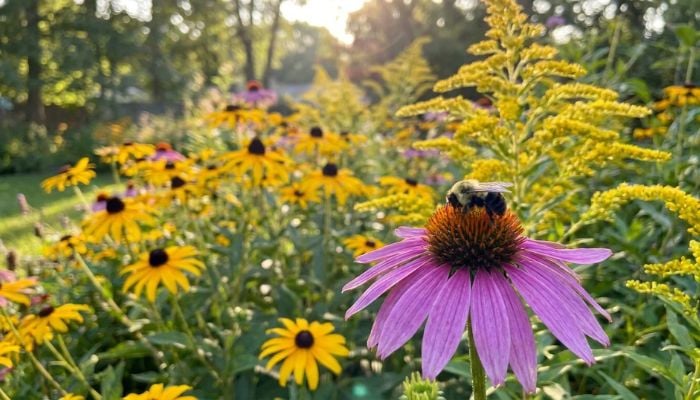
If you want more bees, butterflies, and hummingbirds visiting your garden, native plants are the way to go. They offer the right nectar, the right pollen, and often the right structure to support insects at every stage of their life cycle.
A garden full of exotic ornamentals might look impressive, but native plants do far more ecological work.
Most native pollinator plants are also low-maintenance. Once established, they’re adapted to local soils and rainfall patterns, which means less watering, less fertilizing, and less babying, which is a win for the garden and the gardener.
This guide profiles 12 of the best native plants for pollinators, organized by bloom time so you can design a garden with something flowering from early spring through frost.
Whether you’re working with a small backyard bed or a larger meadow planting, these plants will bring your outdoor space to life.

Early Spring Bloomers (March–May)
Wild Columbine (Aquilegia canadensis)
Wild columbine is one of the first native flowers to open in spring, making it a critical early resource when most pollinators are just emerging from dormancy.
Its distinctive red and yellow pendant flowers are shaped perfectly for ruby-throated hummingbirds, which have bills long enough to reach the nectar deep inside the floral spurs.
Bumblebees, ever resourceful, will “rob” the nectar by piercing the spur from the outside; you can often spot the small holes they leave behind.
This plant grows well in partial shade, making it one of the few pollinator plants that thrives under trees or along woodland edges.
It prefers well-drained soil and self-seeds freely once established. Let it naturalize, and you’ll have a spreading patch within a few seasons with virtually no effort.
Wild Blue Indigo (Baptisia australis)
Wild blue indigo is a long-lived native perennial that takes a year or two to establish but rewards patience with decades of performance.
The deep violet-blue flowers bloom in late spring and are a favorite of bumblebees, which are strong enough to pry the petals apart.
After the bloom, it develops striking inflated seed pods that rattle in the autumn wind and hold their shape through winter.
This plant is drought-tolerant once established and grows in full sun to light shade.
It doesn’t like to be moved after planting, so choose its location carefully. It’s also a larval host plant for several native butterfly species, including the wild indigo duskywing skipper.
Wild Geranium (Geranium maculatum)
Wild geranium is an easygoing spring bloomer with soft pink to lavender flowers that appeal to native bees, especially mason bees and early bumblebees.
It grows naturally in woodland edges and semi-shaded spots, making it useful in parts of the garden where few other pollinator plants will thrive.
It’s a relaxed spreader that forms attractive clumps over time, and the foliage turns reddish-bronze in fall for a second season of interest.
Unlike its exotic garden-center cousins, wild geranium is a true native with real wildlife value, and it tends to be overlooked by deer as well.
If you’re managing deer pressure alongside your pollinator plantings, our guide to whether deer eat geraniums is worth a read.
Late Spring and Early Summer (May–July)
Purple Coneflower (Echinacea purpurea)
Few native plants are as widely loved, or as productive for pollinators, as purple coneflower.
The large, daisy-like blooms attract a parade of visitors from the moment they open; bumblebees, sweat bees, swallowtail butterflies, fritillaries, and skippers all show up reliably.
Once the petals fade, the spiky seed heads become a food source for goldfinches and other birds through fall and into winter.
Purple coneflower is adaptable, tolerating clay soil and drought once established. It blooms from June into August, depending on your region, and self-seeds in good conditions.
Deadhead spent flowers for a tidier look, or leave them standing to feed birds and add winter structure to the garden.
Wild Bergamot (Monarda fistulosa)
Wild bergamot, the native cousin of cultivated bee balm, is one of the most pollinator-active plants you can grow. The lavender-pink tubular flower clusters are a magnet for bumblebees, hummingbirds, and sphinx moths.
Native bees of all sizes work these flowers relentlessly, and the plant serves as a host for several specialist bee species that depend specifically on Monarda.
Wild bergamot spreads by rhizomes, so give it room or install an edging barrier if you need to keep it contained.
It handles clay soil, poor fertility, and dry conditions better than its showier relative, making it a solid choice for difficult spots. It typically blooms in July and August through most of its native range.
Black-Eyed Susan (Rudbeckia hirta)
Black-eyed Susan is one of the easiest native wildflowers to grow from seed and one of the most productive for pollinators.
The cheerful yellow flowers with dark centers bloom prolifically from June through August and attract dozens of native bee species. Long-tongued bees, including bumblebees and leaf-cutter bees, are especially common visitors.
This plant thrives in full sun and poor to average soil, making it ideal for slopes, meadows, and low-maintenance borders.
It’s a biennial or short-lived perennial in most regions, but it reseeds reliably enough that established patches persist for years. Plant it in drifts for maximum visual impact and maximum pollinator value.
Butterfly Weed (Asclepias tuberosa)
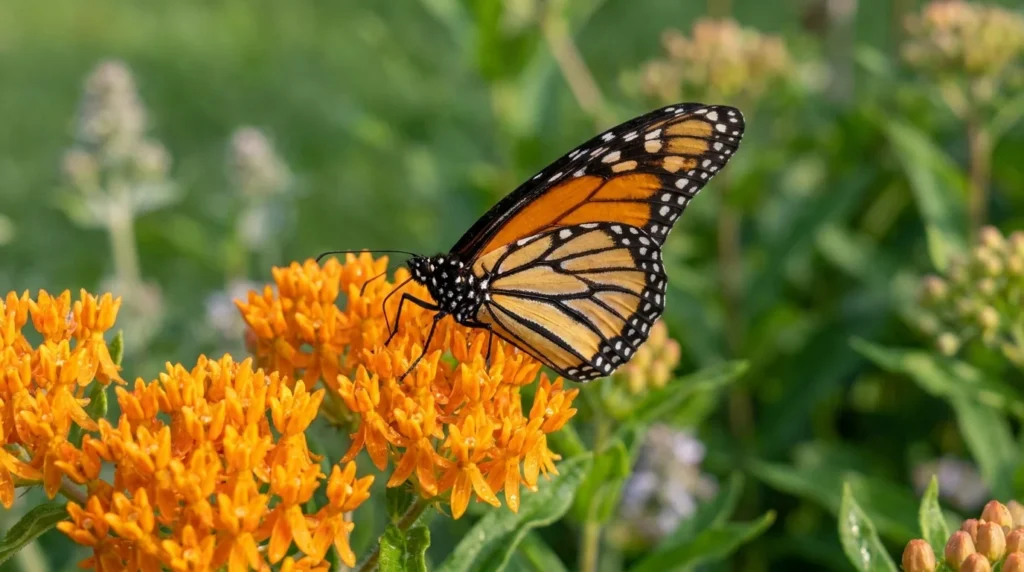
Butterfly weed is the showiest of the native milkweeds, with clusters of vivid orange flowers that bloom in midsummer and draw attention from across the yard.
It’s one of the best plants you can grow for monarch butterflies because it functions as both a nectar source and the only larval host plant monarch caterpillars can use to survive. Without milkweed, monarchs cannot complete their life cycle.
In addition to monarchs, butterfly weed attracts swallowtails, fritillaries, and a wide range of native bees. It’s also one of the most drought-tolerant plants in this lineup, with a deep taproot that helps it survive dry summers.
Plant it in full sun and well-drained soil, and resist the urge to move it once established; that taproot makes transplanting difficult.
Mid-Summer Through Fall (July–October)
Joe Pye Weed (Eutrochium purpureum)
Joe Pye weed is a tall, dramatic native that earns its space in the pollinator garden many times over.
The large dusty-pink flower clusters bloom in August and September, right when many other flowers are winding down, making it a critical late-season resource.
Swallowtail butterflies are particularly drawn to it in large numbers, and bumblebees work it heavily as they build fat stores before winter.
This plant grows 5 to 7 feet tall, so position it at the back of a border or as a meadow anchor. It tolerates moist soil and partial shade better than most native wildflowers, which makes it useful in spots where other plants struggle.
The seed heads persist through winter and provide sculptural interest in the dormant garden.
Swamp Milkweed (Asclepias incarnata)
While butterfly weed prefers dry conditions, swamp milkweed fills the wet end of the milkweed spectrum.
It grows in moist to wet soil and blooms with clusters of soft pink flowers from July through August. Rain gardens, low spots, pond edges, or beds that hold moisture are ideal locations.
Like butterfly weed, it’s both a monarch host plant and a nectar source, and it also attracts a broad range of native bees and other butterflies.
At 3 to 5 feet tall, it’s more manageable than Joe Pye weed and fits naturally into a mixed border. It spreads moderately by rhizome and self-seeds reliably in good conditions.
If you have a persistently wet spot in the yard, swamp milkweed is one of the best solutions available.
Cardinal Flower (Lobelia cardinalis)
Cardinal flower is one of the most visually striking native plants you can grow and one of the most specialized.
The brilliant scarlet tubular blooms are shaped almost exclusively for ruby-throated hummingbirds, whose long bills fit perfectly into the flower structure.
While some native bees do visit, hummingbirds are the primary pollinators, and a planting of cardinal flowers in full bloom is a reliable spot to watch them feed.
It grows in moist to wet soil in sun to partial shade and blooms from July through September. It’s a short-lived perennial that self-seeds freely, so established patches tend to persist without intervention.
Cardinal flower pairs naturally with swamp milkweed in rain gardens and consistently moist border areas.
Native Asters (Symphyotrichum spp.)
Native asters are among the most important late-season pollinator plants available and among the most underused in home gardens.
They bloom from August through October, often into the first frosts, at exactly the moment when monarch butterflies are fueling up for migration and bumblebee queens are preparing for winter.
Research has documented that goldenrod and native asters together provide more calories to fall pollinators than almost any other plant combination.
There are dozens of native aster species across North America, including the tall New England aster with purple blooms, the compact calico aster for shaded spots, and the white heath aster for open meadows.
Choose species native to your region, and plant them in drifts. They’re rarely fussy about soil, and most spread reliably once established.
Goldenrod (Solidago spp.)
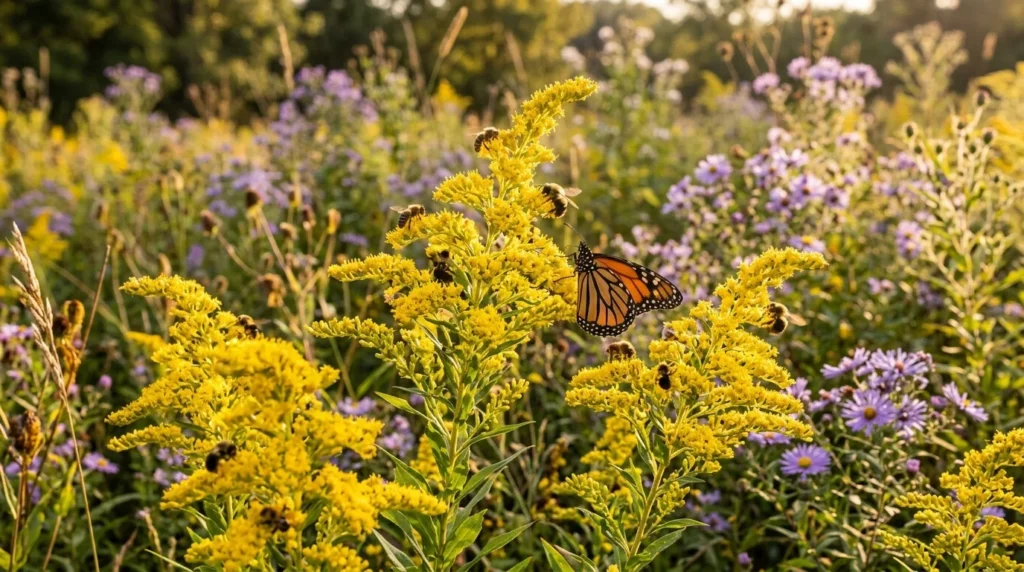
Goldenrod gets blamed for hay fever, which it doesn’t cause. The actual culprit is ragweed, which blooms at the same time and disperses pollen by wind.
Goldenrod pollen is too heavy and sticky for the wind. It travels only by pollinators, which visit goldenrod in extraordinary numbers through late summer and fall. A blooming patch of goldenrod is one of the most pollinator-dense plantings in any garden.
Over 100 bee species use goldenrod as a food source, along with hundreds of moth and butterfly species that rely on it as a larval host plant.
Native goldenrod species exist for nearly every garden condition: tall goldenrod for open sunny areas, zigzag goldenrod for shade, and seaside goldenrod for coastal gardens. Select species native to your region for the best results.
How To Build a Season-Long Pollinator Garden
Picking a few of these plants is a great start. Building a garden that genuinely supports pollinators throughout the season takes a little more intention but not much more effort. The tips below make the biggest difference.
- Plant for succession. Aim for something in bloom from early spring through late fall. A garden that peaks in July and goes quiet after August is beautiful, but it doesn’t support overwintering bumblebee queens or fuel migratory monarchs. Native asters and goldenrod are low-cost insurance for the fall gap.
- Plant in drifts, not singles. One coneflower is nice. A dozen create a foraging patch worth visiting. Pollinators respond to density. Larger drifts get discovered faster and attract more insects than scattered individual plants.
- Leave the stems. Many native bees nest inside hollow or pithy plant stems over winter. Resist cutting back all your perennials in fall. Leave stems standing through winter and delay cleanup until daytime temperatures consistently reach 50°F in spring — that’s when overwintering insects safely emerge.
- Skip the pesticides. Insecticides, including products marketed as organic (like spinosad), kill bees. A garden planted to attract pollinators and then sprayed with poison is a contradiction. For areas where you need fewer bee visitors, see our guide on flowers that won’t attract bees.
- Layer in native ground covers. Low-growing natives between taller perennials fill the understory, provide additional nesting habitat, and naturally suppress weeds.
Plant One Thing and Watch What Happens
Every successful pollinator habitat started somewhere, usually with a single plant someone liked the look of.
You don’t need a meadow, a large budget, or years of gardening experience. A pot of purple coneflowers on a sunny porch attracts bees. A patch of goldenrod at the back of the yard becomes the busiest spot in the garden by September.
Start with two or three plants that match your conditions, and let them establish. Add a few more each season.
Within a few years, you’ll have a functioning habitat that grows more productive over time, requires less work than a conventional border, and puts on a better show from March through November.
Plant for pollinators, and you often end up with a tougher, lower-maintenance garden as a bonus.