
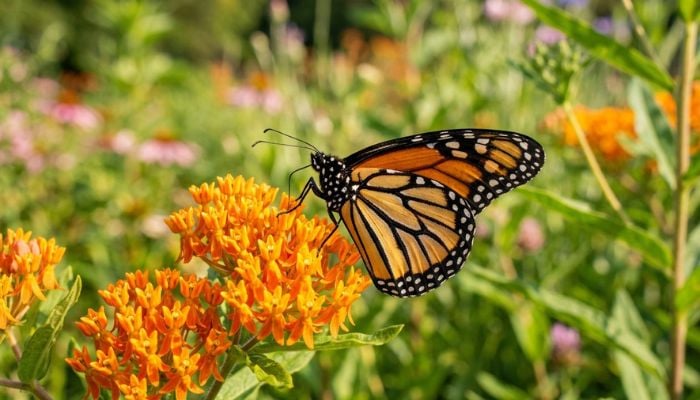
Milkweed is the single link between monarch butterflies and the gardens that can save them. Without it, there are no eggs, no caterpillars, and no next generation of monarchs.
If you’ve been wondering how to attract monarch butterflies, understand that planting milkweed is critical, but it’s not enough.
Monarch butterflies need nectar sources too, and the choices you make about which plants to grow and where can mean the difference between the occasional sighting and a yard that monarchs return to season after season.
The monarch population has declined by more than 80% over the past two decades.
Habitat loss, pesticide use, and climate change have all had an impact, but so has the widespread disappearance of milkweed from farm fields, roadsides, and yards across the country.
Every patch you plant is a direct counter to that trend. This guide covers the milkweed species worth growing, the nectar plants that complete the picture, and how to put it all together.
Why Monarch Butterflies Need Milkweed
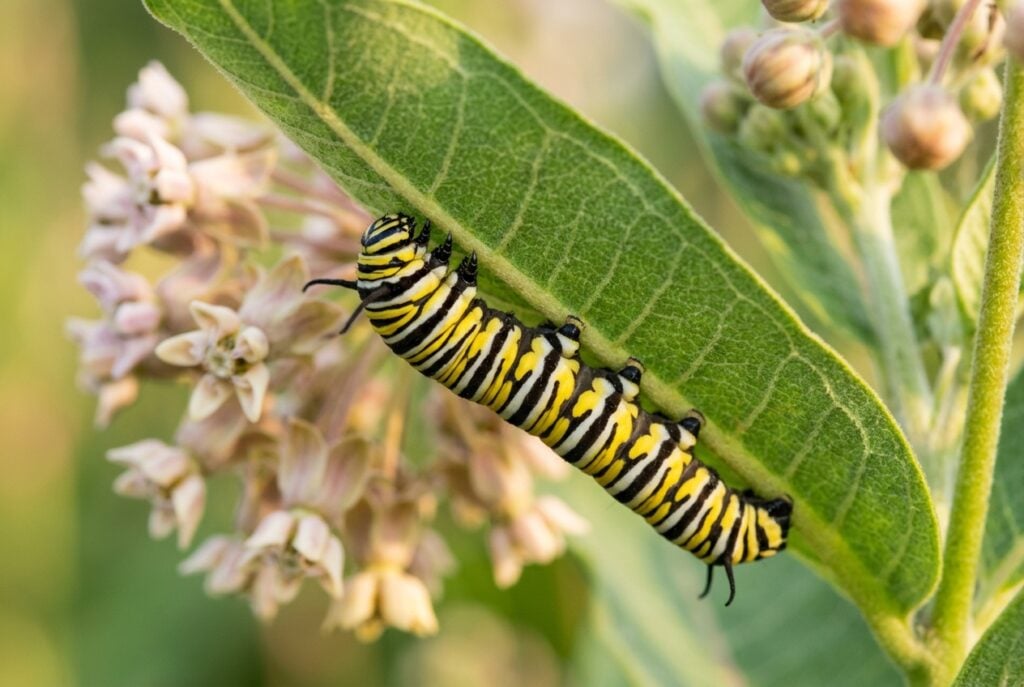
Milkweed (Asclepias spp.) is the only plant that monarch caterpillars can eat. Female monarchs will only lay their eggs on milkweed leaves; no other plant qualifies.
When caterpillars hatch, they feed exclusively on milkweed foliage, which also delivers the cardenolide toxins that make monarchs unpalatable to most predators. It’s a tight, evolved relationship that’s been thousands of years in the making.
This dependency means that a yard without milkweed is a yard that monarchs will pass through but not breed in.
If your goal is to support the species rather than just catch a fleeting glimpse of an adult feeding on nectar from flowers, milkweed is non-negotiable; it’s the foundation everything else builds on.
The 3 Best Milkweed Species for Your Garden
There are over 70 species of milkweed native to North America. Most aren’t practical for a home garden.
These three are widely available, manageable in size, and well-suited to different growing conditions. Plant whichever one fits your soil and sun, or grow all three for maximum impact.
Common Milkweed (Asclepias syriaca)
- What it looks like: Broad, gray-green leaves, tall stems (3–5 feet), and rounded clusters of pink-purple flowers that bloom in early summer. Noticeably fragrant.
- Where it grows best: USDA Zones 3–9. Full sun, dry to average soil. Tolerates poor, sandy, or clay-heavy ground better than most garden plants.
- One thing to know: Common milkweed spreads by underground rhizomes and can colonize an area quickly. Plant it somewhere it has room to expand, or use a buried root barrier. The spreading is a feature if you want a large habitat patch, but it becomes a problem in a tidy mixed border.
Butterfly Weed (Asclepias tuberosa)
- What it looks like: Brilliant orange-yellow flower clusters on compact, bushy plants (1–2 feet tall). One of the showiest native wildflowers you can add to a sunny garden.
- Where it grows best: Zones 3–9. Full sun, well-drained soil. Drought-tolerant once established. Unlike common milkweed, it doesn’t spread aggressively; it stays in a well-behaved clump that gets better every year.
- One thing to know: Butterfly weed is slow to emerge in spring, sometimes not showing until late May or early June. Mark its location in the fall so you don’t accidentally dig it up thinking it hasn’t come back.
Swamp Milkweed (Asclepias incarnata)
- What it looks like: Pink to mauve flower clusters on tall, elegant stems (3–4 feet). Narrower, lance-shaped leaves compared to common milkweed. Lends a more refined look for a formal planting.
- Where it grows best: Zones 3–6. Full sun to part shade, consistently moist soil. Ideal for rain gardens, pond edges, or low spots that stay wet. Less aggressive spread than common milkweed.
- One thing to know: Despite the name, swamp milkweed adapts to average garden soil as long as it receives consistent moisture. It’s not limited to wet sites, but it will not tolerate drought.
A Word About Tropical Milkweed
Tropical milkweed (Asclepias curassavica) is sold at many garden centers, and monarchs will readily use it. The problem is that in warm-winter regions, such as the Gulf Coast, Southern California, and Florida, it doesn’t die back in the fall.
This can disrupt monarch migration by giving caterpillars a year-round food source that encourages adults to skip their journey south altogether.
Tropical milkweed also concentrates a parasitic protozoan called Ophryocystis elektroscirrha (OE) at higher rates than native milkweeds, particularly on plants that never experience a winter dieback.
The fix is straightforward: if you grow tropical milkweed in a frost-free zone, cut it back hard each fall to force dormancy.
If you’re in a climate with natural frost, it dies on its own, and the migration disruption issue is largely moot. Wherever native species are available and suited to your soil, they’re always the better long-term choice.
Nectar Plants That Fuel Adult Monarchs
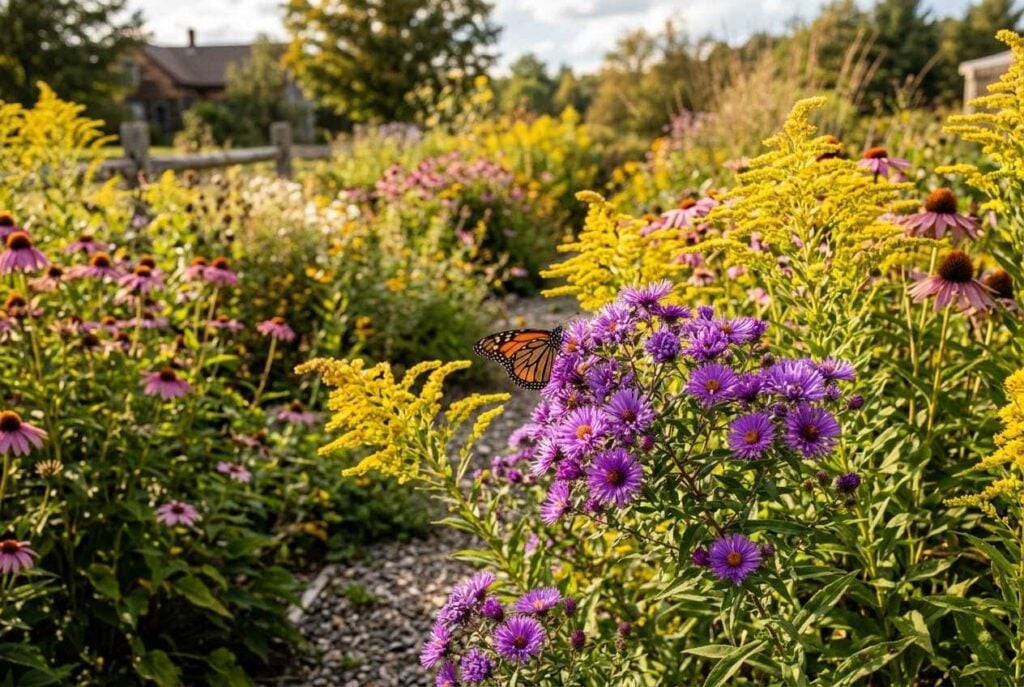
Adult monarchs don’t eat milkweed. They drink nectar from flowers. Milkweed brings them in to breed, but a garden full of nectar sources keeps them fueled, nourished, and lingering.
More importantly, the migratory generation, i.e., the butterflies that head to Mexico each autumn, needs to build significant fat reserves before departure. Late-season nectar plants are disproportionately important for this reason.
For broader plant pairing ideas, our guide to native plants for pollinators covers companion species that support monarchs alongside bees, skippers, and other beneficial insects.
These are the best options for a monarch nectar garden:
- Coneflower (Echinacea purpurea): Blooms from summer into fall; one of the most productive and widely adaptable native nectar plants you can grow.
- New England aster (Symphyotrichum novae-angliae): Critical fall bloomer (Sept.–Oct.) that coincides directly with monarch migration; this one is essential.
- Goldenrod (Solidago spp.): Late-season powerhouse that supports monarchs, bees, and dozens of other pollinators simultaneously. Don’t skip it because of the myth that it causes allergies (it doesn’t; ragweed does).
- Black-eyed Susan (Rudbeckia hirta): Long bloom period, easy to establish, pairs naturally with milkweed in a sunny border.
- Blazing star (Liatris spicata): Mid-summer bloom, tall and striking, highly attractive to monarchs.
- Joe-Pye weed (Eutrochium purpureum): Large, late-summer bloomer that migrating monarchs will pile into on their way south.
Practical Steps for a Monarch-Ready Garden
Start With Sun
Milkweed and most monarch nectar plants need full sun, a minimum of 6 hours per day. A semi-shaded border is not going to cut it.
If your sunniest spot is also your smallest, prioritize milkweed over nectar plants; without the host plant, nothing else matters as much.
Plant in Clusters
A single milkweed plant is better than none, but clusters of 3–5 plants are far more visible to females scouting for egg-laying sites.
The same logic applies to nectar plants: a dense grouping of coneflowers does more work than the same number of plants scattered across the yard.
If you’re weighing which flowers to add based on what they attract, this rundown of flowers that don’t attract bees can help you think through your mix.
Avoid Treated Plants
Many nursery plants, including native species, are pre-treated with systemic insecticides, such as neonicotinoids, before sale. These are lethal to caterpillars and harmful to adults.
When possible, source plants from local native plant nurseries or growers who don’t use systemics. Also, skip broad-spectrum sprays anywhere monarchs and their larvae may be present.
Leave Some Open Ground
Monarchs occasionally puddle for minerals, and females often prefer open, bare soil near milkweed plants for egg-laying.
Avoid heavy mulching directly against your milkweed stems. Leave some exposed soil at the base.
Think Regionally When You Can
Native milkweed species are adapted to the soils and seasons of their home regions.
If you’re in the Midwest, all three species above should perform well. If you’re in the Southeast, look for native local ecotypes rather than nursery stock grown from seed collected elsewhere.
Our guide to the best native plants for the Midwest has additional options that pair well alongside a monarch-focused planting.
Plant It This Season, and Then Get Out of the Way
There’s a temptation to over-engineer a monarch garden. You don’t need to. The monarchs know exactly what they’re looking for; they just need you to put it in the ground.
Start with one milkweed species suited to your soil. Add New England aster and goldenrod for fall nectar. Skip the pesticides. Give it a season.
What you’re participating in, whether you have a 4×4 plot or a half-acre meadow, is something larger than any individual garden.
The monarch migration spans thousands of miles and multiple generations. The butterflies that emerge in your yard in July may be the great-grandchildren of the ones that overwintered in the mountains of Michoacán.
The ones that leave your yard in September will complete that journey on their own, but only if there are enough waypoints like yours along the route.
A yard with milkweed is a yard that’s part of that story. That’s worth planting for.