
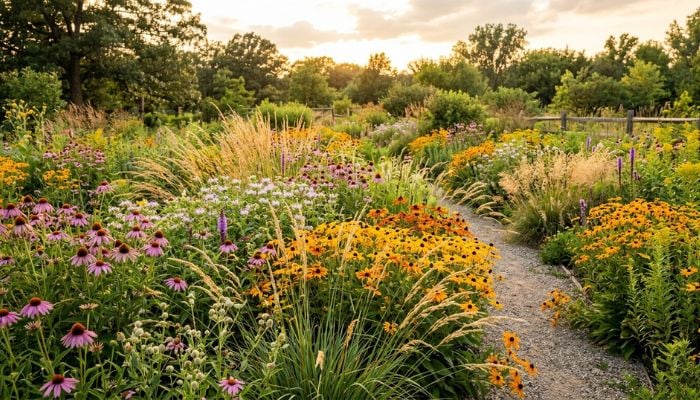
If you’ve planted something that looked great at the nursery and was dead by August, you’re not alone… and it’s probably not your fault.
Most ornamental plants are bred for looks, not local resilience. Native plants are different. They evolved with your soil, your rainfall patterns, and your freeze-thaw cycles. They’re not trying to survive the Midwest. The Midwest is their home.
This guide covers the best native plants for Midwest gardens across Zones 4–6, the hardiness range that includes most of Minnesota, Wisconsin, Michigan, Iowa, Illinois, Indiana, Ohio, Missouri, and Nebraska.
Whether you have a sun-drenched prairie-style yard, a shaded woodland corner, or a chronically wet low spot that drowns everything you plant, there’s a native that won’t just survive there; it’ll thrive.
Why Native Plants Work So Well in the Midwest
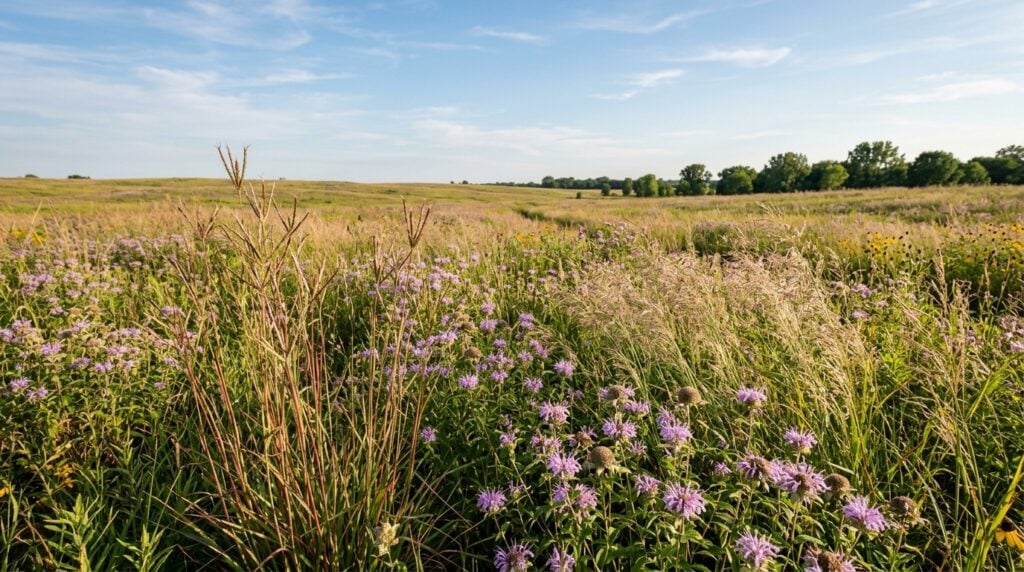
Native plants have one major structural advantage: deep root systems. A purple coneflower can send roots 6 feet into the soil. Prairie dropseed roots go even deeper.
Those roots act like a sponge, absorbing rain fast, reducing runoff, and tapping into subsoil moisture during dry spells. It’s why most Midwest natives handle summer drought far better than ornamental cultivars that need weekly watering.
Beyond drought tolerance, native plants form the base of local food webs. Native bees (there are over 400 species in Illinois alone) often can’t use non-native flowers. Some bee species have co-evolved with specific native plants and can only collect pollen from them.
When you plant natives, you’re not just decorating your yard. You’re supporting a whole community of insects, birds, and mammals that depend on these plants to survive.
If you want to go deeper on this connection, check out our guide covering the best native plants for pollinators.
Understanding Hardiness Zones 4–6 in the Midwest
Your hardiness zone reflects the average annual minimum winter temperature in your area. Here’s how Zones 4–6 break down across the Midwest:
- Zone 4 covers extreme northern Minnesota, the Upper Peninsula of Michigan, and parts of northern Wisconsin. Average winter lows reach -30°F to -20°F. Plant selection here requires cold-hardy natives that handle brutal winters with minimal snow cover.
- Zone 5 is the broad middle band that includes the Twin Cities metro, Madison, Chicago, most of Iowa, and central Wisconsin. Winter lows range from -20°F to -10°F. This is where the widest variety of Midwest natives thrive without special protection.
- Zone 6 covers St. Louis and southern Missouri, central and southern Illinois, most of Indiana and Ohio, and parts of Nebraska. Lows stay between -10°F and 0°F. Zone 6 gardeners can often push the envelope, growing species that need a milder winter to perform their best.
Most of the natives covered in this guide are rated for all three zones. These include prairie and woodland plants that have been part of this landscape for thousands of years.
Prairie Natives for Full-Sun Gardens
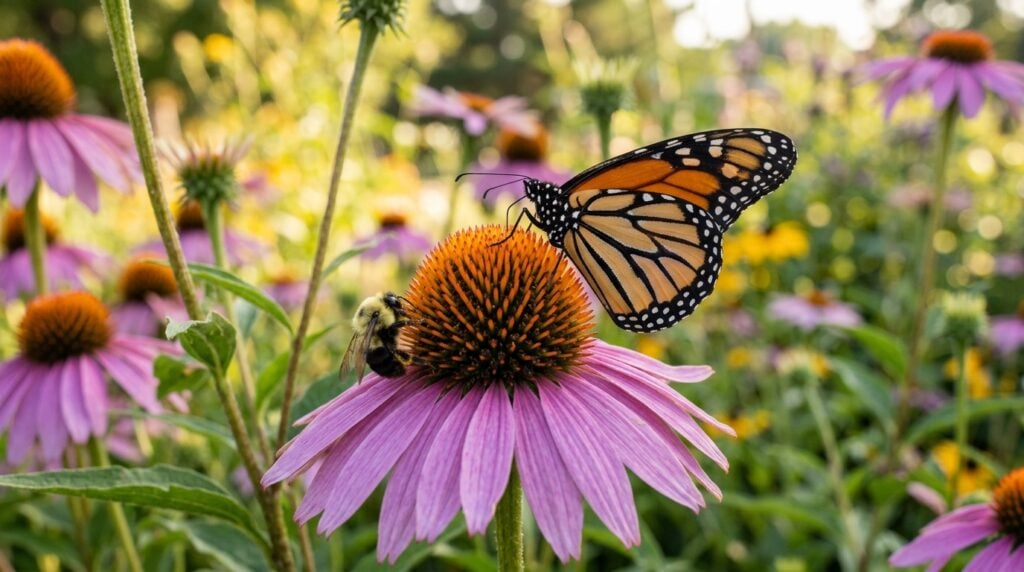
If you have a sunny yard with average to dry soil, prairie natives are your starting point. These plants evolved in the open grasslands of the Midwest.
They want full sun, they can handle clay, and they don’t need fertilizer. In fact, most prairie natives perform better in lean soil. Too much fertility, and they get leggy and floppy.
Purple Coneflower (Echinacea purpurea)
Purple coneflower is the gateway native for good reason. It’s easy, it blooms for weeks in midsummer, and the seed heads feed goldfinches right through December.
Hardy in Zones 3–9, it handles both clay and sandy soil with minimal fuss. Plant it in full sun and let it self-seed, and within a few years you’ll have a naturalistic drift that looks like it belongs there… because it does.
Bloom time: June–August.
Little Bluestem (Schizachyrium scoparium)
Little bluestem earns its place in every season. In the summer, the fine-textured blue-green foliage adds texture between flowering plants.
In the fall, it turns brilliant copper, orange, and burgundy. In the winter, the feathery seed heads catch frost and stand beautifully through snow.
It grows 2–4 feet tall, clumps rather than spreads, and handles drought exceptionally well. It’s one of the most versatile native grasses for a Midwestern landscape.
Hardy in Zones 3–9.
Prairie Dropseed (Sporobolus heterolepis)
Prairie dropseed is a native grass at its most refined. The fine, arching foliage forms a tidy, weed-suppressing mound that’s ideal as a border edge or in mass plantings.
In late summer, it sends up delicate, cloud-like seed heads that carry a faint fragrance some describe as buttery popcorn. It’s slow to establish but incredibly long-lived once settled. It tolerates clay, drought, and modest shade.
Bloom time: August–September. Hardy in Zones 3–8.
Butterfly Weed (Asclepias tuberosa)
Butterfly weed is one of the most striking summer natives you can grow, with vivid orange flower clusters that attract butterflies, bees, and hummingbirds from July through August.
It’s a milkweed, which means monarch butterfly caterpillars need it to survive. If you want to attract monarch butterflies, this plant is non-negotiable.
It’s slow to emerge in spring, so mark where you plant it. It resents transplanting once established, but it’ll reward your patience for years.
Hardy in Zones 3–9.
Black-Eyed Susan (Rudbeckia hirta)
Black-eyed Susan is the cheerful yellow workhorse of the prairie garden. It blooms from June through October, fills gaps while other plants get established, and self-seeds reliably without becoming invasive.
It’s short-lived as a perennial, often acting more like a biennial, and it replenishes itself every year. It grows in nearly any soil, in full sun to light shade. Plant it alongside coneflower and little bluestem for a classic prairie combination.
Hardy in Zones 3–7.
Woodland Edge Plants for Shade and Partial Shade
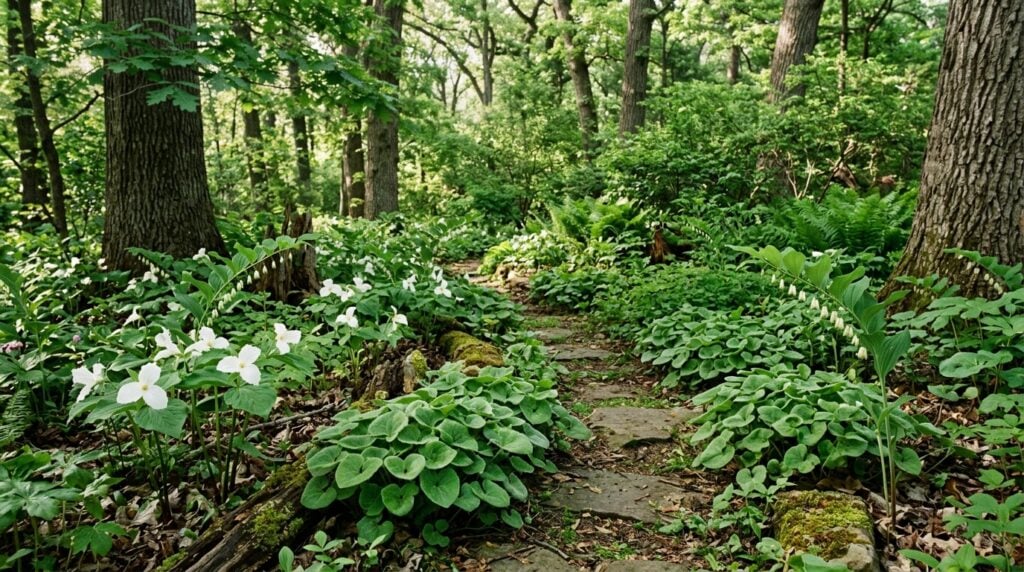
Not everyone has full sun. If you’re working with a shaded corner or a north-facing border with dappled light, woodland-edge natives will fill that space beautifully, with far more seasonal interest than conventional shade plants, such as hostas or astilbe, and far less fuss.
Wild Ginger (Asarum canadense)
Wild ginger is the ideal woodland ground cover. Heart-shaped, deep-green leaves form a dense mat that suppresses weeds and spreads slowly but steadily. It goes dormant in winter but returns reliably every spring.
The flowers are hidden under the foliage and are fascinating up close and inconspicuous from a distance. Plant it under trees or along a shaded path, and give it 2–3 years to establish. After that, it takes care of itself.
Hardy in Zones 3–7.
Bloodroot (Sanguinaria canadensis)
Bloodroot is a spring ephemeral, one of those wildflowers that blooms in early spring, sets seed, and goes dormant by summer.
The flowers are stunning: pure white petals surrounding a golden center, appearing before the distinctive lobed leaves fully unfurl.
It grows naturally at the edges of deciduous forests and does best in rich, moist, well-drained soil with partial shade. Plant it where it won’t be disturbed, and it will slowly form colonies that bloom reliably every March and April.
Hardy in Zones 3–8.
Trillium (Trillium grandiflorum)
Large-flowered trillium is the crown jewel of Midwest woodland gardens. Three white petals, three green leaves, and a presence that makes you stop mid-walk.
It’s slow, taking 7 or more years from seed to first bloom, but established colonies live for decades.
Always buy nursery-propagated plants; trillium is protected in many Midwest states, and wild-collected plants rarely survive. Plant in humus-rich, well-drained soil in deep to partial shade, and leave them alone to naturalize.
Bloom time: April–June. Hardy in Zones 3–8.
Jacob’s Ladder (Polemonium reptans)
Jacob’s ladder is one of the most underused native woodland plants. The finely divided, ladder-like leaves stay attractive all season, and the blue-violet flowers in April and May are reliably beautiful.
It tolerates more sun than most woodland plants, self-seeds moderately, and is genuinely deer-resistant, which is a real asset if you garden where deer pressure runs high.
Hardy in Zones 2–8.
Water-Tolerant Natives for Low Spots and Rain Gardens
If you have a low area that stays wet after rain, don’t fight it. Design for it. Native plants from wet prairie and riverbank habitats will thrive where conventional plants drown, and they’ll slow and filter stormwater runoff as they go.
Swamp Milkweed (Asclepias incarnata)
Swamp milkweed is the wet-soil milkweed, and like all milkweeds, it’s a monarch butterfly host plant. Unlike butterfly weed’s vivid orange, swamp milkweed flowers are soft pink to mauve, blooming from July to August on 3–4 foot stems.
It handles boggy ground, rain gardens, and pond edges where most plants give up. It’s also more shade-tolerant than other milkweeds. Give it a consistently moist spot, and it will thrive for decades.
Hardy in Zones 3–6.
Blue Flag Iris (Iris versicolor)
Blue flag iris delivers drama at the water’s edge. The intricate blue-violet flowers bloom in May and June, followed by handsome sword-shaped foliage that stays attractive all season. It grows 2–3 feet tall, spreads slowly by rhizome, and handles short periods of standing water.
This is a plant that looks like it belongs at the edge of a Wisconsin lake… because it does. Plant in full to partial sun in moist to wet soil.
Hardy in Zones 3–9.
Cardinal Flower (Lobelia cardinalis)
Few native plants make a statement like cardinal flower. The blazing red spikes bloom in late July through September, rising 3–4 feet in moist to wet soil.
Hummingbirds are the primary pollinator, as the flower tube is too narrow for most bees, making this a must-have for anyone building a hummingbird habitat.
Cardinal flower is short-lived as a perennial, but it self-seeds reliably in moist conditions, keeping colonies going year after year.
Bloom time: July–September. Hardy in Zones 3–9.
Where To Source Midwest Native Plants
Sourcing matters. Big-box nurseries sometimes carry native species, but they also sell cultivars (named selections bred for specific traits) that may have reduced value for pollinators compared to straight species.
Seek out local native plant nurseries or conservation district plant sales, which often offer bare-root natives at very low cost in spring.
Local native plant societies (the Illinois Native Plant Society, Wisconsin Native Plant Society, etc.) frequently host sales and can point you to reputable growers in your area.
One hard rule: Never purchase trillium, bloodroot, or other woodland wildflowers unless they are clearly labeled as nursery-propagated.
Wild-collected plants are often dug illegally from natural areas, rarely survive transplanting, and further deplete already-stressed woodland populations.
A simple search for “native plant nursery [your city or state]” is usually enough to find local growers within driving distance.
Buying locally grown plants also means they’re already adapted to your specific regional climate, which gives you a head start you can’t get from a national catalog.
Your Midwest Garden, Rooted in Place
Starting a native plant garden doesn’t require tearing out everything and beginning from scratch.
Pick three or four species from this list, and plant them this season. Watch how they establish, where they self-seed, and which insects find them first.
Add more plants the following year. Notice which birds visit in winter when you leave the seed heads standing. Notice how little supplemental water they need after the first summer.
Native plants ask almost nothing of you once they’re settled in. What they give back in terms of wildlife habitat, seasonal beauty, and resilience you don’t have to maintain is something that has to be seen to be fully appreciated.
The Midwest has one of the richest native floras of any region in North America. Use it.