
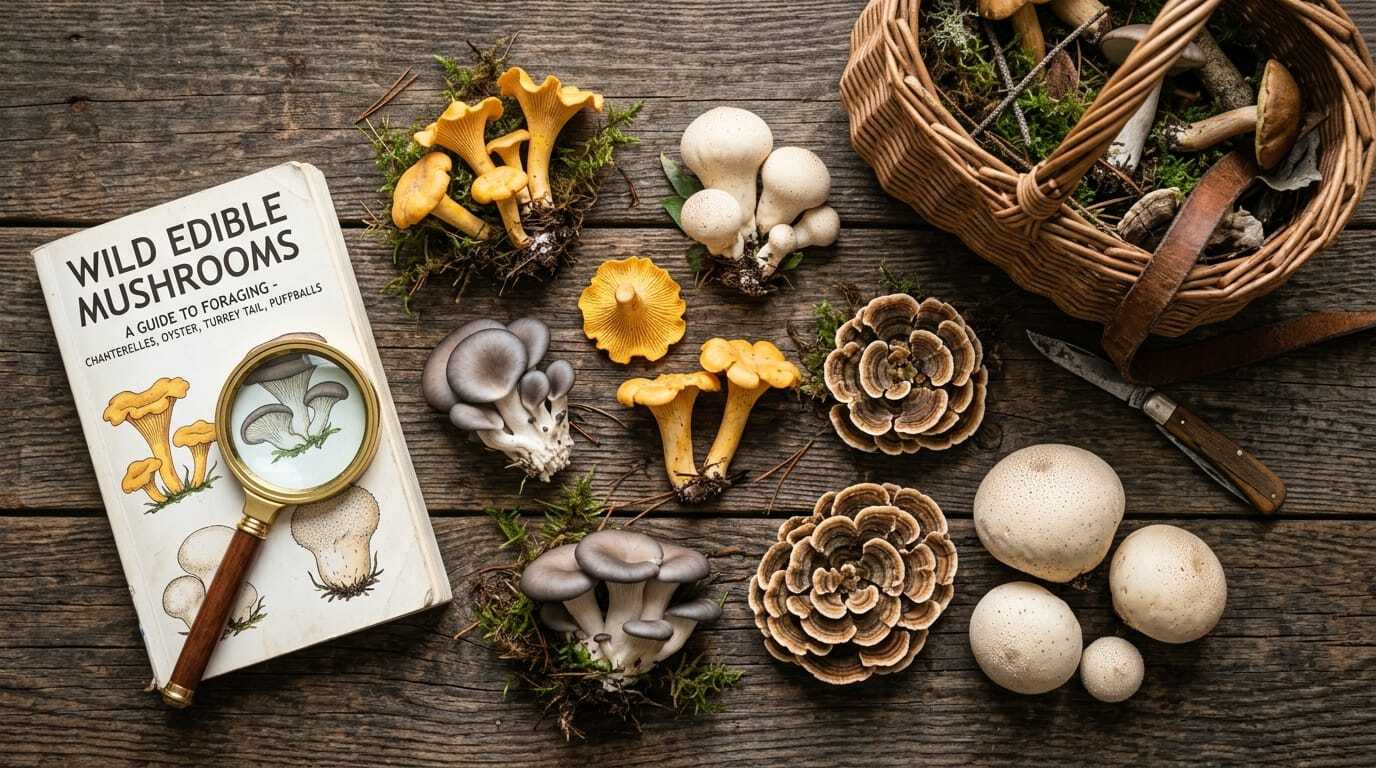
Wild mushroom foraging has exploded in popularity — Google searches for “mushroom foraging” have more than doubled since 2020, and mycological society memberships are hitting record highs across the country. First-timers are heading into the woods armed with apps and enthusiasm, which is great. But enthusiasm without knowledge is where things go wrong.
Here’s what a good first find feels like: you’re walking a trail near an oak grove in September, you spot a cluster of golden shelf-shaped caps fanning out from the base of a log, you go through every check on your list, and you walk home with a pound of hen of the woods that you actually feel confident eating. That confidence doesn’t come from an app. It comes from knowing what you’re doing.
This guide gives you that foundation. We’ll cover the features you need to learn, the safety rules you should never bend, six beginner-friendly edible species, and how to keep building your skills over time.
A Critical Safety Note: Always Cook Wild Mushrooms
Before anything else: never eat wild mushrooms raw. Even well-known edibles — including morels, chicken of the woods, and others on this list — can cause gastrointestinal distress when eaten uncooked. Cooking neutralizes compounds that are harmless once broken down by heat but problematic raw. This applies every time, without exception.
The Golden Rules of Foraging
These aren’t suggestions. They’re the rules that separate safe foragers from cautionary tales. Commit them to memory before you eat a single thing you’ve found in the wild.
- Never eat a mushroom you haven’t positively identified. Not 90% sure. Not probably. Positive. A single wrong call with species like the death cap (Amanita phalloides) can cause fatal liver failure. If you have any doubt, throw it back.
- Use multiple identifying features. One characteristic alone is never enough. Cap color can vary by age, weather, and lighting. Always cross-check cap shape and texture, gill or pore structure, stem features, spore print color, smell, and habitat together.
- Learn the deadly lookalikes first. For every edible species you want to eat, know what poisonous mushrooms look like similar to it. The jack-o’-lantern looks like a chanterelle. The destroying angel looks like a puffball button. Know the difference before you forage.
- Eat a small test amount the first time. Even correctly identified edibles can cause reactions in some people. Try a small cooked portion and wait 24 hours before eating more.
- Never rely on apps alone. AI mushroom identification apps are improving, but they’re not reliable enough for safe foraging decisions. They can’t assess spore print color, smell, or habitat context. Use them as a starting point, not a final answer.
- When in doubt, throw it out. There’s always another mushroom. No meal is worth the risk.
Before You Head Out: Essential Gear
You don’t need much to start, but having the right kit before your first trip makes a real difference.
- Wicker or mesh basket: Allows spores to disperse as you walk, helping propagate the fungi you harvest. Plastic bags trap moisture and degrade your specimens.
- Sharp knife: For clean cuts and for slicing puffballs in half to verify the interior.
- Small brush: For cleaning debris from specimens in the field.
- Paper bags: For separating different species. Never mix unknown mushrooms in the same container.
- Field guide for your region: Get one specific to your area — species vary significantly by geography. This is non-negotiable.
- Notebook and pen: For recording spore prints, smell, habitat, and notes.
- White and dark paper for spore prints: Keep a few folded sheets in your basket.
A field guide and a notebook are your two most important tools. Everything else is secondary.
Key Identification Features
Learning to identify wild mushrooms means learning to read a specific set of physical features. Every time you pick up a mushroom, go through this checklist systematically.
Cap (Pileus)
The cap is usually the most visible part. Note its size, shape, color, texture, and whether the surface is dry, sticky, or slimy. Does it have scales? Is the edge smooth or wavy? Many edible species have very distinctive cap shapes that narrow down identification quickly.
Gills, Pores, or Teeth
Flip the mushroom over. Some mushrooms have gills (thin blade-like structures), some have pores (tiny holes, like a sponge), and others have teeth or ridges. This feature alone rules out or confirms entire families of mushrooms. Chanterelles, for example, have forking ridges rather than true gills — a key distinction from poisonous lookalikes.
Stem (Stipe)
Is the stem hollow or solid? Does it have a ring (annulus) from where a veil once covered the gills? Is there a cup-like structure (volva) at the base? The Amanita family — which contains the most deadly mushrooms in North America — typically has a ring, a skirt-like volva at the base, and white gills. Learning Amanita features is non-negotiable for every forager.
Spore Print
This is one of the most important identification steps, and it takes only minutes. Place the cap gill-side down on a piece of white paper (use dark paper if you suspect white spores). Cover it with a bowl and wait 1–4 hours. The spore color left behind is a definitive diagnostic tool. White, brown, black, rusty-orange, and purple-black prints each point to different mushroom families.
Smell and Taste
Some mushrooms have very distinctive smells — chanterelles have a faint fruity or apricot aroma, while the Jack-o’-lantern (a toxic lookalike) has a strong, sharp smell. Taste is occasionally used by experienced foragers — a small nibble on the tongue that’s immediately spat out — but this is an advanced technique and not recommended for beginners.
Habitat and Season
Where a mushroom grows tells you a lot about what it is. Is it growing on wood or from soil? Near what type of tree? Many edible species have mycorrhizal relationships with specific trees — morels love dying elms and ash trees, while chanterelles are common near oaks and conifers. Season matters too. Morels fruit in spring; chanterelles in summer and fall; hen of the woods in early fall.
How to Take a Spore Print (Step by Step)
Taking a spore print is simple and should become a habit for every mushroom you’re trying to identify.
- Remove the mushroom cap from the stem with a clean cut.
- Place the cap gill-side (or pore-side) down on a sheet of paper — use half white, half dark paper to capture both light and dark spores.
- Cover the cap with a bowl or container to prevent air movement.
- Leave it for 1–4 hours, or overnight for the clearest print.
- Carefully lift the cap straight up. The spore print left behind is a diagnostic feature — record the color in your notes.
Keep a small notebook when you forage. Write down spore print color, smell, habitat, and any other observations. This habit accelerates your learning faster than any field guide.
Field Guide vs. App: Which Should You Use?
If you can only afford one tool, buy the book.
Field guides give you verified, expert-curated information organized by region and species. The National Audubon Society Field Guide to Mushrooms and All That the Rain Promises and More by David Arora are widely recommended starting points. The information has been reviewed, edited, and tested by people who’ve been foraging for decades. It won’t misidentify a death cap as a puffball.
Apps like iNaturalist, Shroomify, and Picture Mushroom use image recognition to suggest identifications. They’re useful for generating a starting hypothesis — especially when you’re still building your mental library. But image recognition can’t assess spore print color, smell, texture, or habitat context, and it regularly misidentifies species in ways that matter. Use an app to generate a shortlist of possibilities, then verify everything with a field guide and your own physical examination.
The hierarchy is simple: field guide first, app second, always. And when in doubt, don’t eat it.
6 Beginner-Friendly Edible Mushrooms to Start With
These species are recommended for beginners because they have strong, distinctive identification features and limited dangerous lookalikes. That said, all the same rules apply — identify carefully every single time, and always cook before eating.
Giant Puffball (Calvatia gigantea)
What it looks like: A large white sphere, ranging from softball to basketball size, with smooth, leathery skin. No cap, no gills, no stem visible from the outside.
Where and when: Fields, meadows, and woodland edges in late summer through fall.
The critical ID test: Slice the puffball in half top to bottom. The interior must be pure white and completely homogenous throughout. Any discoloration, any outline of a developing gill structure, and you don’t eat it — it could be a young Amanita in the egg stage.
Lookalikes: Young Amanita “eggs” can resemble small puffballs from the outside. The slice test eliminates this risk entirely.
Want to go deeper on this family? Read our guide on whether puffball mushrooms are poisonous.
Oyster Mushroom (Pleurotus ostreatus)
What it looks like: Fan-shaped caps, white to gray to tan, growing in overlapping shelf-like clusters. Gills run down a short off-center stem. Spore print is white to lilac.
Where and when: On dead or dying hardwood trees, year-round in milder climates, peak in fall and spring.
The critical ID test: True oysters only grow on wood, never from soil. Gills run down the stem (decurrent). Spore print is white to pale lilac — not pink, which would indicate a different (and potentially problematic) species.
Lookalikes: Few dangerous lookalikes. The angel wings (Pleurocybella porrigens) is a white, wood-growing look-alike but grows on conifers and is much smaller. The elm oyster mushroom is a closely related species worth learning alongside it.
Chanterelle (Cantharellus cibarius)
What it looks like: Egg-yolk to pale golden color, wavy-edged cap, with forking ridges (not true gills) that run partway down the stem. Faint fruity or apricot smell.
Where and when: Growing from soil in association with oaks and conifers, summer through fall.
The critical ID test: The ridges fork and run down the stem. True gills on an otherwise similar mushroom is a red flag. The main lookalike — the jack-o’-lantern — grows in clusters from wood or buried roots, glows faintly in the dark, has true gills, and will make you very sick.
Lookalikes: Jack-o’-lantern mushroom (Omphalotus olearius/illudens) — toxic. False chanterelle (Hygrophoropsis aurantiaca) — orange, thin true gills, different texture. Both are distinguishable with close attention.
Turkey Tail (Trametes versicolor)
What it looks like: Thin, tough, fan-shaped brackets growing in overlapping shelves on dead hardwood logs and stumps. Concentric rings of color — brown, tan, white, rust, blue, green — with a white pore surface on the underside.
Where and when: One of the most widely distributed mushrooms in North America, found year-round on hardwood logs.
The critical ID test: The underside must have a white pore surface with tiny, uniform pores. Lookalikes like the false turkey tail (Stereum ostrea) have a smooth, pore-free underside. Run your finger across — you should feel tiny pores, not smooth surface.
Lookalikes: False turkey tail (Stereum ostrea) — common, smooth underside, not considered edible. Confirm with the pore surface test every time.
Turkey tail isn’t a culinary mushroom in the traditional sense — it’s too tough to eat whole. It’s used for teas, broths, and extracts, and is the subject of ongoing research into its health properties. We have full guides on finding turkey tail mushrooms and how to harvest turkey tail mushrooms.
Hen of the Woods / Maitake (Grifola frondosa)
What it looks like: Large overlapping clusters of gray-brown fronds, white underside covered in tiny pores, growing in a rosette formation at the base of oaks and other hardwoods. Can reach impressive sizes — 20 to 50+ pounds.
Where and when: Fall, almost exclusively at the base of oaks. Returns to the same tree year after year.
The critical ID test: Location is your biggest clue — base of a living or recently dead oak in fall. The frond-like, overlapping structure is distinctive. Spore print is white.
Lookalikes: Berkeley’s polypore (Bondarzewia berkeleyi) is a large, similar-looking bracket fungus that also grows at tree bases. It’s considered edible but much tougher and less flavorful. Few truly dangerous lookalikes make hen of the woods a solid beginner species.
Chicken of the Woods (Laetiporus sulphureus)
What it looks like: Bright orange and yellow shelf fungi, nearly impossible to confuse with anything toxic. Striking two-toned appearance — orange on top, pale yellow pore surface underneath. Tender when young, tough and dry when old.
Where and when: On living or dead trees (primarily oaks, cherries, willows) in summer and fall.
The critical ID test: Color is unmistakable. Yellow pore surface underneath, no gills. Harvest young, tender fronds for best eating.
Lookalikes: None that are truly dangerous for this species. The look is distinctive enough that most experienced foragers consider it one of the easiest to ID.
Important notes: A small percentage of people experience gastrointestinal reactions, especially from specimens growing on certain host trees. Eucalyptus and black locust hosts are more commonly associated with reactions. Also note: in the Pacific Northwest and mountain regions, Laetiporus growing on conifers is often a separate species — Laetiporus conifericola — which is more frequently linked to GI issues than the oak-growing L. sulphureus. If you’re in conifer country, confirm the host tree and proceed cautiously. Harvest from oak for the safest experience everywhere.
How to Keep Getting Better
Mushroom identification is a skill that builds over years, not days. The best things you can do early on:
- Join a local mycological society. Most hold regular forays (group foraging walks) with experienced members. Having an expert confirm your identifications in the field is invaluable.
- Forage with experienced people whenever possible. Nothing replaces field experience with someone who’s been doing this for years.
- Study one species at a time. Pick one beginner-friendly species, go out specifically looking for it, and don’t eat it until you’ve found and correctly identified it at least three or four times with the help of a field guide.
- Keep a foraging journal. Photos, spore prints, habitat notes, and your identifications (with confirmations or corrections) build into a personal reference that’s more useful than any book.
The foraging community is generally welcoming and generous with knowledge. Tap into it.
Final Thoughts
Wild mushroom identification is one of the most rewarding skills you can develop as a forager or homesteader — but it demands respect. The same forest that offers golden chanterelles also hosts the death cap (Amanita phalloides), which looks harmless, tastes fine, and has killed experienced foragers. There is no antidote once symptoms appear.
Start slow. Learn a few species thoroughly before expanding your list. Use every identification tool available — field guides, spore prints, smell, habitat, season — and never let hunger or excitement override caution.
The golden rule: when in doubt, don’t eat it.