
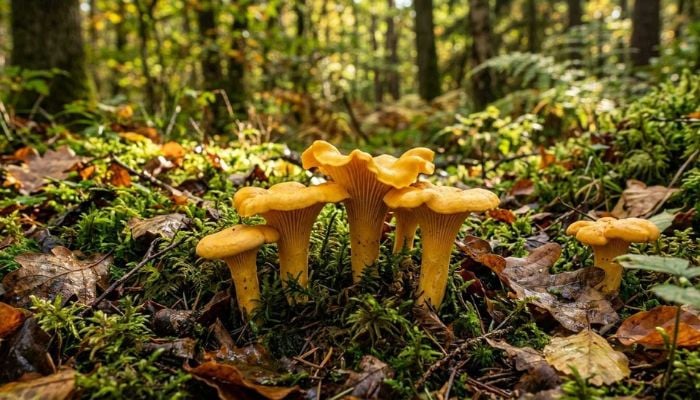
The golden chanterelle mushroom is the wild mushroom that turns beginners into committed foragers. It’s beautiful, delicious, found across most of North America, and, once you know it well, one of the more reliably identifiable edible species in the woods.
However, “once you know it well” is the key phrase. There’s a dangerous lookalike worth taking seriously, and there’s no shortcut to learning the distinguishing features. You simply have to educate yourself and remember what you’ve learned.
This guide covers everything you need to identify chanterelles with confidence, including the defining physical characteristics, the lookalikes you must know, where and when to find them, and how to clean, store, and cook your haul.
What Is a Golden Chanterelle Mushroom?
The golden chanterelle (Cantharellus cibarius and closely related species) is a wild edible mushroom prized worldwide for its fruity aroma, golden color, and rich, slightly peppery flavor.
It’s one of the most commercially harvested wild mushrooms in the world and is often sold at farmers’ markets and high-end restaurants throughout Europe and North America.
Chanterelles are mycorrhizal, meaning they form a symbiotic relationship with the roots of nearby trees.
You won’t find them growing on rotting logs. They come up from the soil and always live near trees, which is one of the first things to confirm when you think you’ve spotted one.
Key Identification Features
No single feature identifies a chanterelle on its own. Use all of the following together:
Color
The cap ranges from pale egg-yolk yellow to deep golden-orange. Some Pacific Northwest species lean more pale or apricot. The color is relatively consistent across the cap, not blotchy or patchy. The stem is typically the same color as the cap or slightly paler.
Cap Shape
Young chanterelles are convex with inrolled margins. As they mature, the cap flattens and then becomes wavy, irregular, and funnel- or vase-shaped. The edges are distinctly wavy or lobed, not clean and smooth.
False Gills (Ridges, Not True Gills)
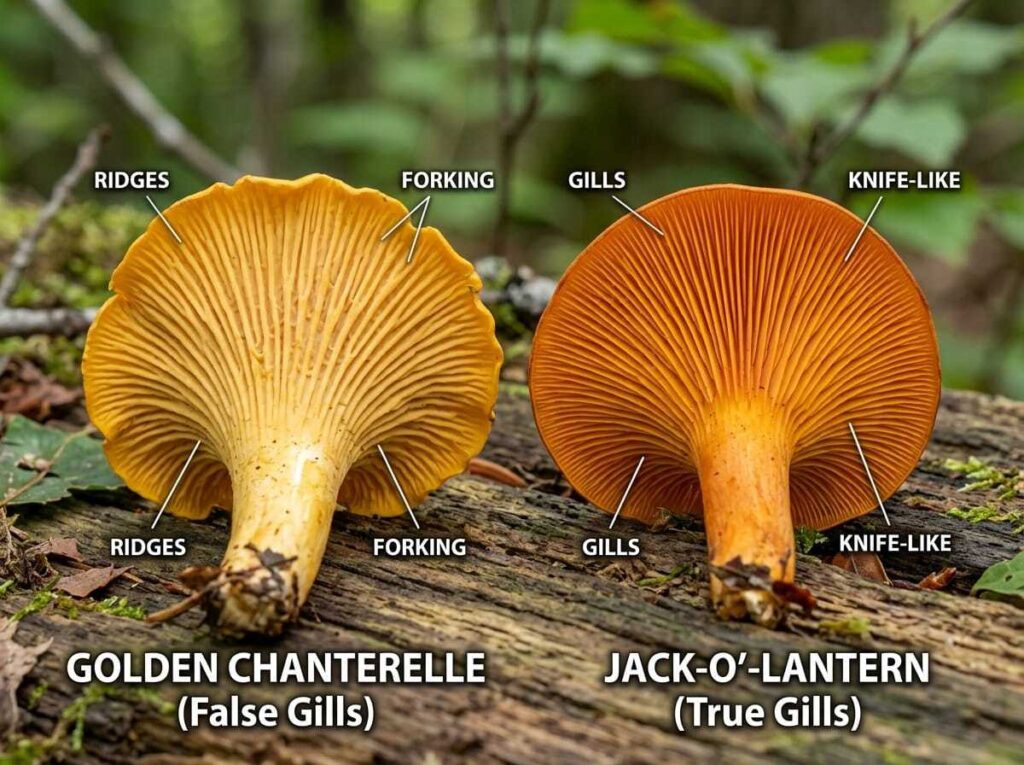
This is the most important identification feature. Flip the chanterelle over. Instead of sharp, blade-like true gills that separate cleanly from the cap like paper, you’ll see blunt, forking ridges that are the same color as the cap.
These ridges run partway down the stem (a feature called “decurrent”). They fork repeatedly as they travel outward from the stem. You cannot easily peel them off. They’re part of the flesh of the cap, not attached structures.
This single feature rules out the most dangerous lookalike, the jack-o’-lantern mushroom, which has true, sharp, crowded gills.
Stem
The stem is solid (not hollow), typically stout and tapered toward the base, and the same golden-yellow color as the cap. There is no ring (annulus) on the stem, i.e., no skirt left from a veil. There is no cup or volva at the base either.
Smell
Fresh chanterelles have a pleasant, faintly fruity aroma often described as apricot or peach. It’s subtle but distinctive. The jack-o’-lantern mushroom, by contrast, has a much sharper, more pungent smell. If the mushroom you’re holding has a strong, unpleasant odor, put it down.
Flesh
Slice the mushroom in half lengthwise. Chanterelle flesh is white to pale yellow, firm, and dense. It does not bruise or change color when cut. There’s no latex (milky fluid) released—that would indicate a milk cap species.
Spore Print
The spore print of a golden chanterelle is white to pale yellow. Take a print if you’re in any doubt.
Chanterelle Lookalikes: What To Watch Out For
Jack-o’-Lantern Mushroom (Omphalotus olearius / O. illudens)
This is the primary dangerous lookalike, and it’s worth studying carefully. Jack-o’-lanterns are toxic. They cause severe gastrointestinal distress, including vomiting and diarrhea that can last for up to 24 hours. They won’t kill you, but they’ll make you wish they had.
Key differences from chanterelles:
- Jack-o’-lanterns grow in dense clusters at the base of trees or from buried roots. Chanterelles grow singly or in scattered groups directly from the soil.
- Jack-o’-lanterns have true, sharp, crowded gills. Chanterelles have blunt, forking ridges.
- Jack-o’-lanterns are a more vivid orange. Chanterelles are golden-yellow to egg-yolk.
- Jack-o’-lanterns glow faintly in the dark (bioluminescent gills). This is a fun confirmation test in a dark room.
- Jack-o’-lanterns smell sharper and more pungent.
If your “chanterelle” is growing in a tight cluster from wood or a buried stump, it is not a chanterelle.
False Chanterelle (Hygrophoropsis aurantiaca)
This mushroom is less dangerous but still worth knowing. The false chanterelle is a deep orange mushroom with true, crowded, forking gills (they fork similarly to chanterelles, which creates the confusion).
Key differences from chanterelles:
- Color is deeper, more saturated orange, almost carrot-orange rather than golden.
- Cap edge is inrolled even in mature specimens.
- True gills (though forking), not ridges; they’re thinner and more blade-like than chanterelle ridges.
- Grows in coniferous woodland and on or near rotting wood, not from soil near hardwoods.
The false chanterelle is considered mildly toxic to some people and should not be eaten.
Smooth Chanterelle (Cantharellus lateritius)
This one is actually edible and closely related. It’s just not the golden chanterelle. The smooth chanterelle has very reduced ridges that are almost absent, giving it a smoother underside.
It’s found primarily in the eastern US. Even though it’s edible, it’s still good to have the skills to identify it separately.
Where To Find Chanterelles
Chanterelles are woodland mushrooms with strong associations with trees. The most reliable habitats include:
- Mixed hardwood and conifer forests, particularly near oak, beech, and Douglas fir.
- Cool, moist woodland with good leaf litter coverage.
- Mossy areas and stream banks in deciduous woods.
- Slopes and hillsides that retain moisture without becoming waterlogged.
In the eastern US, look for chanterelles near oaks and beech trees. In the Pacific Northwest, they’re strongly associated with Douglas fir and hemlock. In the South, they often fruit earlier and are commonly associated with pine and mixed forests.
Once you find a productive patch, return to the same spot year after year. Chanterelles are mycorrhizal, so the mycelium persists in the soil and will fruit in the same areas repeatedly as long as the host tree is healthy.
When To Forage Chanterelles
Chanterelles fruit in summer and fall across most of North America, but timing varies significantly by region:
- Northeast and Midwest: July through October, with peak fruiting in July–August after warm rains.
- Southeast: Can fruit as early as May–June; a second flush often comes in fall.
- Pacific Northwest: Late summer through November; some areas produce into December.
- Rocky Mountain regions: July–September at elevations.
The trigger is warm, wet weather followed by a few days of moderate temperatures. After a good soaking rain in July or August, chanterelles can appear within a few days and persist for a week or more before deteriorating.
How To Harvest Chanterelles
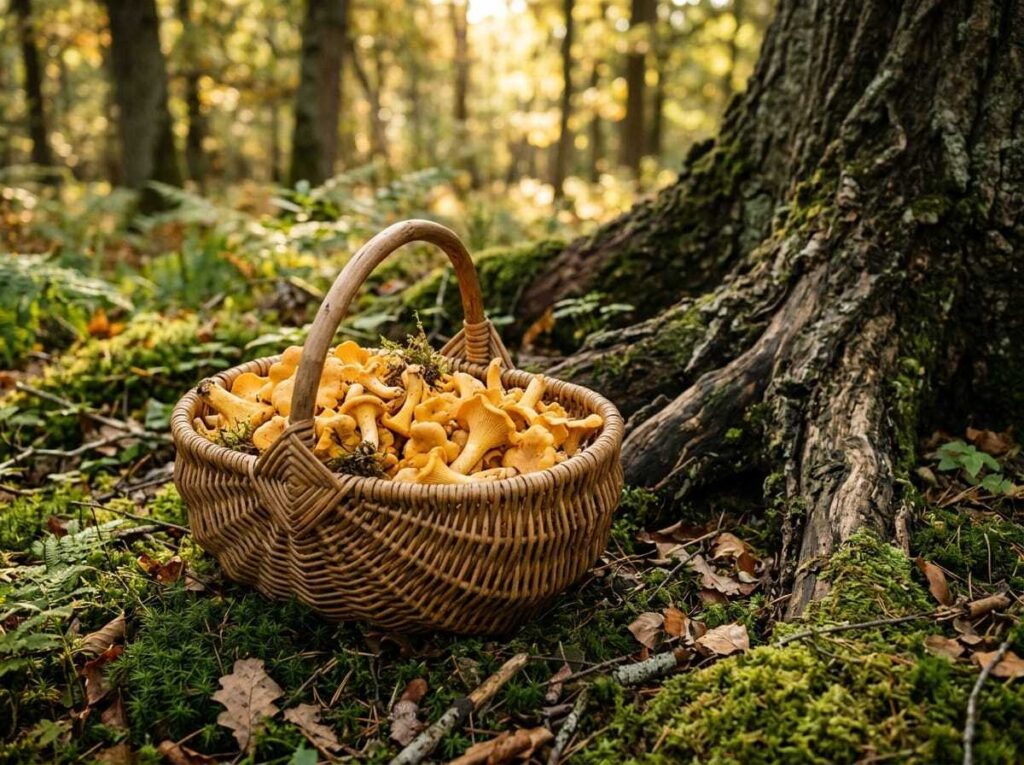
Cut the stem at the base with a clean knife rather than pulling the whole mushroom out. This leaves the mycelium intact and causes less disturbance to the forest floor. Use a wicker or mesh basket; this lets spores disperse as you walk, which helps sustain wild populations.
Only harvest chanterelles that are firm and fresh. Avoid specimens that are soft, waterlogged, or showing signs of insect damage throughout (a few bug marks are fine; a completely riddled mushroom isn’t worth taking).
Bring paper bags or breathable containers to separate different species. Never mix unidentified mushrooms with your confirmed edibles.
Cleaning and Storing Chanterelles
Chanterelles hold up better than most wild mushrooms, but they still need attention after harvest.
- Cleaning: Brush off debris with a soft brush or dry cloth. If they’re very dirty, a quick rinse under cold water is fine—just dry them immediately. Don’t soak them; they absorb water readily and become waterlogged.
- Refrigeration: Fresh chanterelles keep well for up to a week in the refrigerator, stored in a paper bag or loosely wrapped in a cloth (not sealed in plastic, which causes condensation and rot).
- Freezing: Sauté chanterelles in butter first, and then freeze. Raw frozen chanterelles turn mushy. Pre-cooking preserves texture and flavor reasonably well for up to 3 months.
- Drying: Chanterelles don’t dehydrate as well as some other mushrooms; they lose much of their delicate flavor. If you have a large haul, cooking and then freezing is the better preservation method.
Cooking With Chanterelles
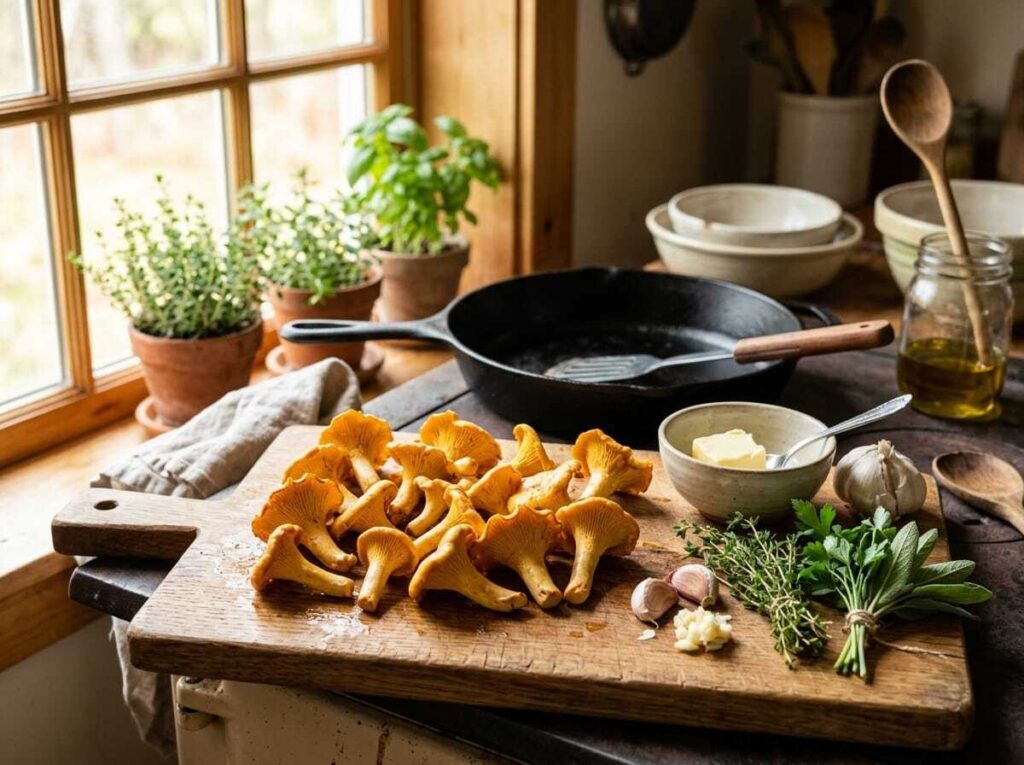
Chanterelles are best treated simply. Their flavor, which is earthy, fruity, and faintly peppery, doesn’t need much help. Try a few of these delicious ideas:
- Sautéed in butter with shallots and fresh thyme: The classic preparation, and for good reason.
- Scrambled eggs or omelets: Chanterelles and eggs are a near-perfect pairing.
- Pasta: Tossed with fresh pasta, cream, and parmesan.
- Risotto: Stirred in at the end to preserve texture.
- On toast: Sautéed chanterelles on grilled sourdough with a squeeze of lemon.
Avoid high heat that will drive out their moisture before they brown. Start with a dry pan over medium heat to cook off water, and then add butter once they’ve released their liquid.
Building Your Chanterelle Knowledge
The best way to get confident with chanterelles is to find a confirmed patch with an experienced forager first. Many local mycological societies run summer forays specifically when chanterelles are fruiting. It’s worth joining one for the field experience alone.
If you’re building your foraging foundation from scratch, start with our Beginner’s Guide to Wild Mushroom Identification for the core principles: how to use spore prints, what identification features matter, and the safety rules that apply to every species you forage.
For other beginner-friendly species, the puffball family is a great next step. Read our breakdown of whether puffball mushrooms are poisonous to understand what to look for before you eat one.
The golden chanterelle rewards patience and careful observation. Learn it well, and you’ll be finding it reliably for the rest of your life.