
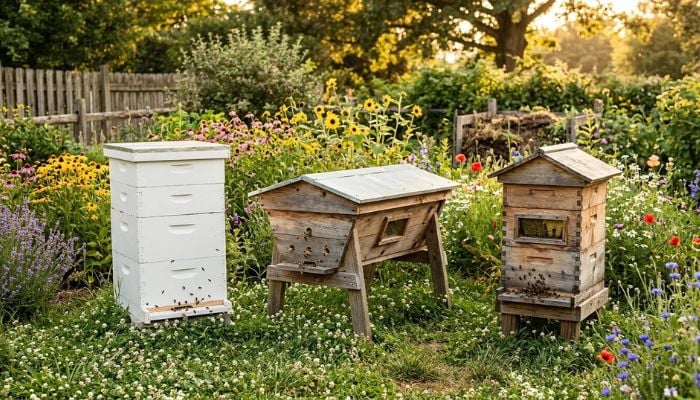
You’ve decided to start beekeeping. Maybe you’ve already got a spot picked out in the backyard, protective gear on your shopping list, and a general sense that bees live in boxes. Now comes the first real purchasing decision: what is the best beehive for beginners?
It sounds simple enough, but spend five minutes in any beekeeping forum, and you’ll quickly find yourself in the middle of strong opinions.
Langstroth advocates point to honey yield and the sheer volume of available resources. Top bar fans love the simplicity and low cost. Warré devotees preach minimal intervention and natural bee behavior. Everyone’s convinced they made the right call.
For a first-year beekeeper, the hive choice carries real weight.
The hive you start with shapes how you learn, who can help you when things go sideways, how much gear you’ll need to buy, and whether your first season is manageable or overwhelming.
This guide cuts through the debate and gives you a clear, honest comparison of all three hive types so you can choose with confidence and get into beekeeping with the right foundation.
If you’re completely new to beekeeping, start with our beekeeping for beginners guide before you spend anything on equipment.
Why Your First Hive Choice Matters
The hive you choose affects far more than just how the bees live.
It shapes what books are useful to you, whether your local beekeeping club can walk you through a hive inspection, whether replacement parts are easy to find, and how difficult your first season is going to feel.
New beekeepers already have a steep learning curve regarding colony behavior, seasonal management, pest identification, and queen health.
A good hive makes that curve manageable. A poor choice for your situation adds friction at exactly the moment you don’t need it.
The right hive helps you build knowledge quickly. The wrong one can leave you isolated from the support systems that make beekeeping survivable in year one.
The Langstroth Hive
How It Works
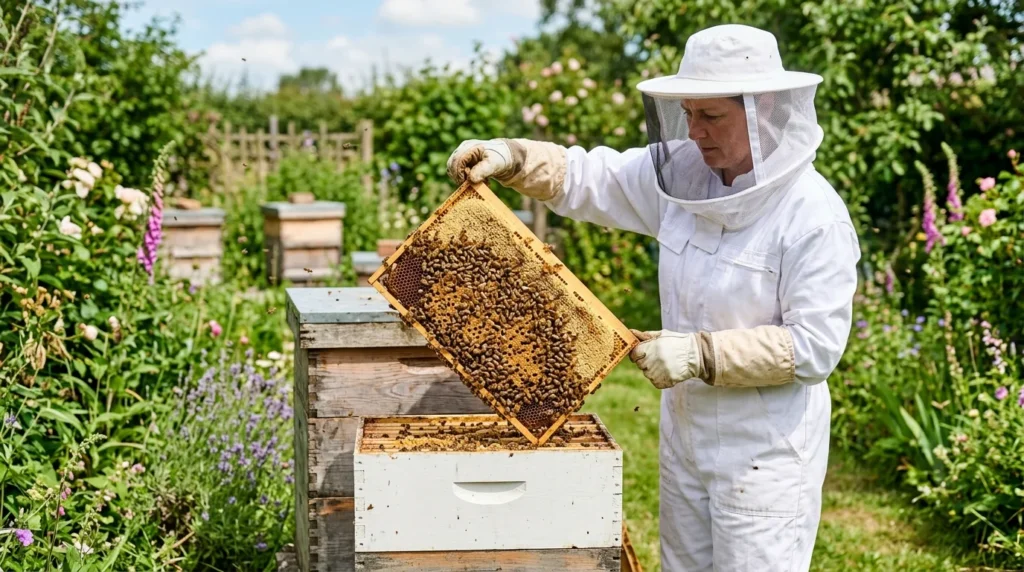
The Langstroth is the standard rectangular box hive that most people picture when they think of beekeeping.
It uses stacked boxes called “supers” filled with removable wooden frames where bees build comb and store honey. The design is built around “bee space,” the precise 3/8-inch gap that prevents bees from sealing everything shut with propolis.
As the colony grows, you add more boxes on top. Inspections happen by pulling out individual frames. Honey is harvested by spinning frames in an extractor.
Rev. Lorenzo Langstroth patented the design in 1852, and it has been the global standard ever since. When most people picture a professional beekeeper working a hive, they’re picturing a Langstroth.
Pros for Beginners
- Unmatched resources and community support: Every major beekeeping book, most YouTube channels, and nearly every local beekeeping association assumes you have a Langstroth. When something goes wrong (and in year one, something always does), help is everywhere.
- Standardized equipment: Boxes, frames, and accessories are interchangeable between brands. If something breaks or wears out, replacements are easy to source locally or online without waiting for specialty orders.
- Highest honey yield: The vertical modular design supports large colony populations, which translates to more honey production than horizontal hive types.
- Works with standard extractors: Any commercial honey extractor is designed for Langstroth frames, making harvest faster, cleaner, and more efficient than crush-and-strain methods.
- Secondhand equipment is plentiful: Because Langstroth is so dominant, used gear turns up frequently in local beekeeping groups and online marketplaces, often at a fraction of new prices.
Cons To Keep in Mind
- Heavy lifting is required: A full honey super can weigh 40 to 60 pounds. For beekeepers with back problems, limited strength, or physical limitations, this is a genuine concern that should factor into your choice.
- More active management: Langstroth hives require regular inspections and proactive swarm management. If you’re hoping for a truly hands-off experience, this hive will push back against that.
- Foundation-based comb: Most Langstroth setups use pre-formed wax or plastic foundation. Some beekeepers prefer this for consistency; others consider it less natural than free-drawn comb.
The Top Bar Hive
How It Works
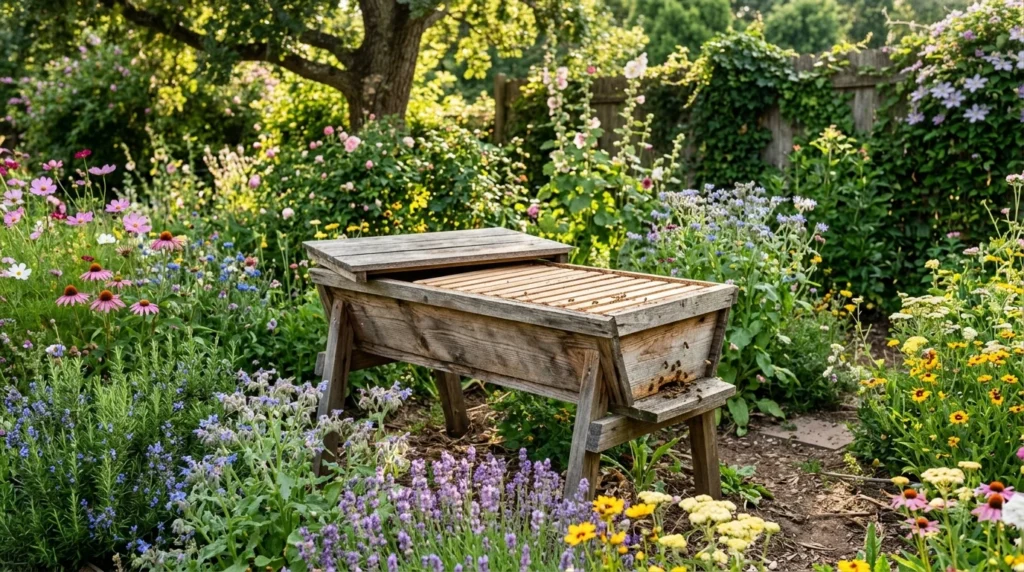
The top bar hive is a horizontal design with a long wooden trough at a fixed height, rather than a stack of boxes that grows vertically.
Bees build comb downward from removable bars laid across the top opening. There are no frames, no foundation, and no heavy boxes to lift or rearrange. You inspect the hive by lifting one bar at a time, straight up.
Top bar hives are especially popular among hobbyists drawn to a simpler, more accessible setup, particularly those who want to observe their bees closely without a lot of equipment in the way.
Pros for Beginners
- No heavy lifting: The hive is worked from a fixed height, one bar at a time. This makes it genuinely accessible for beekeepers who can’t manage the weight demands of a Langstroth.
- Lower entry cost: Top bar hives are simple enough to build yourself from basic lumber. Many beekeepers make their first hive for well under $100 in materials, compared to several hundred for a complete Langstroth setup.
- Natural comb building: Bees draw their own comb freely from each bar without foundation, which many natural beekeeping advocates prefer for colony health and bee autonomy.
- Gentler colony disturbance: Inspections tend to disrupt fewer bees at once compared to a Langstroth inspection, and many beekeepers find the colony calmer to work with.
Cons To Keep in Mind
- Far fewer learning resources: Top bar content exists, but it represents a small fraction of what’s available for Langstroth. Finding a local mentor with meaningful top bar experience is genuinely difficult in most areas.
- Lower honey yield: The fixed horizontal space limits how large the colony can grow, which caps honey production. Top bar beekeeping is best approached with modest honey yield expectations.
- Fragile comb: The top bar comb has no supporting frame structure. It can collapse during inspections, especially in warm weather when wax softens, and recovering from a dropped comb is a messy, stressful experience that takes practice to avoid.
- No standard extractor compatibility: Extracting top-bar honey requires crush-and-strain, which uses more wax and is slower than frame extraction. You won’t be spinning frames.
- Harder swarm management: You can’t easily add space to a top bar hive, which limits your tools for managing swarming behavior when the colony outgrows its space.
The Warré Hive
How It Works
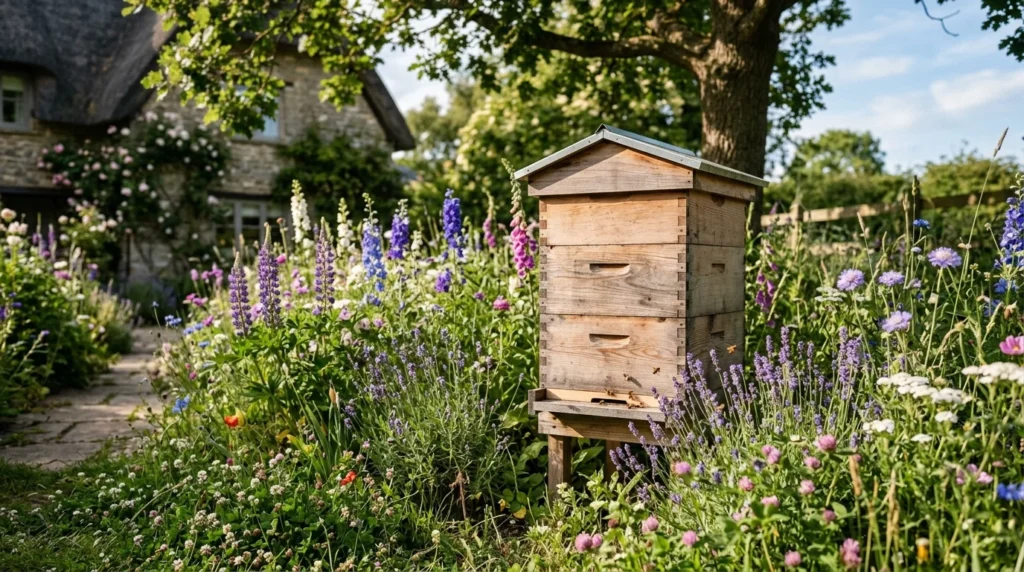
The Warré hive, pronounced “war-AY,” was designed by French beekeeper Abbé Émile Warré in the early 20th century. He called it the “People’s Hive,” and it was designed to be low-cost, low-intervention, and closely modeled on how bees naturally live in hollow trees.
It uses small stacked boxes with top bars (not full frames), and new boxes are added at the bottom of the stack rather than the top, allowing the colony to expand downward just as it would in nature.
The Warré philosophy centers on minimal disturbance. You check on the bees periodically, but you’re not digging through the colony on a regular schedule.
Pros for Beginners
- Low intervention management: If you’re genuinely drawn to observing bees more than managing them, the Warré aligns with that philosophy better than any other common hive type.
- Closer to natural bee behavior: Bees expand downward in tree cavities, and the Warré lets them do exactly that. The smaller box size also more closely mirrors natural hollow tree dimensions than a standard Langstroth deep box.
- Simpler initial setup: Fewer components to purchase and manage out of the gate, which can lower the upfront cost compared to a full Langstroth build.
Cons To Keep in Mind
- Very limited resources: Warré content represents a tiny slice of the overall beekeeping knowledge base. Finding a mentor with real Warré experience is rare, and troubleshooting problems without guidance is harder.
- Difficult to inspect properly: The design discourages frequent, thorough inspections, which means problems, such as disease pressure, queenlessness, and pest infestations, can go undetected far longer than in a Langstroth.
- Bottom-adding requires lifting: When it’s time to add new boxes at the bottom, you have to lift the existing hive structure. Depending on colony size, that can be heavier than it sounds.
- Low honey yield: The Warré is not designed for production beekeeping. Honey is an incidental benefit, not the primary output.
- Harder to learn on: Reduced visibility into colony dynamics makes it genuinely difficult to understand what normal looks like, which is critical foundational knowledge for any first-year beekeeper.
How To Choose: At a Glance
Here’s how the three main hive styles compare across the factors that matter most for a first-year beekeeper:
| Langstroth | Top Bar | Warré | |
| Best for | Most beginners | Limited mobility | Low-intervention hobbyists |
| Community & resources | Excellent | Limited | Very limited |
| Honey yield | High | Low–Medium | Low |
| Heavy lifting | Yes (40–60 lbs) | No | Moderate |
| Entry cost | Moderate | Low | Low–Moderate |
| Inspections | Frequent, easy | Moderate, careful | Infrequent, harder |
| Natural comb | No (foundation) | Yes | Yes |
| Equipment availability | Excellent | Limited | Limited |
Which Hive Is Right for You?
For most beginners, it’s best to start with a Langstroth. Not because it’s perfect (no hive is), but because the ecosystem surrounding it is unmatched.
When your colony throws an unexpected swarm in May, and you’re not sure what you’re looking at, you want to be able to open a book, pull up a YouTube video, or call your local beekeeping association and get real, immediately useful help.
That support system assumes you have a Langstroth. Everything else assumes you’ve already done the homework.
Here’s a simple framework for the decision:
- You want the most resources, community support, and the best path for learning: Start with Langstroth. This is the right call for the majority of first-time beekeepers.
- You have physical limitations that make heavy lifting genuinely risky: A top bar hive is worth serious consideration. Go in knowing you’ll have fewer learning resources to draw from, and plan to supplement with online communities specifically focused on top-bar beekeeping.
- You’re drawn to natural, low-intervention beekeeping: Start with a Langstroth anyway for your first season, build a solid understanding of colony behavior, and consider adding a Warré as a second hive once you know what healthy and unhealthy colonies look like.
Two Hives Beat One
Many experienced beekeepers recommend starting with two hives rather than one.
Having a second colony gives you a live comparison for what’s normal, a source of frames or brood to support a struggling hive, and a built-in backup if one colony doesn’t survive its first winter.
If you’re going with Langstroth, and you should, two medium-box setups are a common and well-regarded starting configuration.
Budget is a real factor in this decision, and two hives obviously cost more than one.
Your Hive Shapes the Whole First Season
The hive itself is just a box. What makes it the right choice, or the wrong one, is the support structure around it.
The Langstroth gives you access to the widest community, the deepest library of resources, and the most flexibility as your skills develop. Start there, build your confidence, and let your experience be your guide as your apiary grows.