
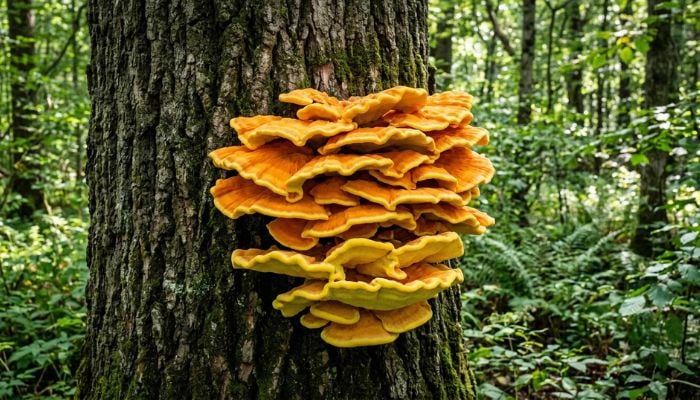
Chicken of the woods is one of the most beginner-friendly wild mushrooms you can find. It’s bright and bold and has no dangerous lookalikes. If you’ve been hesitant to start foraging, this is an excellent first mushroom to learn.
This guide covers everything you need: how to identify chicken of the woods, which trees to look for, when to harvest it, edibility notes (including a rare but real reaction some people have), and simple ways to cook it.
What Is Chicken of the Woods?
Chicken of the woods (Laetiporus sulphureus and related species) is a shelf fungus, a bracket mushroom that grows in overlapping clusters directly on tree bark.
It doesn’t look like a typical gilled mushroom. There’s no stem, no cap in the conventional sense, and no gills underneath. Instead, it fans out in vivid orange and yellow shelves that are almost impossible to miss.
The name comes from its texture and flavor when cooked. The young flesh is tender, meaty, and mildly savory, genuinely similar to chicken, especially when sautéed or roasted. It’s one of the few wild mushrooms that earns its common name honestly.
How To Identify Chicken of the Woods
Color
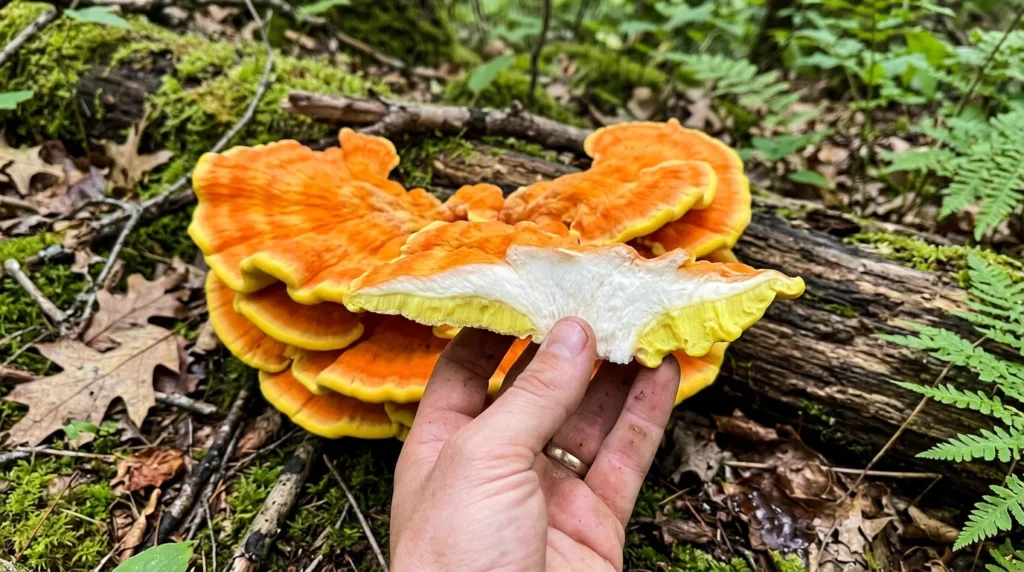
The top surface of the brackets ranges from bright orange to orange-red. The underside and the growing edges are a vivid sulfur yellow to pale yellow. Together, the two-tone coloring of orange above and yellow below is the most immediate identification feature.
From any distance in the woods, a fresh flush of chicken of the woods looks like a traffic cone attached to a tree. You won’t miss it.
Shape and Growth Pattern
The mushroom grows in overlapping, fan-shaped or shelf-shaped clusters. Individual brackets can be anywhere from a few inches to over a foot across. A large cluster can weigh several pounds. The edges are wavy, rounded, and soft when young.
Unlike gilled mushrooms, the underside has a smooth to finely pored surface with tiny, densely packed pores rather than gills. This is an important detail. If you see gills, it’s not chicken of the woods.
Texture
Young, fresh specimens are tender and slightly moist. As the mushroom ages, it becomes tougher, drier, and eventually chalky or crumbly. The edges are always the youngest and most tender part; the portions closest to the tree get tough first.
Smell
Fresh chicken of the woods has a mild, pleasant, faintly mushroomy smell. Nothing rank or unusual.
Which Trees Does It Grow On?
Chicken of the woods grows on dead, dying, or living trees. It’s a wood-rotting fungus that causes brown (cubical) rot in its host. The species you encounter depends on your region and the host tree.
- Oak is the most common host in the eastern US and produces Laetiporus sulphureus, the most widely eaten species.
- Cherry, locust, and other hardwoods also host it regularly. Finds on cherry, walnut, and hickory are common.
- Conifers host a related species, Laetiporus conifericola, in the Pacific Northwest. Some foragers report this conifer form causes more stomach upset than the oak form, so if you’re in the West and your find is on a conifer, exercise extra caution your first time eating it.
- Eucalyptus is a less desirable host. Chicken of the woods on eucalyptus has been linked to more frequent adverse reactions. Avoid it.
The mushroom may grow at the base of a tree, from the trunk itself, or from a buried root, sometimes appearing to grow out of the ground while still attached to a root below the surface.
When To Find It and When It’s Past Its Prime
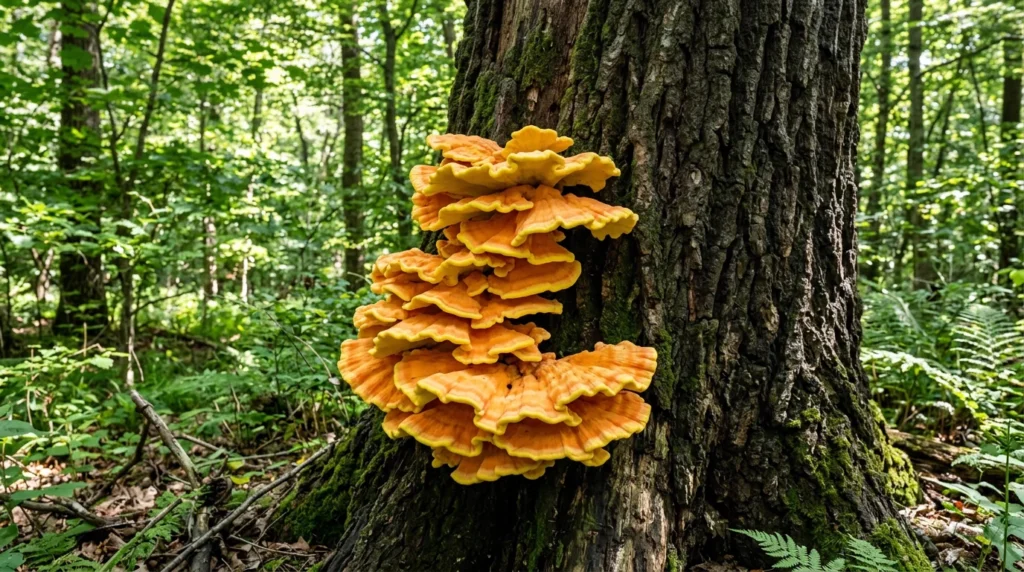
Chicken of the woods fruits primarily in summer and fall. You’ll find it July through November across most of the US, peaking in August and September. In warmer southern regions, you may find it outside this window.
A fresh, edible specimen is:
- Vivid in color (bright orange and yellow)
- Soft and slightly yielding to the touch at the edges
- Free of insect damage at the interior
Pass on a specimen that is:
- Faded, pale, or washed out in color
- Dry, chalky, or crumbly at the edges
- Slimy or visibly decomposing
- Riddled with insect tunnels when you slice it
The color is your best freshness indicator. A bright, waxy-looking cluster is fresh. A dull, bleached specimen is too old. Always harvest the tender outer edges and leave the tough inner portions behind.
Edibility Notes: Is Chicken of the Woods Safe To Eat?
Yes, for most people. Chicken of the woods is widely considered one of the safest edible wild mushrooms, and it’s a common find at farmers’ markets and in specialty grocery stores.
That said, a small percentage of people do experience adverse reactions, even after cooking thoroughly.
Symptoms can include nausea, vomiting, dizziness, or lip swelling. The reaction appears more common when the mushroom was grown on certain tree hosts (particularly conifers or eucalyptus) and when it isn’t cooked all the way through.
Follow these practical rules:
- Always cook it fully: Never eat chicken of the woods raw or undercooked.
- Try a small amount your first time: Even if your foraging companions have eaten it before without issue, individual sensitivities vary.
- Stick to oak-grown specimens for your first few harvests.
- Stop eating it if you feel unwell: The reaction, when it occurs, typically sets in within a few hours.
There are no dangerous lookalikes for chicken of the woods at the beginner level. Nothing toxic closely resembles this bright shelf fungus. That said, always positively confirm every ID feature before eating anything from the wild.
How To Cook Chicken of the Woods

The most important rule is to cook it all the way through. Undercooking is the most common cause of reactions.
Sautéed in Butter or Olive Oil
This is the simplest and most reliable method. Slice the mushroom into strips or chunks, and then sauté in butter or olive oil over medium-high heat until the pieces are golden brown and cooked through, about 8 to 10 minutes.
Season with salt, pepper, and fresh herbs. It works beautifully as a side dish or layered onto toast.
As a Chicken Substitute
The meaty texture makes it genuinely useful as a poultry substitute in many recipes. Slice it thickly and use it in tacos, sandwiches, stir-fries, and pasta dishes. Season generously, as chicken of the woods absorbs flavors well and holds up to bold sauces.
Roasted in the Oven
Toss pieces with olive oil, salt, and garlic, and then roast at 400°F for 20–25 minutes, flipping once halfway through. The edges get crispy while the interior stays tender. This method works well when you have a large batch.
In Soups and Stews
Add it to mushroom soup, chicken soup (the texture really works here), or hearty stews. It holds its shape during cooking, unlike many delicate mushrooms that dissolve into broth.
Storage Tips for Chicken of the Woods
Fresh chicken of the woods keeps in the refrigerator for 3–5 days. You can also slice, sauté, and freeze it for later use. Raw frozen chicken of the woods tends to get watery once thawed; cooking it first gives much better results.
Where To Learn More
Chicken of the woods is a great entry point into foraging, but it’s one piece of a much larger picture. If you want to keep building your mushroom ID skills, these resources will help:
- Our Beginner’s Guide to Wild Mushroom Identification covers the core principles every new forager needs: how to use spore prints, which features actually matter for ID, and how to approach a mystery mushroom safely.
- If you’ve spotted something on your trees and you’re not sure what it is, What’s Growing on My Tree? breaks down the most common shelf and bracket fungi you’ll encounter in the backyard and beyond.
- For another beginner-friendly species with a serious flavor payoff, read up on finding turkey tail mushrooms, another common find on dead hardwood that’s as easy to identify as chicken of the woods.