
If you garden long enough, something will eventually start chewing holes in your leaves. With a little research, you’ll likely stumble across diatomaceous earth, but it sounds almost too easy: dust a little white powder, wait, and let the bugs dry out.
There is some truth to that, but diatomaceous earth works best when you understand what it can and cannot do.
Using food-grade diatomaceous earth for garden pests can be useful against certain crawling, soft-bodied, or thin-skinned pests, especially when conditions are dry. It’s not a cure-all, and it’s not harmless just because it’s natural.
Used carefully, it can protect seedlings and vulnerable plants. Used carelessly, it can irritate your lungs, waste your time after rain, and harm the beneficial insects you actually want in your garden.
Here is how to use it well, when to leave it on the shelf, and how to fit it into a smarter pest-control plan.
What Diatomaceous Earth Is
Diatomaceous earth, often shortened to DE, is a fine powder made from the fossilized remains of tiny aquatic organisms called diatoms.
These diatoms had silica-based shells, and over time their remains formed soft sedimentary deposits that can be mined, ground, and sold as a powder.
For garden use, the important thing to know is that DE is not a chemical poison. It does not work by being eaten like bait, and it does not move through the plant like a systemic insecticide.
It works physically. Under a microscope, the particles have sharp, abrasive edges that can scratch the waxy outer coating of certain insects. Once that protective layer is damaged, the insect loses moisture and dries out.
That physical action is why DE is popular with gardeners who want a lower-residue pest option. It’s also why application matters so much.
If the powder is wet, clumped, blown away, or placed where pests never crawl through it, it won’t do much good at all.
Food-Grade vs. Pool-Grade Diatomaceous Earth
Only use food-grade diatomaceous earth in the garden. Food-grade DE is the type commonly sold for garden, livestock, and household pest uses. It’s still dusty and should be handled carefully, but it’s the appropriate form for plants and soil.
Pool-grade diatomaceous earth is different. It has been heat-treated for filtration use, which changes the silica structure and makes it much more hazardous to breathe.
It’s not meant for garden pest control, and it shouldn’t be dusted on plants, used around vegetables, or handled like a garden amendment.
A simple rule helps: if the bag is sold for pool filters, don’t use it in the garden. Look for food-grade DE labeled for pest-control or garden use, and follow the product label.
How Diatomaceous Earth for Garden Pests Works
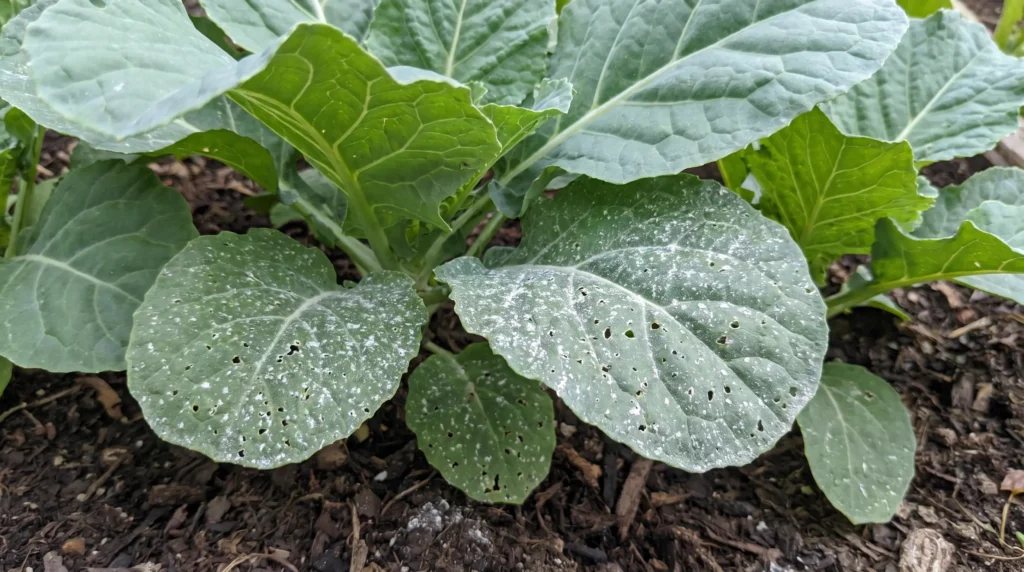
Diatomaceous earth works only when pests come into direct contact with the dry powder. That makes it most useful for insects that crawl across soil, stems, lower leaves, or protected plant surfaces.
Our guide on garden pest identification can help you determine exactly which pests are plaguing your plants.
Diatomaceous earth may help with:
- Ants moving through raised beds or compost areas.
- Earwigs hiding around seedlings and mulch.
- Flea beetles on young brassicas and eggplants.
- Slugs and snails in dry weather, though results are inconsistent.
- Crawling beetle larvae and some soft-bodied insects.
- Cutworms moving around the base of tender transplants.
It’s less reliable for pests that fly in, feed briefly, and leave. It also does not solve infestations hidden inside leaves, fruit, stems, or soil.
For example, leafminers, squash vine borers, and many grubs are protected from surface dust most of the time.
Think of DE as a contact barrier, not a full pest-control program. It’s best for slowing down pest pressure while you also improve plant health, remove pests by hand, use row covers, encourage beneficial insects, and rotate crops.
How To Apply Diatomaceous Earth in the Garden
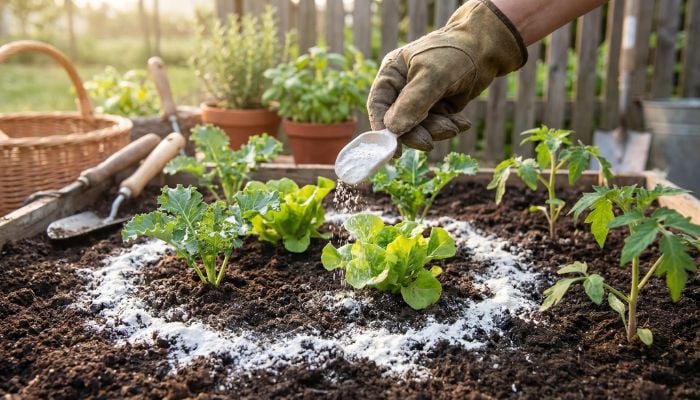
The goal is a light, targeted dusting, not a thick white blanket. More powder doesn’t make DE work better. A heavy layer can cake, blow around, or create unnecessary dust exposure.
Use this basic method:
- Wait for a dry day. Apply DE when leaves, soil, and mulch are dry. Morning dew, irrigation, and rain all reduce its effectiveness.
- Wear a dust mask and gloves. Even food-grade DE can irritate your lungs, eyes, and skin. Avoid breathing the powder.
- Dust lightly around plant bases. Create a thin ring around seedlings, transplants, or the base of plants where crawling pests are active.
- Apply to lower leaves only when needed. If pests are feeding on leaves, use a light dusting on affected foliage, especially the undersides where insects hide.
- Avoid flowers. Do not dust blooms or flowering herbs. Bees, hoverflies, butterflies, and other beneficial insects may contact the powder there.
- Reapply after rain or overhead watering. Once DE gets wet, it loses much of its abrasive action until it dries, and rain can wash it away completely.
A small hand duster, flour sifter, or shaker container can help you apply a fine, even layer. If you can see a soft dusting on the soil surface, that’s usually enough.
When Diatomaceous Earth Works Best
DE works best in dry, protected situations where pests must crawl through it repeatedly. Around the base of cabbage seedlings, along the edge of a raised bed, or near a known trail of ants, it can be a useful short-term barrier.
It’s also helpful when you catch pest pressure early. A few flea beetles on young eggplant leaves are easier to slow down than a full outbreak spread across the whole garden.
The same goes for cutworms around fresh transplants. A narrow ring of DE around new seedlings can buy time while the plants get established.
For best results, pair DE with observation. Look under leaves, check plants in the evening, and note where damage is actually happening. Dusting every plant in the garden because one leaf has holes is usually overkill.
When Not To Use Diatomaceous Earth
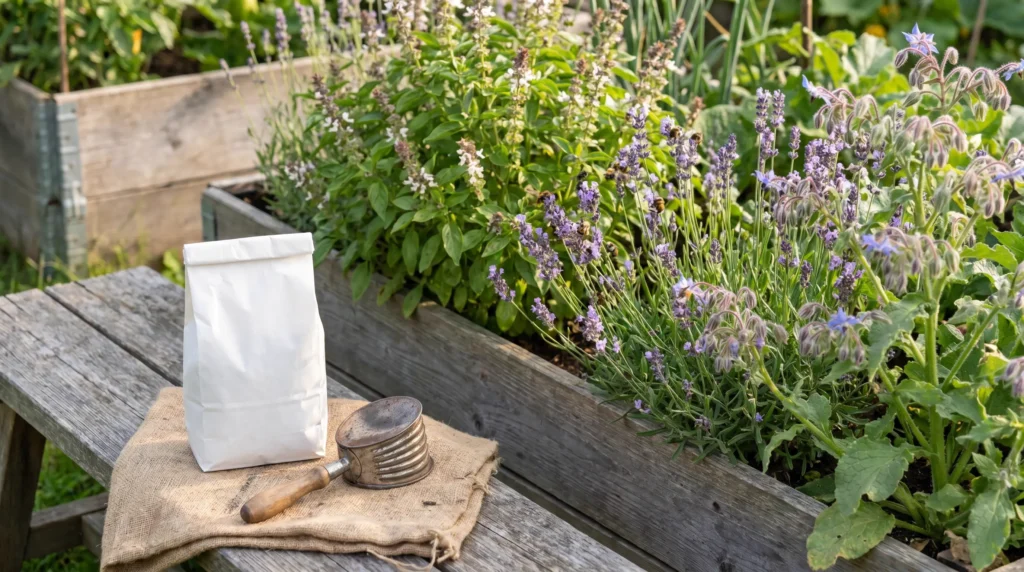
The biggest mistake with DE is treating it like a harmless all-purpose dust. It is natural, but it’s still an insect-killing powder, and it doesn’t know the difference between pests and beneficial insects.
Avoid using DE when:
- Plants are flowering or covered in pollinator activity.
- Bees, butterflies, lady beetles, lacewings, or hoverflies are actively visiting the area.
- Leaves are wet from dew, rain, or irrigation.
- Wind will blow the powder into your face or onto nearby flowers.
- The pest is hidden inside plant tissue or underground, where DE cannot reach it.
- You are trying to treat a fungal disease or nutrient problem.
If your main issue is a plant disease, DE is the wrong tool. For fungal problems, gardeners should compare options such as copper fungicide or sulfur powder, but those are different products for different problems.
DE is for direct-contact insect pest control, not mildew, blight, rust, or soil deficiencies.
How To Protect Bees and Beneficial Insects
The safest way to use DE is to apply it narrowly and keep it away from flowers. Dust the soil around the base of affected plants rather than the whole bed.
If you must dust leaves, avoid blooms entirely and apply in the evening when pollinators are less active.
You can also try using physical barriers first. Row covers, collars around seedlings, hand-picking, pruning badly infested leaves, and trap crops often reduce the need for dusts.
These methods are especially useful in vegetable gardens where you want a lively population of predators and pollinators.
Remember that beneficial insects are part of pest control too. Lady beetle larvae, lacewing larvae, parasitic wasps, ground beetles, spiders, and hoverfly larvae all help keep pest populations in check.
If you dust everything, you may remove some of the helpers along with the pests.
Safety Tips for Gardeners
Food-grade DE is widely used, but the dust still deserves respect. The biggest concern for gardeners is breathing it in during application. Fine particles can irritate the nose, throat, and lungs, especially if you are applying DE often or in a breeze.
Use these precautions:
- Wear a dust mask or respirator when applying it.
- Keep children and pets away during dusting.
- Avoid applying it on windy days.
- Store the bag in a dry place with the label intact.
- Wash your hands after handling it.
- Follow the product label for crops, rates, and restrictions.
Do not mix up food-grade and pool-grade products. If you’re not sure which one you have, don’t use it on plants.
What To Use Instead When DE Is Not the Right Fit
If DE is not a good match for the pest or conditions, choose a more targeted method.
- For flying pests on tender crops, lightweight row covers may prevent damage before it starts.
- For aphids, a firm spray of water, pruning, and beneficial insects may be enough.
- For caterpillars, hand-picking or a product labeled for caterpillar control may work better than dusting the soil.
Neem oil can be useful in some pest situations, but it also needs careful timing and label-following to avoid harming pollinators or stressing plants. The same is true for any garden input. Organic does not automatically mean risk-free.
If you’re dealing with disease rather than insects, look at disease-specific options instead. Copper fungicide and sulfur powder are used for certain fungal issues, but they should be chosen based on the disease, plant, weather, and label directions.
A Smarter Way To Use Diatomaceous Earth
Diatomaceous earth is most useful when you treat it like a precise tool instead of a garden cure-all.
Use food-grade DE only, keep applications light and targeted, apply it in dry weather, and reapply only when needed. Avoid flowers, protect pollinators, and don’t waste it on pests that will never crawl through the powder.
The best pest control usually comes from layering small habits: healthy soil, strong plants, regular scouting, physical barriers, hand removal, and selective treatments when a problem actually appears.
DE can be part of that system, but it shouldn’t replace careful observation. In a balanced garden, the goal is not to kill every insect. The goal is to keep pest damage low enough that your plants can keep growing strong.