
One of the most common questions new flock keepers ask is, “What exactly do chickens eat?” The short answer is a lot. Chickens are omnivores and enthusiastic ones at that.
The longer answer is that while chickens will eat almost anything you offer them, not everything is good for them, and their diet does significantly affect egg production, feather quality, and overall health.
So, what to feed backyard chickens? This guide breaks down everything your backyard flock needs, including the right base feed, what treats are safe, what to keep out of the coop, and how to adjust feeding through the seasons.
The Foundation: Complete Layer Feed
The cornerstone of any backyard flock’s diet is a complete layer feed. This is a commercially formulated ration designed to provide everything a laying hen needs, including protein, carbohydrates, fats, vitamins, and minerals, in the right proportions.
What to look for in a layer feed:
- 16–18% protein. Protein is the building block of eggs. Too little and production drops; too much is wasteful and can stress the kidneys.
- Balanced calcium. Layer feeds include calcium for shell production, though most flock keepers also offer supplemental oyster shell free-choice (more on that below).
- Complete vitamins and minerals. A quality layer feed should be labeled “complete,” meaning it’s formulated to be the primary diet without needing additional supplementation under normal conditions.
Layer feed comes in three physical forms: pellets, crumbles, and mash. Pellets and crumbles are the most popular for backyard flocks, as they produce less waste than mash and are easier for hens to eat cleanly.
Pellets work well for standard and large breeds; crumbles are a better option for smaller birds or bantams.
When To Switch to Layer Feed
Move your birds off chick starter (or grower feed) and onto layer feed at around 16–18 weeks of age, right around when they approach laying age.
Chick starter is high in protein but too high in it for laying hens long-term, and it lacks the calcium balance laying hens need. Don’t switch earlier than 16 weeks; calcium in layer feed can be hard on young kidneys.
Scratch Grains: A Treat, Not a Meal
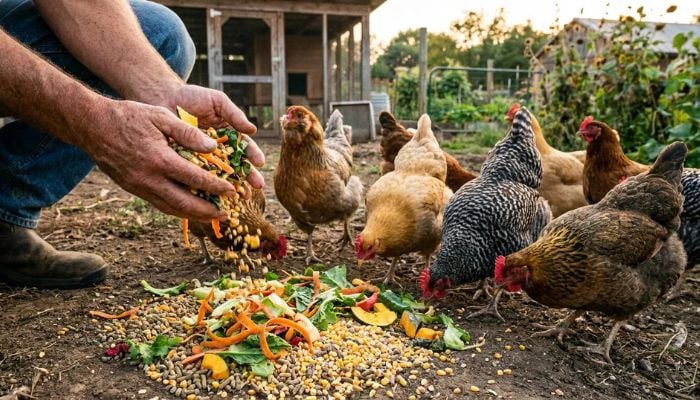
Scratch grains, which are a mix of cracked corn, wheat, barley, milo, and other whole grains, are a beloved chicken treat. Hens go absolutely wild for scratch.
But scratch is to chickens what candy is to people: they love it, they’ll fill up on it given the chance, and it will absolutely ruin their diet if you let it.
The problem with scratch as a main diet component is that it’s high in carbohydrates and low in protein.
Hens filling up on scratch eat less complete feed, which means less protein, fewer nutrients, and lower egg production. Scratch-heavy diets can also lead to obesity in confined birds.
The right way to use scratch:
- Offer it as a treat, not a main feed. No more than 10% of daily intake.
- Use it in the late afternoon, when it acts as a “hot water bottle.” The digestion process generates body heat overnight.
- Scatter it in the run or yard to encourage foraging behavior.
- Skip it or reduce it in hot weather when hens need less internal heat generation.
Scratch is also useful for training your flock and encouraging them into the coop at night. A handful at dusk gets chickens moving in the right direction fast.
Kitchen Scraps: What’s Safe and What’s Not
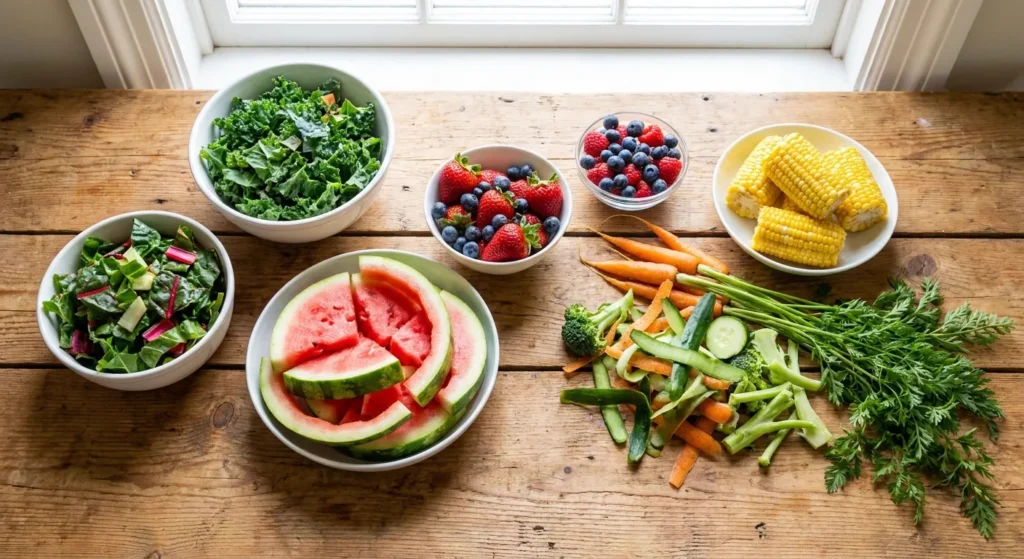
One of the great joys of keeping backyard chickens is turning kitchen waste into eggs. Chickens are enthusiastic recyclers and will happily process most fruit and vegetable trimmings, bread heels, cooked grains, and leftover produce.
But some kitchen foods are genuinely toxic to chickens, and knowing the line between safe and dangerous scraps is important.
Safe Kitchen Scraps
- Vegetables: Leafy greens, broccoli, cabbage, carrots, squash, peas, cucumber, corn (cooked or raw), and green beans.
- Fruits: Berries, apple slices (no seeds; apple seeds contain cyanide compounds), melon, grapes, and watermelon (an excellent hot-weather treat).
- Cooked grains: Cooked rice, oatmeal, and pasta (plain, no sauce).
- Cooked legumes: Cooked beans and lentils (raw dried beans are toxic; always cook them first).
- Bread and baked goods: In small amounts. These are high in simple carbs, so treat sparingly.
- Cooked eggs: Scrambled or hard-boiled (a good protein boost during molt). Don’t worry about teaching them to eat eggs if the eggs are cooked and look nothing like what’s in the nest box.
- Cooked meat and fish: In small amounts as a protein supplement.
Foods To Avoid
- Avocado: Toxic, particularly the skin and pit; can cause respiratory distress and death.
- Onions and garlic: Can cause hemolytic anemia with regular consumption; small amounts are low risk but are best avoided.
- Raw dried beans: Contain phytohaemagglutinin, which is toxic to chickens; always cook beans before offering.
- Chocolate: Contains theobromine, toxic to many animals, including chickens.
- Rhubarb: The leaves, especially, are toxic; the stalks are risky too.
- Citrus. Not toxic in small amounts but can interfere with calcium absorption; most chickens don’t like it anyway.
- Salty or heavily processed foods: Chips, deli meat, and fast food scraps; excessive salt is harmful.
- Moldy or spoiled food: Mold produces mycotoxins that are harmful to chickens; if you wouldn’t eat it, don’t feed it.
A useful rule of thumb: If it’s a whole food and you’d eat it, it’s usually fine. If it’s heavily processed, salty, spicy, or spoiled, skip it.
Grit: The Digestive Non-Negotiable
Chickens don’t have teeth. They grind their food in a muscular organ called the gizzard, which needs small, hard particles, aka grit, to work effectively.
Hens that free-range on dirt or pasture naturally pick up grit as they scratch and forage. Confined birds in coops or runs with solid floors don’t have that access, and without grit, they can’t properly digest whole foods and fibrous scraps.
There are two types of grit:
- Insoluble grit (granite grit or flint grit) is the kind that stays in the gizzard and does the actual grinding. This is what’s typically sold as “poultry grit” or “chick grit” at feed stores.
- Soluble grit (oyster shell) dissolves in the digestive system and is used for calcium, not for grinding. Don’t substitute one for the other.
If your birds are on a complete layer feed and have no access to soil or outdoor foraging, offer insoluble grit free-choice in a small dish alongside their feed. They’ll take what they need.
Oyster Shell: Calcium for Strong Shells
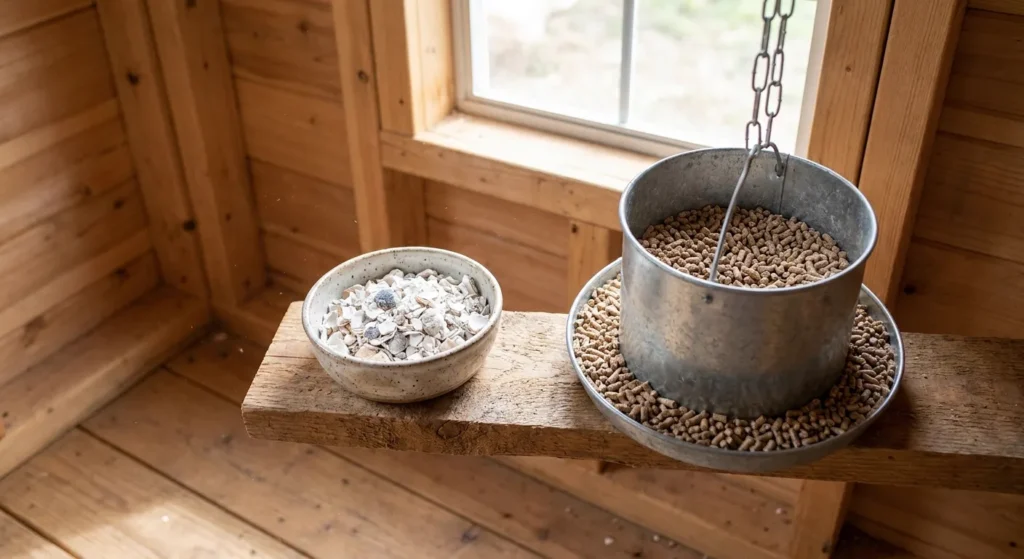
Even though layer feeds contain calcium, many flock keepers find that offering oyster shell free-choice in a separate dish improves shell quality, particularly for high-production hens whose calcium demand is higher than the base feed provides.
Signs your hens need more calcium:
- Thin-shelled or shell-less eggs
- Soft or pliable shells
- Hens eating their own eggs (sometimes a calcium response)
Oyster shell is inexpensive and widely available at feed stores. Keep a small dish in the coop or run and refill it every week or two. Hens will self-regulate; they take what they need and ignore it when they don’t need it.
Don’t add oyster shell to feed directly: It throws off the calcium balance for the whole flock, and cockerels or non-laying hens don’t need the extra calcium.
Water: The Most Important “Feed” of All
Egg production is roughly 74% water. A hen who runs out of water, even for a few hours, will drop production, and a prolonged water shortage can halt laying for days or weeks.
Fresh, clean water available at all times is non-negotiable. Key considerations:
- Use nipple waterers or clean rubber tubs. Stagnant water in open containers gets dirty fast.
- Clean and refill daily in warm weather; check for freezing in winter.
- Place waterers in shade in summer to keep water cooler longer.
- Electrolyte supplements in hot weather help hens stay hydrated and maintain production through heat stress.
Some flock keepers add a splash of apple cider vinegar (raw, with the mother) to water on a regular basis as a general health tonic. The evidence is mixed, but it’s generally harmless in small amounts.
Seasonal Feeding Adjustments
Chickens’ nutritional needs shift with the seasons, and a good feeding program accounts for that.
Spring and summer:
- Increase access to fresh greens and fruit as produce becomes available.
- Reduce or eliminate afternoon scratch to avoid heat generation during already-hot days.
- Monitor water intake closely; hens need significantly more in the heat.
- Fermented feed (layer pellets soaked in water until slightly fermented) is popular in summer for improved gut health and palatability in heat.
Fall:
- As hens begin to molt, temporarily increase protein. Feathers are almost entirely protein, and the molt is metabolically demanding. Switch to a higher-protein feed (18–20% protein flock raiser or grower) during active molt, and then switch back to layer feed when molt is complete.
- Increase scratch amounts slightly in the late afternoon as temperatures drop.
Winter:
- Offer scratch in the afternoon to generate body heat overnight.
- Ensure water doesn’t freeze. Use heated waterers or check multiple times a day.
- Supplement with high-energy treats such as sunflower seeds and mealworms to help hens maintain weight in cold conditions.
- If you’re supplementing light to maintain production, make sure nutrition supports it; hens laying through winter need adequate feed.
How Much Should You Feed Your Chickens?
Standard-size laying hens eat approximately 1/4 pound (about 120 grams) of feed per day under normal conditions. For a flock of four, that’s about 1 pound of feed per day, or roughly 7 pounds per week.
Most flock keepers use a free-choice feeding approach that typically involves a hanging feeder or trough that’s kept full and refilled as needed. Hens self-regulate well and rarely overeat on complete feed.
The main exception is when scratch grains or high-calorie treats are offered in excess; those can lead to overeating relative to nutritional needs.
Feeder positioning matters:
- Hang or elevate feeders so the trough is at approximately back height for your birds; this reduces scratching and waste.
- Keep feeders dry. Wet feed molds quickly.
- At night, bringing feeders indoors or using rodent-proof feeders keeps the coop from attracting mice and rats.
Strategic Feeding for Success
Feeding backyard chickens well doesn’t require a complicated system; it requires getting a few fundamentals right and keeping them consistent.
A tried-and-true system is complete layer feed as the base, scratch and scraps as the extras, grit and oyster shell available free-choice, and fresh water always topped up.
Get those basics in place, and your flock will reward you with consistent eggs, healthy feathers, and birds that stay productive for years.
If you’re still setting up your flock, our guides on the best chicken breeds for beginners and when chickens start laying eggs cover the other major decisions that shape your first season.
And if you’re building your setup from scratch, our guide on how to build a coop walks through everything from supplies needed to predator-proofing in one place.