
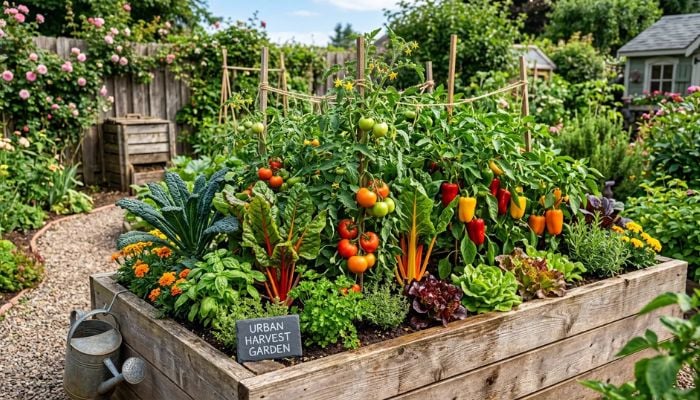
Raised beds give you more control over your soil, better drainage, and an earlier start to the season than in-ground growing, but not every vegetable is equally happy in them.
Some crops thrive in the confined, well-amended space of a raised bed. Others need more room or deeper soil than a standard bed provides.
This guide breaks down the best vegetables to grow in raised beds season by season, covers the space-efficient techniques that make a small footprint productive, and tells you what to skip so you don’t waste a growing season on the wrong crops.
Why Raised Beds Work So Well for Vegetables
Before getting into specific crops, it helps to understand why raised beds produce so reliably.
- You control the soil completely. Raised beds are filled with a custom mix (not whatever compacted, rocky, or clay-heavy soil you’re starting with), which means better drainage, better aeration, and better fertility from day one.
- They warm up faster in spring. The soil in a raised bed is surrounded by air on all sides, so it thaws and warms earlier than in-ground beds, often giving you 2–4 extra weeks of growing time depending on your climate.
- Weeds are easier to manage. Starting with weed-free fill and staying on top of it is much simpler than fighting established weed populations in an in-ground bed.
- Pests and drainage are easier to control. Raised beds drain well by default, which means fewer fungal problems, and adding row covers, netting, or hardware cloth underneath is straightforward.
Cool-Season Vegetables for Raised Beds
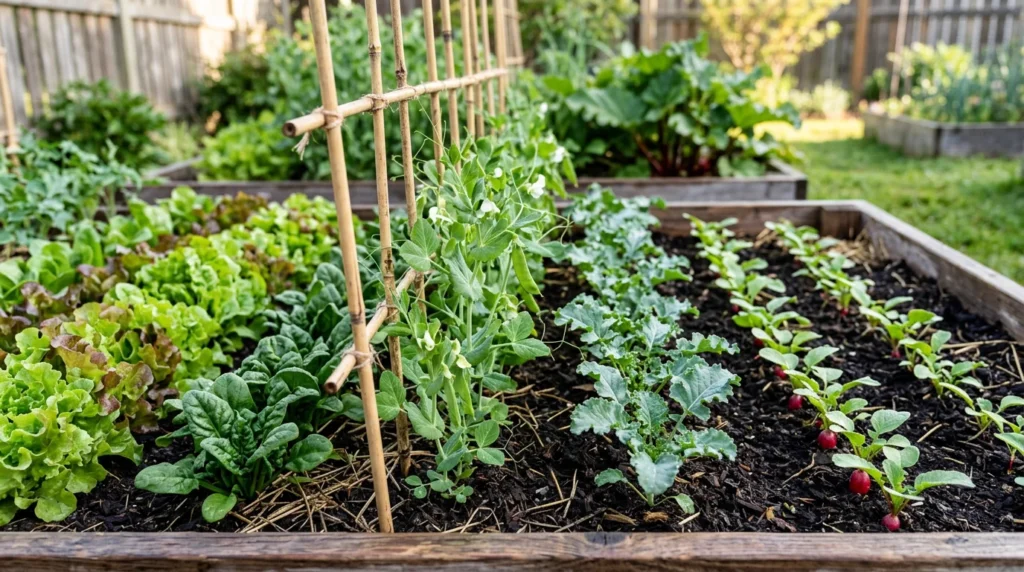
Cool-season crops are the workhorses of spring and fall raised bed gardening. They grow best when daytime temperatures are in the 45–70°F range and can handle a light frost—some even improve in flavor after one.
Lettuce
Lettuce is one of the most productive raised bed crops per square foot. It germinates quickly, grows fast, and can be harvested as a cut-and-come-again for weeks before it bolts. Loose-leaf varieties are the most forgiving; head lettuces take a bit more time and space.
- Spacing: Plant leaf lettuce 6 inches apart; plant head lettuce 10–12 inches apart. You can sow seeds thickly and thin to the final spacing, eating the thinnings as baby greens.
- Season: Direct sow 4–6 weeks before your last frost date in spring and again 6–8 weeks before your first frost date in fall.
Spinach
Spinach is cold-tolerant (down to about 20°F for established plants) and among the fastest cool-season crops to maturity, with most varieties ready in 40–50 days. Like lettuce, it can be harvested repeatedly by cutting outer leaves.
Bolting is the main challenge. Once temperatures consistently hit 75°F, spinach will bolt and turn bitter. Plant it early and harvest before summer heat arrives.
- Spacing: 4–6 inches apart. Square foot gardening allows up to 9 plants per square foot for baby spinach.
Peas
Sugar snap peas and snow peas are a natural fit for raised beds, but they need vertical support such as a trellis or bamboo stakes set along the back or center of the bed. Most varieties reach 4–6 feet tall.
Peas fix nitrogen in the soil as they grow, which is a bonus for whatever you plant after them.
- Spacing: 2–3 inches apart in a double row alongside a trellis.
- Season: Sow directly outdoors 4–6 weeks before the last frost. Peas don’t like transplanting.
Carrots
Carrots need loose, deep soil to develop properly, so a raised bed filled with a well-amended mix is close to ideal, especially if your native soil is heavy or rocky.
Use a bed that’s at least 12 inches deep for full-sized varieties; shorter “Chantenay” or “Danvers” types work in shallower beds.
- Spacing: 3–4 inches apart in all directions (thin after germination).
- Season: Direct sow 3–4 weeks before the last frost. Carrots left in the ground after a frost often get sweeter.
Other Strong Cool-Season Picks
- Radishes: Fastest crop in the garden (25–30 days). Great for filling gaps between slower crops.
- Kale: Cold-hardy and productive over a long season; flavor improves after frost.
- Swiss chard: Handles both cool and warm weather better than most greens; one of the most adaptable raised bed crops.
- Arugula: Fast-growing, spicy, and excellent for cut-and-come-again harvests.
- Beets: Grow both the root and the greens; don’t need much depth for standard varieties.
Warm-Season Vegetables for Raised Beds
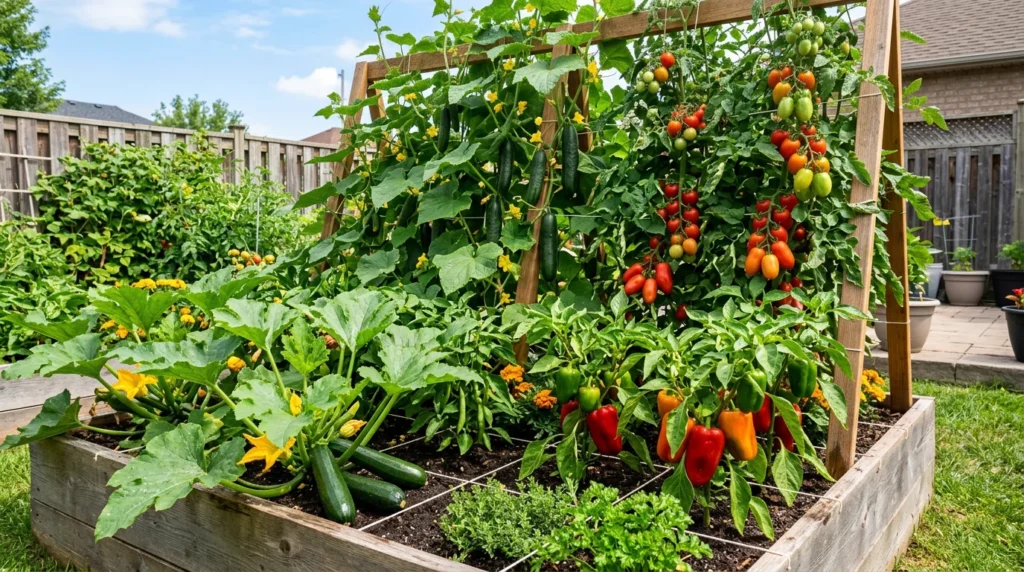
Once nighttime temperatures stay consistently above 50°F, it’s time to transition to warm-season crops. These are the heavy producers that most people think of when they imagine a summer vegetable garden.
Tomatoes
Tomatoes are the most popular raised bed vegetable, and for good reason; they love the warm, well-drained conditions a raised bed provides.
Choose determinate varieties (which grow to a fixed size and ripen all at once) for compact beds, or stake and cage indeterminate varieties that keep growing all season.
- Spacing: 18–24 inches for determinates; 24–36 inches for indeterminates. One square foot gardening technique puts one tomato plant per 4-square-foot section.
- Depth: Tomatoes benefit from deep planting. Bury the stem up to the lowest leaves, and they’ll root along the buried stem. Use a bed that’s at least 12 inches deep.
Peppers
Peppers (both sweet and hot) thrive in raised beds. They’re compact, productive, and love the warmth that a raised bed retains. They’re also slower to mature than most warm-season crops. Most varieties need 70–90 days from transplant.
- Spacing: 12–18 inches apart.
Bush Beans
Bush beans are one of the most space-efficient warm-season crops you can grow. They need no support, mature quickly (50–60 days from seed), and produce over a 2–3 week window before the plant is done.
Succession planting (sowing a new batch every 2–3 weeks) keeps the harvest going through summer.
- Spacing: 4–6 inches apart. Don’t thin too aggressively; beans can be grown densely.
Summer Squash and Zucchini
Zucchini is productive to a fault. One or two plants will produce more than most families can eat. The plants are large (3–4 feet across), so they need space.
A single zucchini plant per 4-square-foot section is about right in a raised bed, and plan for it to sprawl beyond its allocated space.
Cucumbers
Cucumbers do well in raised beds if you give them a trellis to climb. Vertical growing saves surface area and improves air circulation, reducing disease pressure. Bush cucumber varieties work well if you prefer them to stay compact.
- Spacing: 12 inches apart on a vertical trellis.
Other Strong Warm-Season Picks
- Basil: Pairs perfectly with tomatoes and grows well tucked into any gaps in a warm-season bed.
- Eggplant: Loves heat; grows similarly to peppers.
- Green onions/scallions: Fast, compact, and useful as gap fillers.
- Herbs in general: Basil, parsley, chives, and dill all do well in raised beds alongside vegetables.
Space-Efficient Techniques for Raised Beds
Raised beds reward intensive planting. Because you’re working with amended soil and consistent fertility, you can grow plants closer together than traditional row spacing allows.
Square Foot Gardening
Square foot gardening divides the bed into a grid of 1-foot squares, with each square dedicated to a specific crop. The number of plants per square depends on the crop’s spacing:
- 1 per square: Tomatoes, peppers, eggplant, large cabbage
- 2 per square: Cucumbers, squash (vertical), bush melons
- 4 per square: Lettuce heads, Swiss chard, basil
- 9 per square: Spinach, beets, bush beans
- 16 per square: Radishes, carrots, green onions
This method maximizes yield, simplifies spacing decisions, and makes crop rotation easier to plan bed by bed.
Succession Planting
Rather than planting an entire bed of lettuce at once and having it all bolt at the same time, stagger your plantings. Sow a section every 2–3 weeks so you have a rolling harvest instead of a single glut.
Vertical Growing
Any crop that climbs, such as beans, cucumbers, peas, and small-fruited squash, can be trained up a trellis. This opens up the ground-level square footage for shorter companion plants underneath and dramatically increases the yield per square foot of bed space.
Interplanting
Fast-growing crops can be tucked between slower-maturing ones. Radishes or arugula sown between tomato transplants will be harvested long before the tomatoes need that space.
This technique, called interplanting, means you’re almost never looking at bare soil in a productive bed.
What NOT To Grow in Raised Beds
Some vegetables are poor candidates for raised beds, not because they won’t grow, but because they need so much space that they’re not worth the bed real estate.
Corn
Corn is the clearest example. Corn is wind-pollinated and needs to be grown in blocks of at least 4 rows to pollinate properly. A single 4×8 raised bed of corn will produce almost no harvestable ears. It’s much better suited to in-ground row planting.
Sprawling Vines
Sprawling vines, such as standard (non-bush) varieties of pumpkins, winter squash, and watermelons, need enormous amounts of horizontal space. A single butternut squash vine can spread 8–10 feet.
Unless you have room for it to sprawl outside the bed onto open ground (or you’re growing it vertically, which requires very sturdy support), it’ll quickly overwhelm the space.
Brassicas
Large brassicas, such as full-sized cabbage and cauliflower, are workable but require significant space (one plant per 2 square feet) for a relatively modest yield. If space is limited, smaller brassicas like kale, arugula, and radishes give you much more return.
Perennials
Perennial vegetables, such as asparagus and rhubarb, can technically grow in raised beds, but they’ll occupy that space permanently. If you’re rotating crops through your beds for soil health and pest management, a perennial planting makes that difficult.
Seasonal Planting Reference
Spring (plant 4–6 weeks before last frost):
- Lettuce, spinach, arugula, kale
- Peas (direct sow)
- Radishes, beets
- Transplant: broccoli, cabbage, onion sets
Late Spring / Early Summer (after last frost):
- Tomatoes, peppers, eggplant (transplant)
- Beans, cucumbers, zucchini (direct sow)
- Basil (transplant or direct sow)
Midsummer (for fall harvest):
- Lettuce, spinach, kale (direct sow for fall)
- Radishes, arugula
- Carrots (for fall/winter harvest)
Fall (6–8 weeks before first frost):
- Cold-hardy greens: kale, chard, spinach, arugula
- Garlic (plant in fall, harvest the following summer)
Getting the Most From Your Raised Beds
The best raised bed vegetable garden isn’t just about choosing the right crops; it’s about managing your soil from season to season.
Top-dress with compost at the start of each growing season, rotate crop families across different beds to reduce disease buildup, and pull spent plants promptly to make room for the next succession.
Before you know it, you’ll be growing all types of veggies and herbs like a pro. Looking for more growing tips? Check out our guide on how to grow vegetables to find 9 simple ways to increase your harvest.