
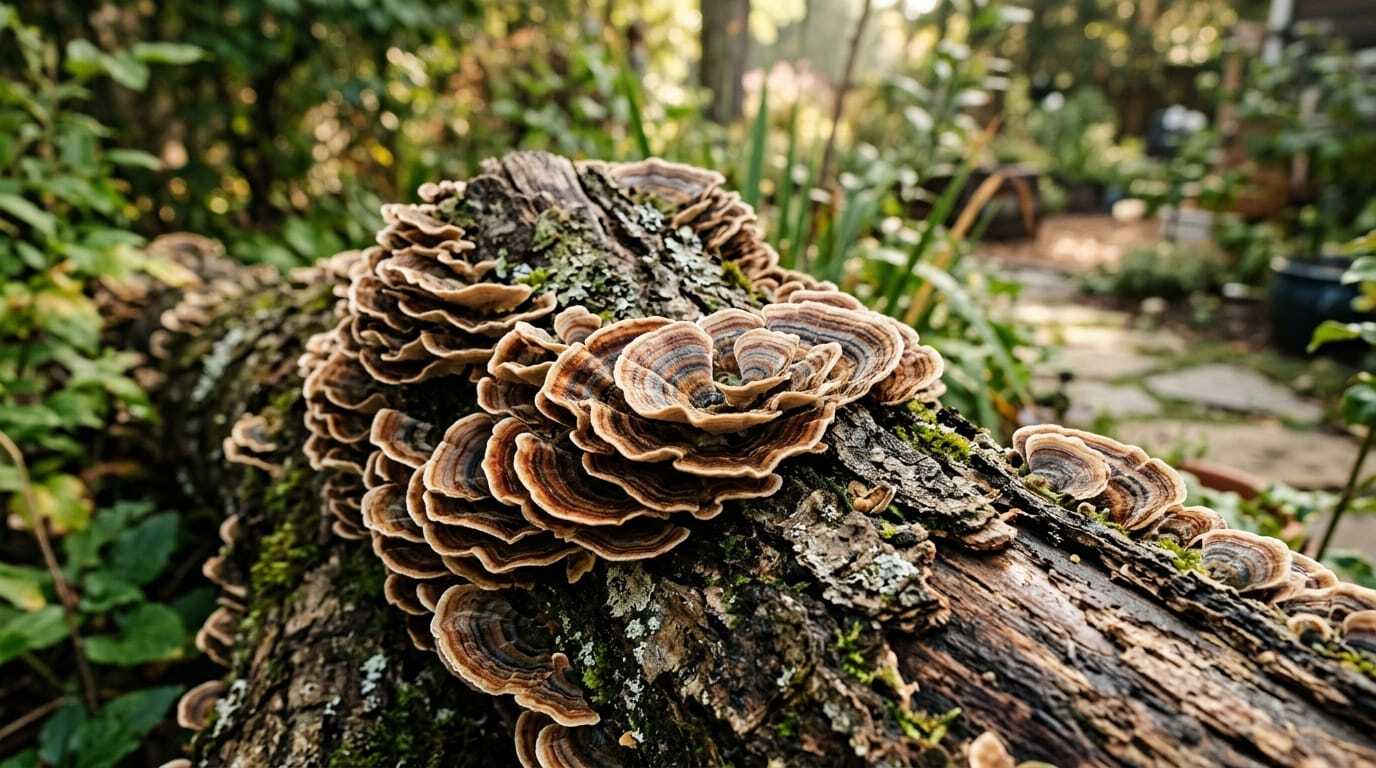
You walked outside, looked up at your tree, and stopped. There it is — a cluster of shelf-like growths jutting out from the bark. Maybe it’s rusty orange, creamy white, or layered like the pages of a book. Maybe it’s been there for weeks and you just noticed it. Either way, your first instinct is probably: Is my tree dying?
The short answer: it depends. The longer answer is worth understanding.
What You’re Looking At
Those shelf-like growths are called bracket fungi or shelf fungi — the visible, fruiting bodies of a fungal organism that’s been living inside your tree (or its dead wood) for months or even years. What you see on the outside is just the mushroom — the part the fungus uses to reproduce. The real action is happening underneath the bark, in the wood.
Fungi are decomposers. That’s their job in the ecosystem. They break down wood into nutrients that cycle back into the soil. When you see bracket fungi on a tree, the fungus is doing exactly what it evolved to do. The question is whether it’s breaking down dead wood or living tissue — and that distinction matters a lot.
Common Types You Might See
Knowing what you’re looking at helps you understand the urgency (or lack of it). Here are the most common bracket fungi you’ll encounter:
Turkey Tail (Trametes versicolor)
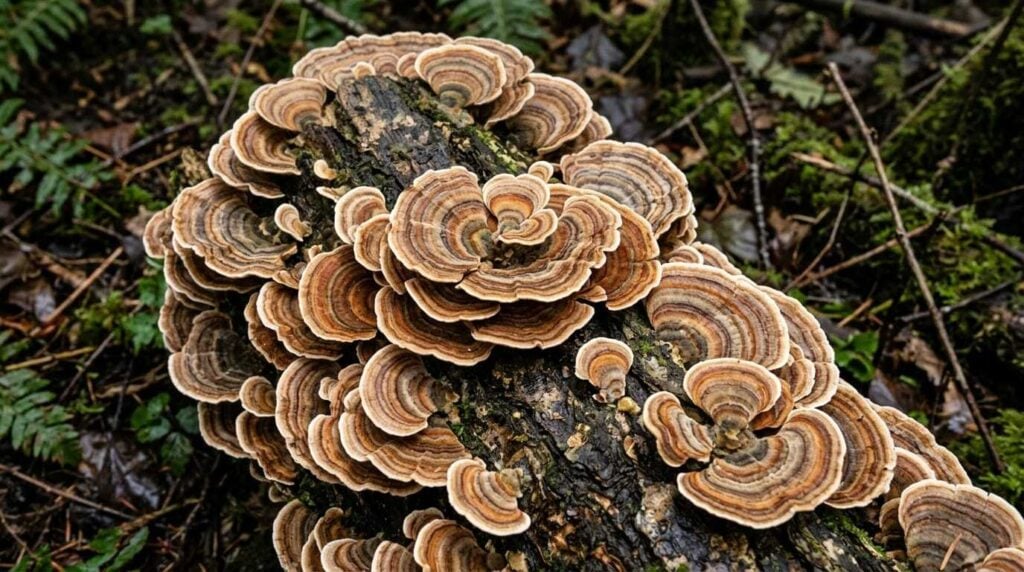
One of the most recognizable. Fan-shaped, thin, and banded with concentric rings of brown, tan, rust, and white — like a turkey’s tail fanned out. Usually grows in overlapping clusters on dead wood or dead portions of living trees.
It’s a decomposer that loves stumps, fallen logs, and already-dead wood. If it’s on your tree, look closely at where — if it’s on a dead branch or the remnant of an old wound, you may have nothing to worry about.
Chicken of the Woods (Laetiporus sulphureus)
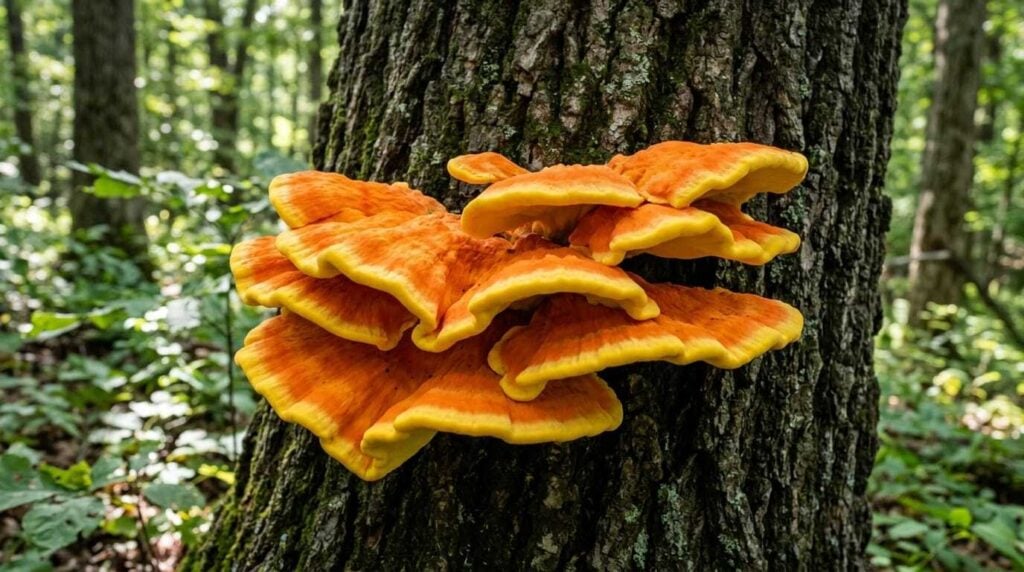
Hard to miss — bright orange and yellow, shelf-shaped, looks almost artificial. This one’s actually edible when young, which is a silver lining. It tends to grow on oaks, cherries, and other hardwoods, and it does cause heartwood rot.
On a living tree, it’s a warning sign. The tree may still look healthy from the outside while significant decay is happening inside.
Artist’s Conk (Ganoderma applanatum)
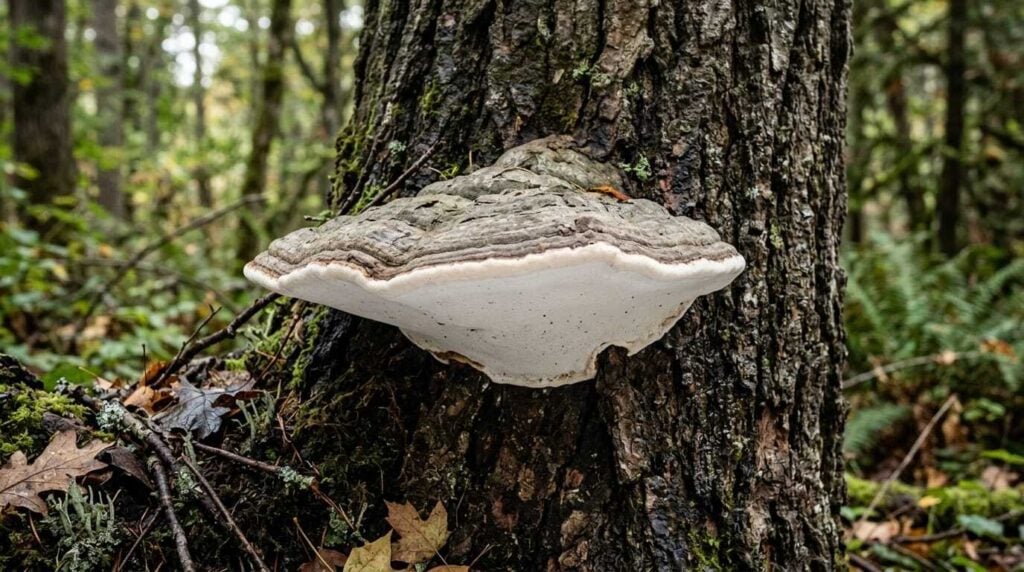
Large, hard, shelf-shaped, typically grayish-brown on top with a white underside. It gets its name because you can “draw” on the white surface and the marks stay. Found on a wide range of hardwoods. Artist’s conk causes white rot, and when it appears on a living tree’s trunk or root flare, it’s a serious indicator of internal decay.
Hen of the Woods / Maitake (Grifola frondosa)
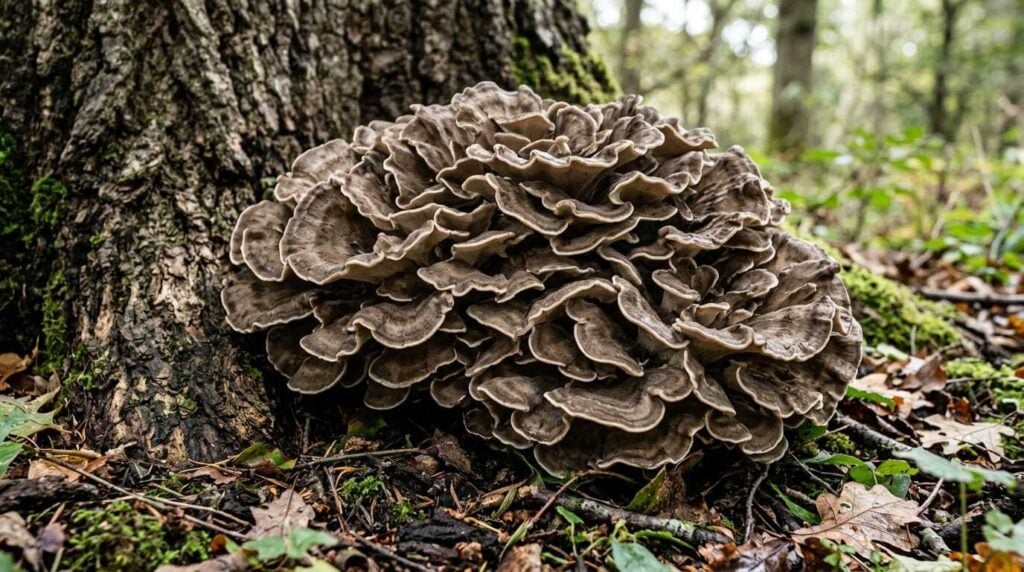
Grows at the base of oaks (and sometimes other hardwoods) in large, layered clumps of overlapping gray-brown caps. Another edible, highly prized one. But its presence at the base of a tree indicates root rot, which is a structural concern regardless of how the canopy looks.
Oyster Mushrooms (Pleurotus ostreatus)
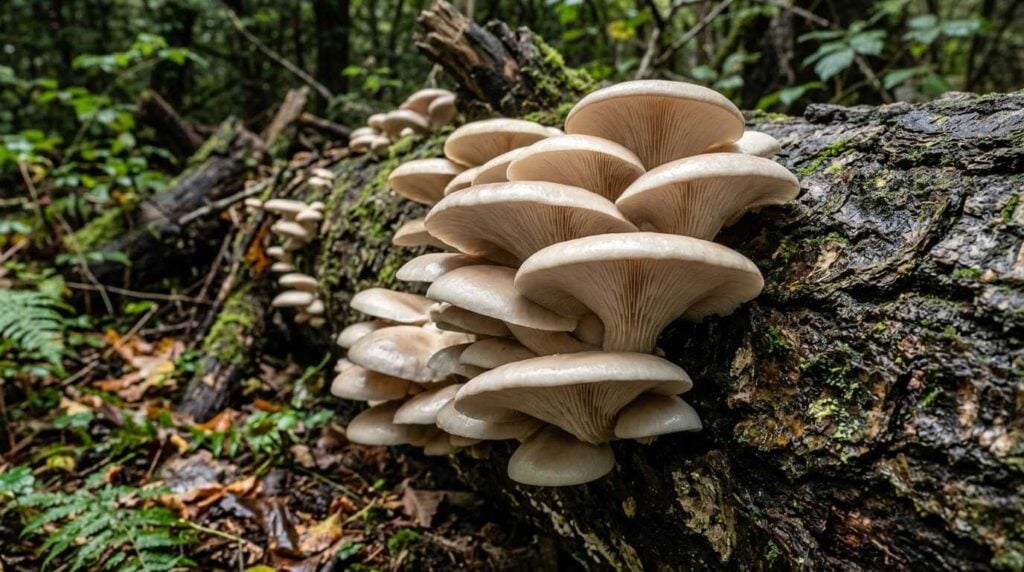
Fan-shaped, smooth, usually white to light gray, growing in shelved clusters on the side of a tree. Often found on dead or dying hardwoods. Generally not as alarming as Ganoderma species — they prefer wood that’s already compromised.
What It Actually Means for Your Tree
Here’s the truth that most articles dance around: bracket fungi on a living tree almost always means there’s some level of decay inside. The fungus didn’t get there by accident — it entered through a wound, a crack, a dead branch stub, or root damage. And by the time you see the fruiting body on the outside, the fungus has been working for a while.
That said, not every fungus means your tree is about to fall over. Context matters enormously.
The fungus is on a dead stump or log in your yard: No concern for your living trees. The fungus is doing its job decomposing dead wood.
The fungus is on a dead branch on an otherwise healthy tree: Monitor it. The decay may be localized. Remove the dead branch.
The fungus is growing from the trunk of a living tree: This warrants attention. Heartwood rot is present. The question is how extensive.
The fungus is at the base or root flare: This is the most serious scenario. Root and butt rot affects the structural integrity of the entire tree — a tree can look perfectly healthy above and be catastrophically compromised below.
Multiple fruiting bodies at different spots on the same tree: Decay is likely extensive. Get a professional opinion before the next storm season.
Does It Mean Your Tree Is Dangerous?
Not necessarily — but it does mean your tree deserves a closer look, especially if it’s near your house, a structure, or anywhere people spend time.
Trees with significant internal decay can stand for years. But they lose structural strength over time, and the risk profile changes. A tree that seemed “fine” can fail suddenly in a windstorm. This isn’t meant to be alarmist — it’s just the honest reality of wood decay.
Signs that push the needle toward “call someone now”:
- Fungus at or below the root flare
- Visible cracks in the bark near the fungus
- Any leaning that’s new or worsening
- Dead branches appearing in the upper canopy (called “flagging”)
- Soft, spongy wood when you press near the base
- The tree recently experienced a major stress event (drought, construction nearby, flooding)
If none of those apply and the fungus is on a single dead branch or an old wound higher up on the trunk, you may have time to simply monitor the situation.
Can You Treat It?
Fungicides don’t work on established internal wood decay. By the time the fruiting bodies appear outside, the fungus is already well-established inside the wood. There’s no spray or injection that reverses that.
What you can do:
- Remove dead branches where fungus is fruiting to reduce further entry points
- Avoid wounding the tree — every cut, nick from a mower, or construction damage is a potential entry point for future fungal infection
- Don’t pile mulch against the trunk (it traps moisture and creates ideal conditions for fungal colonizers)
- If the tree is manageable, have an ISA-certified arborist assess it — they can probe for decay, evaluate structural risk, and advise whether cabling, bracing, or removal makes sense
The fungus itself — the fruiting bodies you see — can be knocked off, but it doesn’t change what’s happening inside. And it will likely come back.
When to Leave It Alone
If bracket fungi are growing on:
- A dead stump
- A fallen log
- Old firewood
- A long-dead snag that poses no fall risk
…let them be. They’re part of the ecosystem doing important work. Some, like turkey tail and hen of the woods, have documented medicinal properties. Others, like chicken of the woods, are genuinely delicious. There’s no need to treat fungi on dead wood — it’s exactly where they belong.
The Bottom Line
Seeing shelf fungi on your tree is a signal worth taking seriously, not a reason to panic. The key question is always: living tree or dead wood? And if it’s a living tree — where on the tree, and what do the other signs say?
When in doubt, get a professional set of eyes on it before a storm makes the decision for you.