
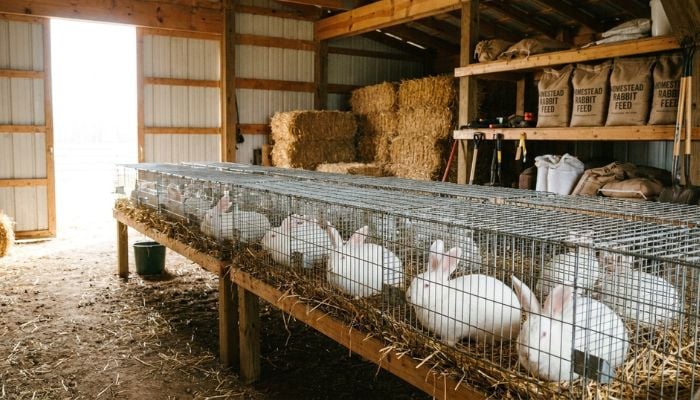
If you’ve been thinking about adding livestock to your homestead but don’t have the space or budget for pigs or cattle, learning how to raise meat rabbits might be the smartest move you can make this year.
Rabbits are quiet, compact, and shockingly efficient. They can convert feed to meat faster than almost any other homestead animal, and they don’t require a lot of land to do it.
Raising rabbits for meat has been a homestead practice for centuries, and it’s having a serious comeback among small-scale farmers and suburban homesteaders alike.
Whether you’ve got a quarter-acre backyard or a full rural property, rabbits fit where other livestock can’t.
This guide covers everything you need to get started: the best meat rabbit breeds for beginners, how to size and set up a hutch, what to feed your rabbits and when, basic breeding schedules, and an honest look at processing.
If you’ve been on the fence, this is the guide that’ll get you off it.
Why Meat Rabbits Make Sense for the Homestead
Before we get into breeds and hutch specs, it’s worth understanding why meat rabbits are such a practical choice, especially when you’re just getting started with homestead livestock.
- Feed conversion efficiency. Rabbits have one of the best feed-to-meat conversion ratios of any animal you can raise. They convert roughly 4 pounds of feed into 1 pound of meat, compared to 7–8 pounds for beef cattle. That’s a significant difference.
- Small footprint, big output. A single doe (female rabbit) can produce 4–6 litters per year with 6–10 kits per litter. That’s potentially 40–60 rabbits annually from one breeding doe. You can raise a large supply of meat in a space the size of a small garage.
- Quiet and low-profile. Unlike chickens, rabbits don’t crow. Unlike pigs, they don’t escape and root up the garden. They’re one of the easiest livestock animals to keep on a suburban lot without disturbing the neighbors.
- Affordable to start. A basic rabbit setup costs far less to build than a chicken coop with a run, and starter breeders are typically available locally for $25–$50 each.
- Nutrient-dense meat. Rabbit meat is high in protein, low in fat, and lower in cholesterol than most common meats. It’s mild in flavor and takes on seasonings well. It’s far more versatile than most first-timers expect.
The Best Meat Rabbit Breeds for Beginners
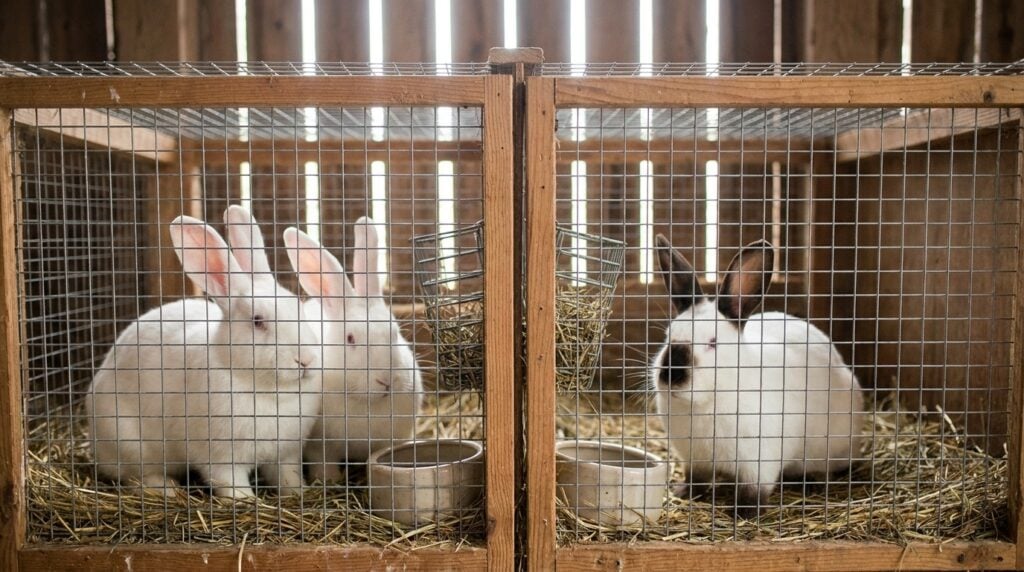
There are many different rabbit breeds, but meat breeds are selected for fast growth, good muscle development, and efficient feed conversion. Here are the three you’ll encounter most often on homestead operations, and for good reason.
New Zealand
New Zealand rabbits are the gold standard for meat production. Despite the name, they were developed in the United States in the early 1900s and have dominated the commercial rabbit industry ever since.
They reach market weight in about 8–10 weeks, making them among the most efficient breeds available.
They’re calm, hardy, and widely available from breeders across the country. New Zealands come in white (the most common for meat production), red, black, and blue, as well as broken patterns.
If you want to start with a single breed and learn the ropes before experimenting with others, start here.
- Typical live weight at market: 9–12 lbs.
- Time to market weight: 8–10 weeks
Californian
Californian rabbits are nearly as popular as New Zealand whites and are often crossed with them to produce hybrid kits with even better growth rates.
They’re white with dark points on the nose, ears, feet, and tail, similar in appearance to a Himalayan cat.
They tend to be slightly more muscular through the hindquarters, and many producers prefer their carcass quality.
Californians are calm, adapt well to cage life, and are an excellent choice for homesteaders who want a second breed for crossing.
- Typical live weight at market: 8–10 lbs.
- Time to market weight: 8–10 weeks
Rex
Rex rabbits are known for their uniquely dense, velvety fur, but they hold up well as a meat breed too.
They’re a bit slower to reach market weight than New Zealand or Californian breeds, but their medium size and exceptional pelt quality make them a solid choice for homesteaders interested in a dual-purpose animal.
If you’re thinking about learning to tan rabbit hides alongside raising meat, Rex is the breed to start with. The meat quality is excellent, and the skins are genuinely beautiful to work with.
- Typical live weight at market: 7–10 lbs.
- Time to market weight: 10–12 weeks
A note on Flemish Giants: They’re often recommended online for beginners due to their gentle nature, but they’re slow growers and inefficient feed converters. Save them for pets or show. They’re not a practical choice for a working meat rabbit operation.
How To Raise Meat Rabbits: Hutch Setup and Sizing
Housing is one of the biggest variables in whether your rabbit operation runs smoothly or becomes a constant headache. Get this piece right from the start, and everything else becomes easier.
Cage Size Requirements
A good rule of thumb is that each adult rabbit needs at least 1 square foot of floor space per pound of body weight.
For a 10-pound New Zealand doe, that means a minimum cage size of 30″×36″, and bigger is always better.
- Breeding does: 30″×36″ minimum, 30″×48″ preferred
- Buck (male): 24″×30″ minimum
- Grow-out cages (kits to market weight): Can be kept together in a group. 24″×36″ accommodates 4–6 kits comfortably up to around 6–8 weeks
Wire-bottom cages are standard for meat rabbit operations. The gaps allow droppings to fall through into a collection tray below, keeping the cage cleaner and dramatically reducing disease pressure.
Use 14-gauge 1″×1/2″ wire for the floor. The finer mesh supports their feet better than coarser grid patterns and prevents sore hocks.
Indoor vs. Outdoor Housing
Rabbits can be raised indoors (in a garage, barn, or shed) or in an outdoor hutch. Both work well, but each comes with trade-offs.
- Indoors: Better temperature control, easier predator protection, and you can work with the animals in any weather. The main requirement is good ventilation to prevent ammonia buildup from urine, which causes respiratory problems over time.
- Outdoors: More natural airflow and easier cleanup if you build a hutch with a sloped collection tray. The risks are heat and predators. Rabbits are very sensitive to high temperatures; heat stress and death can occur above 90°F. A covered hutch with solid sides, hardware cloth panels, and a secure latch is the minimum for an outdoor setup.
In hot climates, indoor or heavily shaded outdoor setups are non-negotiable. Heat stress is the number-one cause of unexpected rabbit deaths on new homesteads.
Nest Boxes
Every breeding doe needs a nest box when she’s within a week of kindling (giving birth). The standard size is roughly 12″×18″×10″, which is large enough for her to enter and turn around, small enough that kits stay close together and retain warmth.
Wood or metal both work. Line the bottom with straw or untreated wood shavings. She’ll pull her own fur to add to the nest in the days before kindling. After the litter is weaned at 4–6 weeks, remove and disinfect the nest box before the next breeding cycle.
The Meat Rabbit Feeding Guide
Feeding meat rabbits well isn’t complicated, but the ratios matter. The goal is steady, efficient growth, not the fastest possible growth, which can lead to digestive problems and losses of young kits.
Pellets
Commercial rabbit pellets are the foundation of a meat rabbit diet. Look for pellets with 16–18% protein for growing kits and 15–16% for maintenance adults.
Avoid pellet mixes with seeds, dried fruits, or colorful pieces; those are formulated for pet rabbits and don’t support efficient meat production.
Daily feeding guidelines:
- Adult does (non-pregnant): 4–6 oz pellets per day
- Pregnant does (from breeding through kindling): Free-choice (unlimited)
- Nursing does: Free-choice; lactation burns significant calories
- Growing kits: Free-choice from weaning through 8–10 weeks
Hay
Timothy hay or orchard grass should be available at all times. Hay keeps the digestive system moving, prevents hairballs, and supplies fiber that pellets alone can’t provide.
Unlimited hay won’t make a rabbit overweight; it’s the pellets that add the calories.
Alfalfa hay is higher in protein and calcium and is appropriate for kits under 6 months and for pregnant or nursing does. For adult rabbits at maintenance, stick with grass hays to avoid excess calcium buildup.
Fresh Greens
Fresh greens are a supplement, not a staple. They add variety and additional micronutrients but can cause digestive upset if introduced too quickly or given in large quantities.
Safe options include romaine lettuce, kale (in moderation), cilantro, parsley, carrot tops, and dandelion greens.
Start small. A small handful, a few times per week per adult rabbit, is plenty. Watch for soft or runny droppings. If you see those, cut the greens back immediately.
Avoid iceberg lettuce (high water content and low nutrition), large amounts of cabbage or broccoli (can cause bloating and gas), and anything from the onion or allium family.
Water
Fresh water at all times is non-negotiable. Rabbits that don’t have adequate water will eat less, grow slower, and produce smaller litters.
Water bottles and gravity-fed crocks both work. Crocks are easier to keep clean, but they can tip or be contaminated with bedding. In winter, check water twice daily; rabbit water freezes faster than you’d expect.
Breeding Schedule Basics
One of the major advantages of meat rabbits is their reproductive rate.
A doe can technically be rebred within days of kindling, though most homesteaders wait until kits are 4–6 weeks old before rebreeding. This gives the doe time to recover condition and keeps her productive long-term.
Here’s a practical breeding schedule for a small operation:
- Breed the doe at 4–6 months of age (once she’s reached adult body weight; don’t breed underweight animals).
- She’ll kindle 28–32 days after breeding.
- Kits open their eyes at around 10 days and begin eating solid food at 3–4 weeks.
- Wean kits at 4–6 weeks by removing them to a grow-out cage.
- Wait 2–4 weeks, and then rebreed.
This schedule allows for roughly 5–6 litters per year per doe. With 6–8 kits per litter and a realistic mortality rate of 10–15%, you can expect 30–40 kits per doe annually under good management conditions.
Keep records from day one. A simple notebook or spreadsheet tracking breeding dates, kindling dates, litter sizes, and individual weights makes a big difference, especially as your herd grows.
You’ll quickly identify which does are consistently productive and which aren’t earning their feed.
An Honest Look at Processing
No guide to raising meat rabbits would be complete without addressing processing. If you’re raising rabbits for food, you’ll need to either process them yourself or find a local small-livestock processor.
Most meat rabbits are processed at 8–12 weeks when they reach 4–5 lbs. of live weight. The longer you wait past that window, the slower the feed conversion and the tougher the meat tends to become.
Processing at the right time is part of good rabbit management, not just economics.
Home processing is legal in most states for personal use, and the process itself is faster than processing chickens. Many homesteaders find it easier than they expected.
There are detailed, practical video walkthroughs available online if you want to learn before starting your first season.
If home processing isn’t right for you, ask around at local farms, homestead Facebook groups, or your agricultural extension office.
Small-scale processors exist in most rural areas and typically charge modest fees for small batches. When compared to the cost to process a cow, rabbits are much more affordable.
The emotional piece: If you’re new to raising animals for food, give yourself grace. The decision to raise and process your own meat is one that most people navigate over time, not all at once.
It becomes more matter-of-fact with experience, and for many homesteaders, it ends up being one of the most grounding and honest parts of the whole practice.
Start Small, Stay Consistent, and Let the Rabbits Work
Meat rabbits aren’t the most glamorous livestock you can add to a homestead, but they’re among the most practical. The low startup cost, compact space requirements, and remarkable productivity make them a genuinely smart fit at almost any scale of operation.
Start with two or three does and a single buck. Get your housing and feeding routine solid before you think about scaling.
Give yourself a full season to learn the rhythms, including how does cycle, how kits develop, and what your local feed costs are, before deciding how large you want your rabbitry to become.
The homesteaders who stick with rabbits long term are almost always the ones who kept it simple at first. A well-managed small rabbitry consistently outperforms an overambitious one that got messy before the basics were dialed in.
If you’re already raising backyard chickens or quail alongside your rabbits, you’ll find the systems complement each other well.
Between poultry eggs, rabbit meat, and seasonal garden harvests, a small homestead can cover a remarkable amount of its own protein needs, and meat rabbits are one of the most efficient pieces of that picture.