

The soil inside your raised bed is everything. Get it right, and your plants practically take care of themselves. Get it wrong by packing it with straight garden soil or cheap topsoil, and you’ll spend the season wondering why nothing’s thriving.
Filling a raised bed doesn’t have to be expensive or complicated. Whether you’re building your first 4×4 bed or scaling up to a 12-foot row of beds, there’s a formula that works and smart ways to cut the cost when you’re filling more space than your budget wants to cover.
Here’s everything you need to know about the best soil mix for raised beds, including what to put in it, how much you actually need, and how to fill a big bed without going broke.
Why Raised Bed Soil Is Different From Garden Soil
Most people building their first raised bed make the same mistake: they head to the hardware store and grab bags of “garden soil” or “topsoil” because it’s cheap and it’s dirt. That’s exactly the wrong move.
In-ground garden beds rely on natural drainage and the movement of water through a large volume of earth.
Raised beds don’t have that luxury. They’re a contained box, and whatever you put in them needs to handle water. This includes draining freely after a rain and then holding enough moisture to feed roots between waterings.
Regular garden soil and topsoil compact over time. In a raised bed, that leads to water pooling on the surface, roots that can’t breathe, and slow-draining conditions that invite rot and disease.
Bags labeled “garden soil” are blended for in-ground use and are too dense for the contained environment of a raised bed.
What you need is a light, well-draining mix that stays loose season after season. That’s where the classic raised bed formulas come in.
The Best Soil Mix for Raised Beds: The Classic Mix (Mel’s Mix)
The most tried-and-true raised bed soil recipe is Mel’s Mix, developed by Mel Bartholomew for his Square Foot Gardening method. It’s been around for decades, and it works.
The recipe:
- 1/3 blended compost (from multiple sources if possible)
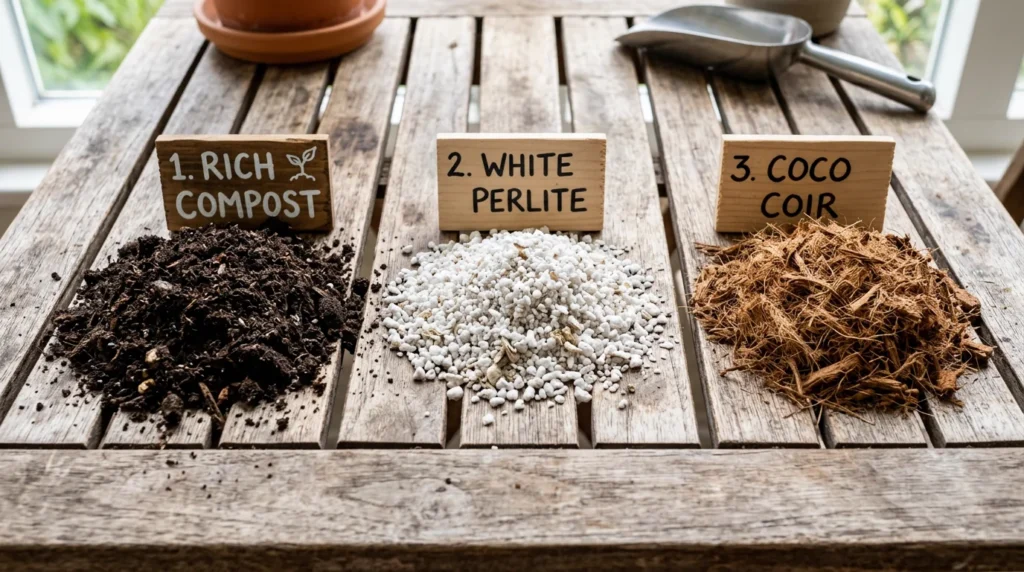
- 1/3 peat moss or coconut coir
- 1/3 coarse vermiculite
Each ingredient plays a specific role. Compost provides nutrients and feeds soil biology. Peat moss or coconut coir holds moisture while staying light and fluffy. Vermiculite keeps the mix aerated and helps with drainage.
The result is a mix that never compacts, drains well after heavy rain, and retains just enough moisture to keep roots happy in dry spells. It’s also light; you can work in it with your hands, and it’s easy on roots at transplant time.
A note on peat moss vs. coconut coir: Peat moss is more widely available and cheaper, but it comes from non-renewable peat bogs. Coconut coir is a sustainable byproduct of coconut processing and performs similarly. Either works, but coir is the more eco-friendly choice.
Budget Alternatives: How To Fill Large Beds Without Spending a Fortune
Mel’s Mix is excellent, but filling a large raised bed with it can add up fast, especially the vermiculite, which isn’t cheap in quantity. If you’re building multiple beds or a bed larger than 4×4, here are some ways to bring the cost down.
The Hugelkultur Base Layer
For deep beds (12 inches or more), fill the bottom 4–6 inches with logs, branches, straw, wood chips, or other organic material before adding your soil mix on top. This is the core idea behind hugelkultur, a centuries-old German technique.
As the wood breaks down over time, it retains moisture and releases nutrients. It also means you need significantly less actual soil mix to fill the bed.
Don’t use anything treated, painted, or diseased. Raw hardwood scraps, fallen branches, or chipped wood work well. Avoid fresh sawdust (it binds nitrogen as it decomposes) and black walnut (toxic to many plants).
The “Lasagna” or Layered Fill Method
This is similar to hugelkultur but uses softer organic material. Layer cardboard (no glossy coatings), straw, leaves, grass clippings, and finished compost in the bottom half of the bed, and then top with your blended soil mix.
The layers break down over the season, enriching the soil below.
Substitute Perlite for Vermiculite
Vermiculite is often the most expensive component of Mel’s Mix. Coarse perlite does a similar job (it aerates the soil and improves drainage) at a lower cost. It doesn’t hold moisture quite as well as vermiculite, but for most gardens the difference is minimal.
Buy Compost in Bulk
Bagged compost from the big-box store is convenient but expensive per cubic foot. Many municipalities offer free or cheap compost through yard waste programs. Local landscape supply yards often sell compost by the cubic yard at a fraction of the bagged price.
If you have multiple beds to fill, a truckload of bulk compost will save you significantly.
Mix in Quality Topsoil
Once your bed is over 12 inches deep, consider a 50/50 blend: half your Mel’s Mix recipe, half quality topsoil (not cheap fill dirt—look for screened topsoil with some organic content).
The topsoil adds bulk and weight without much compromise in drainage, especially in the lower half of a deep bed where roots aren’t as active.
How Much Soil Do You Actually Need?
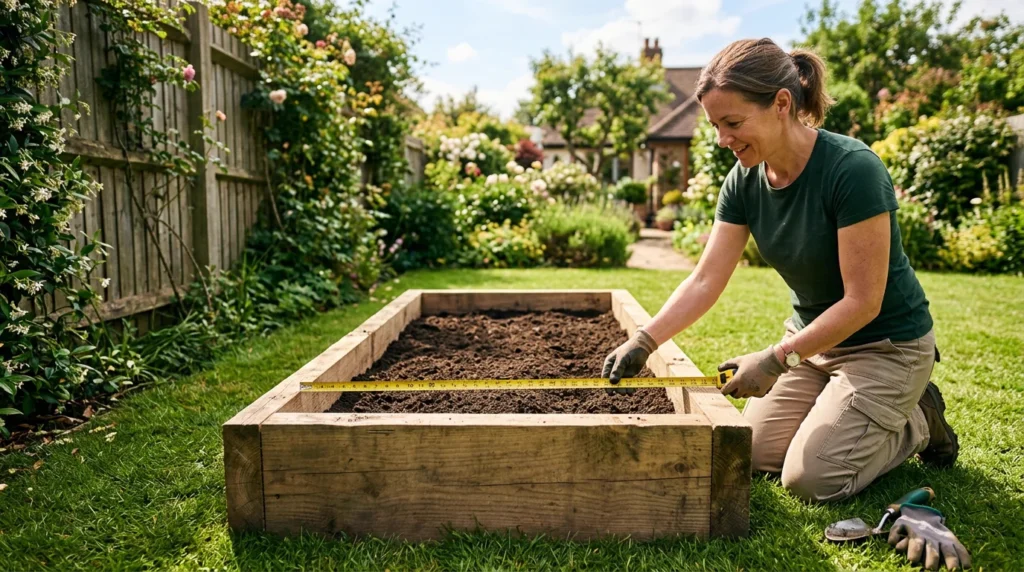
This is the question that trips up most first-time raised bed builders. Run out, and you’re making a second trip to the store. Buy too much, and you’re stacking bags in your garage.
To calculate volume, you need three dimensions: length × width × depth. If you use inches, you’ll wind up with cubic inches. Divide that by 1,728 to get cubic feet.
Example: A standard 4×8 bed at 12 inches deep
4 ft. × 8 ft. × 1 ft. = 32 cubic feet
Most bags of soil are sold by cubic foot, commonly 1 or 2 cubic foot bags. The bed in our example would require 32 one-cubic-foot bags or 16 two-cubic-foot bags.
At $7–$10 per bag, you’re looking at $112–$160 in soil for a single 4×8 bed, which is exactly why bulk materials make so much more sense at scale.
Quick reference by bed size (at 12-inch depth):
- 4×4 bed: 16 cubic feet
- 4×8 bed: 32 cubic feet
- 4×12 bed: 48 cubic feet
- 2×6 bed: 12 cubic feet
- 3×6 bed: 18 cubic feet
For beds shallower than 12 inches, just adjust proportionally. A 4×8 bed at 6 inches deep needs 16 cubic feet, or half the amount of a bed 12 inches deep.
What NOT To Put in a Raised Bed
Some materials that seem like they’d work will cause more problems than they solve. Here’s what to avoid.
- Straight topsoil or garden soil: These compact in a contained bed. You can mix in some quality topsoil as a cost-cutting measure, but it should never be the only thing in the bed.
- Fill dirt: This is the stuff used in construction. It’s dense, is often low in organic matter, and may contain debris. Not suitable for raised beds.
- Non-finished compost: Raw kitchen scraps or fresh manure can burn plants and introduce pathogens. Use only finished, well-aged compost.
- Fresh grass clippings in bulk: A thin layer is fine as mulch on top, but a thick layer of fresh grass clippings inside the bed will mat, create an anaerobic layer, and produce ammonia as it breaks down.
- Soil from your yard: Unless you’ve tested it and know it’s well-draining and free of weed seeds and disease, bringing in yard soil defeats the purpose of a raised bed. It often carries weed seeds, compacts easily, and may cause the same drainage problems that made you want a raised bed in the first place.
Topping Up Your Beds Between Seasons
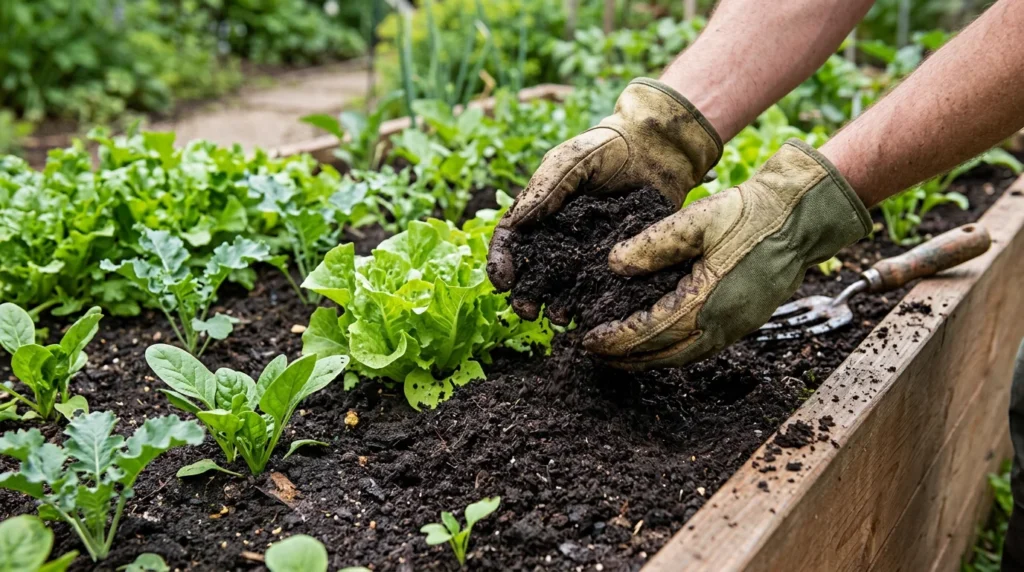
Here’s something new gardeners don’t always expect: your raised bed soil will shrink. The organic material in your mix breaks down over time, which is a good thing (it means the biology is active), but it means your bed level will drop a few inches each season.
Before each new growing season, add 2–3 inches of fresh compost to the top of the bed. Don’t till it in; just let it sit on the surface and let the worms do the work. Over a season, it will work its way down.
You can also add a thin layer of compost mid-season around established plants without disturbing roots. This is called top-dressing, and it gives your soil a nutrient boost right when heavy-feeding crops such as tomatoes and squash need it most.
Every 3–4 years, you may want to do a more significant refresh that includes adding compost plus perlite or vermiculite to restore the drainage structure that breaks down over time.
Start Building Your Raised Bed Soil Mix Today
Building great soil is a long game, and a raised bed makes it easier because you’re working with a controlled volume. Each season, you’re adding organic matter, improving biology, and building a growing medium that gets better over time, not worse.
That’s one of the real advantages of raised bed growing over working directly in your yard, and it starts with what you put in the box. Once your soil is dialed in, plan your planting with our guide to the best vegetables to grow in raised beds.